


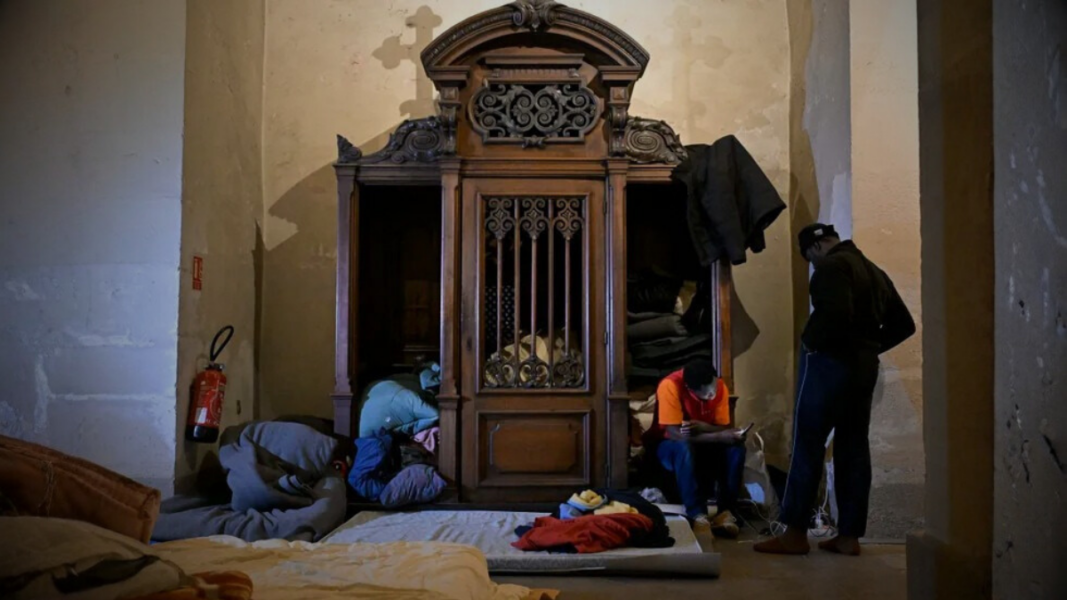
More than sixty migrants, presented as “unaccompanied minors,” have been occupying the Saint-Polycarpe church in Lyon for days. The young people, who previously slept in precarious tents just a few meters from the temple, have set up mattresses and sleeping bags under the statue of Joan of Arc, next to the baptistery and the walls that commemorate the fallen French. With the arrival of the cold, they have turned the interior of the temple into an improvised shelter.
It is not an isolated case. Every winter, one or more churches in France are illegally occupied by groups of migrants. In recent years, temples in Toulouse and Marseille have experienced similar scenes. The pattern repeats: groups of young people arrive with their belongings, a media campaign is quickly set up in their favor, and the bishopric tries to handle the situation without resorting to public force. With the arrival of spring, the occupants are usually evacuated, sometimes after negotiations, sometimes through firm interventions.
A bishopric divided between the duty to welcome and the defense of worship
The Diocese of Lyon has published a brief and prudent statement. In it, it reminds that the Church collaborates with multiple initiatives to help vulnerable people, but emphasizes that it cannot substitute for political authorities or migration legislation. The bishopric rules out calling the police to evict the occupants and maintains the usual prayers and celebrations in the parish.
In parallel, voices within the French ecclesiastical environment, such as the Catholic radio RCF, have called for material donations for the migrants housed in the temple. The situation once again shows the tension—already known since the pontificate of Francis—between indiscriminate welcoming and the protection of sacred space and the spiritual life of the communities.
The shadow of political instrumentalization
An element pointed out by neighbors, priests, and French journalists is that these occupations rarely arise spontaneously. According to Le Journal du Dimanche, associations linked to the extreme left deliberately choose Catholic temples to house the migrants. It is they who organize the arrival of the groups, coordinate media communication, and negotiate with diocesan and municipal officials.
This phenomenon is not new. Already in 1996, the parish priest of Saint-Bernard in Paris—despite rejecting a police intervention in his church—denounced that certain groups were instrumentalizing the undocumented for political purposes: “Extreme left groups use migrants to spread their slogans.”
In the case of Lyon, two associations are behind the occupation of Saint-Polycarpe: the Soutiens/Migrants Croix-Rousse collective and the Marche des Solidarités, both known for their migrant activism and closeness to extreme left movements.
A crisis that repeats and for which no one offers a solution
The result is already familiar: temples turned into improvised dormitories, parishes blocked in their ordinary life, bishoprics caught between moral duty and civil legality, and militant organizations using the Church as a showcase for political claims.
France, which is going through a growing migration crisis, thus faces a debate that returns year after year, while the faithful wonder how long places of worship can remain open if the occupations and the absence of structural responses continue.