


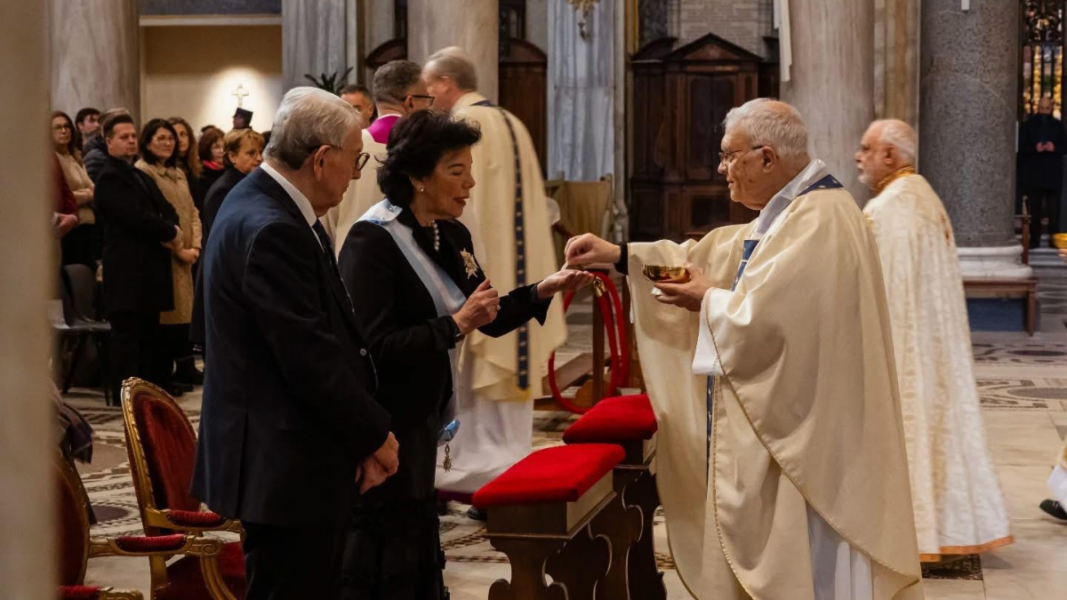
The image of Isabel Celaá, Spain’s ambassador to the Holy See, receiving Holy Communion during the feast of the Immaculate Conception from a place of honor reserved for the diplomatic corps, encapsulates a contradiction that the Church cannot ignore. This is not a matter of political opinion, but an objective fact: Celaá has been for years one of the public officials who most actively supported the legislative framework that considers abortion a right. As a minister, she defended the expansion of this «right,» promoted a discourse openly contrary to the Gospel of life, and was part of a government that turned the elimination of the unborn into a guaranteed benefit. Her public trajectory is inseparably linked to the advancement of a culture that the Church unequivocally defines as gravely contrary to human dignity.
For this reason, her presence in a prominent place during the liturgy and her public access to the Eucharist raise a grave question of ecclesial coherence. The Church teaches that abortion is an intrinsic evil and that those who formally or legislatively cooperate with it place themselves objectively in a rupture with ecclesial communion. This is not a personal interpretation: canon 915 establishes that those who obstinately persist in manifest grave sin should not be admitted to Communion. The incoherence does not lie in the figure of Celaá as a person, whose conscience only God knows, but in the contrast between her political actions and the sacrament she receives: one cannot proclaim as a right what destroys innocent human lives and, at the same time, receive the Body of Christ, the author of that same life. The Eucharist demands truth, and truth demands recognizing that certain public positions directly contradict the Gospel.
That this scene takes place precisely on the day of the Immaculate Conception adds an even more painful symbolic contrast. While the Church celebrates Mary’s spotless purity, representative of the total «yes» to life, Communion is offered to someone who has been a visible face of policies that deny that life in its first stage. That this occurs with normalcy, without any explanation or pastoral warning, reveals to what extent in Europe we have replaced clarity with indifference and charity with ambiguity. It is not mercy to allow a baptized person to present themselves publicly in contradiction with the faith they profess; it is a form of spiritual abandonment.
The Church’s mission is not to avoid diplomatic discomforts, but to safeguard the sanctity of the Eucharist and guide consciences toward the truth. In the United States, the case of Nancy Pelosi showed that it is possible to pastorally correct, out of charity and coherence, those who hold public office and promote laws contrary to life. In Europe, however, it seems that everything is tolerated to avoid tensions. But faith does not grow in confusion: the absence of clear criteria weakens the Church’s credibility and scandalizes the faithful, who see how what the Magisterium denounces as a most grave evil is normalized.
No one wishes to exclude Isabel Celaá from sacramental life; on the contrary, her full conversion is desired, as for any child of the Church. But the Eucharist is not a protocolary gesture to which everyone has an automatic right, but the supreme sign of communion with Christ and his teaching. When a public figure has supported policies that radically deny human life, receiving Communion without public rectification amounts to saying that this contradiction does not matter. And it does matter: it matters doctrinally, spiritually, and for the credibility of Christian witness. True charity does not consist in allowing incoherence, but in calling to the truth. For this reason, the scene of the Immaculate Conception is not a diplomatic anecdote, but a symptom of a grave pastoral disorientation that the Church must address with courage, for the good of its mission and for the good of souls.