


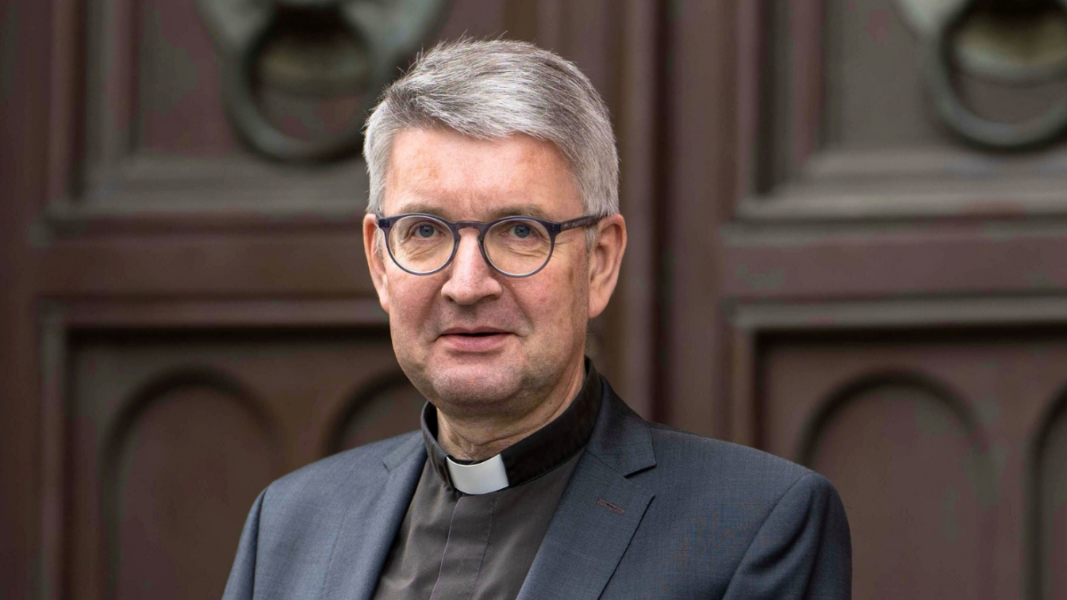
During his homily for the Immaculate Conception, the bishop of Mainz (Germany), Peter Kohlgraf, called for reinterpreting Catholic identity in terms of openness and dialogue, and described as “absurd” the claim that he and other German prelates are no longer Catholic. His statements, reported by Katholisch.de, come amid growing tension between Rome and sectors of the German episcopate over proposals contrary to the Magisterium.
“We are no less Catholic”: the bishop responds without addressing the problem
In Mainz Cathedral, Peter Kohlgraf assured that it is “an absurdity” to claim that he and other German bishops have ceased to be Catholic. However, he did not respond to the substance of these criticisms, which concern the proposals of the German Synodal Way to modify teachings of faith and morals that the Church considers irreformable.
The bishop explained that the feast of the Immaculate Conception had led him to reflect on “what it means today to be Catholic” and lamented that some reduce the faith to a few “controversial” topics. But he did not mention that precisely those “topics” affect sexual morality, the priesthood, Revelation, and other points on which Rome has already intervened on several occasions.
A vision that relativizes the truth of the faith
Kohlgraf insisted that it is not enough to defend a truth that, according to him, would be “disconnected” from current times. He criticized those who maintain that there are immutable truths that must always be proclaimed in the same way. But that is precisely the constant teaching of the Church: revealed truth does not change with the cultural climate.
Instead, he proposed defining being Catholic as a dialogical attitude. According to him, it is not the one who firmly proclaims the Church’s teachings who is Catholic, but the one who “tries to understand the other.” Presenting doctrinal fidelity as an aggression and replacing it with a psychological disposition is, in fact, a way of relativizing the faith: it substitutes content with attitude.
The bishop claims that “one can be wrong” even in matters of faith
Another point in his homily generated concern. Kohlgraf said that being Catholic means admitting that one can be wrong and that the other’s opinion may be necessary to understand the faith. This, applied at a personal level, may express humility; but applied by a bishop in the doctrinal realm, it leaves revealed truth on an opinion-based plane.
It is not the mission of a successor of the apostles to “see if he is right” against other opinions, but to safeguard the faith that the Church has received. Rome has reminded this on multiple occasions, especially to the German bishops.
A trend already known in the German episcopate
Kohlgraf also spoke of a Church that will be “smaller and more international,” but “more determined.” However, his words fit into a trend already common in Germany: redefining Catholic identity based on sociological and psychological categories, leaving doctrinal content in the background.
While the German bishops insist that the criticisms are unfair, the Holy See has expressly warned that some proposals of the Synodal Way cannot be adopted without breaking the unity of the Church. Kohlgraf’s statements go in the same direction: more dialogue, less doctrine; more relativity, less clarity.