


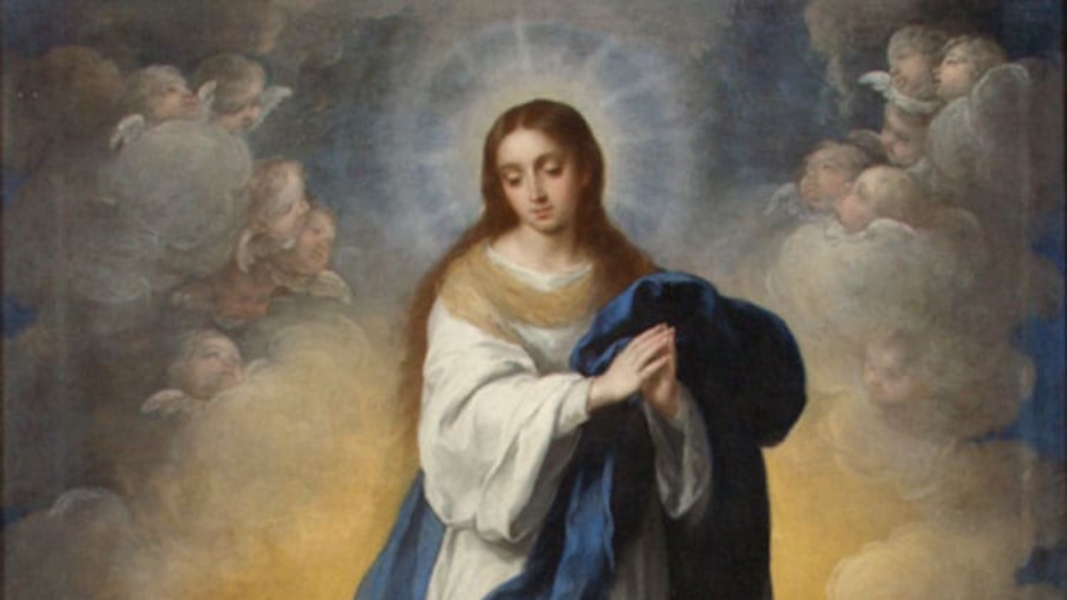
A report from Cadena SER proposes rethinking the December 8 holiday, presenting it as a labor obstacle and relying exclusively on secularist and feminist activists opposed to Catholic dogma. The absence of alternative voices and the approach used demonstrate an openly ideologized treatment of a festivity deeply rooted in Spanish history.
Faith as a “labor problem”: the reductionism of SER
The feast of the Immaculate has been part of the Spanish calendar for centuries, with a presence in cultural and religious life infinitely prior to the modern State. However, SER reduces it to an inconvenience “that hinders labor activity”. This utilitarian view completely ignores the historical, identity, and spiritual value of the celebration.
When a feast is emptied of its religious content, only a more or less annoying day off remains. But the Immaculate was not born to facilitate bridges or complicate them. It was born from the recognition of an essential mystery of Christianity and a tradition that took root in a singular way in our country. Forgetting this is not neutrality: it is deliberately stripping meaning from a structural element of our culture.
Source selection: from disagreement to activism
The report relies exclusively on two voices known for their openly opposed stance toward the Christian faith. There are no historians, no reference theologians, no specialists in cultural tradition; only ideological activism.
The first, linked to radical feminism, describes the Immaculate Conception as an “oxymoron” and claims that its celebration is explained by supposed social strategies aimed at shaping women’s roles in labor contexts. SER presents this interpretation as a valid explanation, without contrasting it with historians, theologians, or specialists in religious anthropology.
Similarly, Juan Picó, president of Europa Laica, argues that a labor calendar influenced by Christian holidays “makes no sense” in a secularized society. SER incorporates his statements to reinforce the idea that religious holidays should be replaced by civil or scientific commemorations. Picó also questions the Marian dogma for considering it unprovable and takes the opportunity to criticize other celebrations with strong social roots, such as Holy Week. SER includes these assessments without offering an academic, legal, or cultural rebuttal that provides context or nuances the arguments.
The total absence of alternative voices reinforces the impression that the piece has been constructed from a single and predefined perspective, in line with the most radical secularist approaches.
The Immaculate: history, identity, and faith
Spain maintains this solemnity not by ecclesiastical imposition, but because it is part of its soul. Devotion to the Immaculate is an element recognized in military history, in parish life, in cultural heritage, and in popular piety. From the Battle of Empel, through the proclamation of the dogma in 1854, to the countless images that populate our cities, the Purísima represents a characteristic expression of the people’s faith.
Questioning its presence in the calendar is not reviewing a minor custom: it is calling into question one of Spain’s deepest ties to its Christian tradition. And doing so without recognizing its historical relevance constitutes a form of cultural revisionism, very useful for certain sectors, but very damaging to society as a whole.
Secularism as the new civil religion
Cadena SER invokes the Constitution to justify the suppression of a religious holiday. However, the State’s non-confessionality does not require erasing the Christian traces of the nation; it only prevents the State from legally identifying with a confession. Confusing neutrality with hostility reveals a militant vision: the one that seeks to relegate faith to the private sphere and make the Christian disappear from the public space.
The problem is not only that SER criticizes a holiday, but that it does so from an ideological premise: the religious is superfluous; the Catholic is bothersome; the Christian must be replaced by a new identity, more malleable and more akin to the dominant cultural agenda.
Defending the truth against the narrative
Cadena SER’s report does not pose a legitimate debate about the labor calendar. It poses something different: the erosion of Spain’s Christian memory. It presents the Marian dogma as irrelevant, hides its historical weight, and offers only voices opposed to any public expression of faith. It is not an analysis: it is a proposal for cultural deconstruction.