


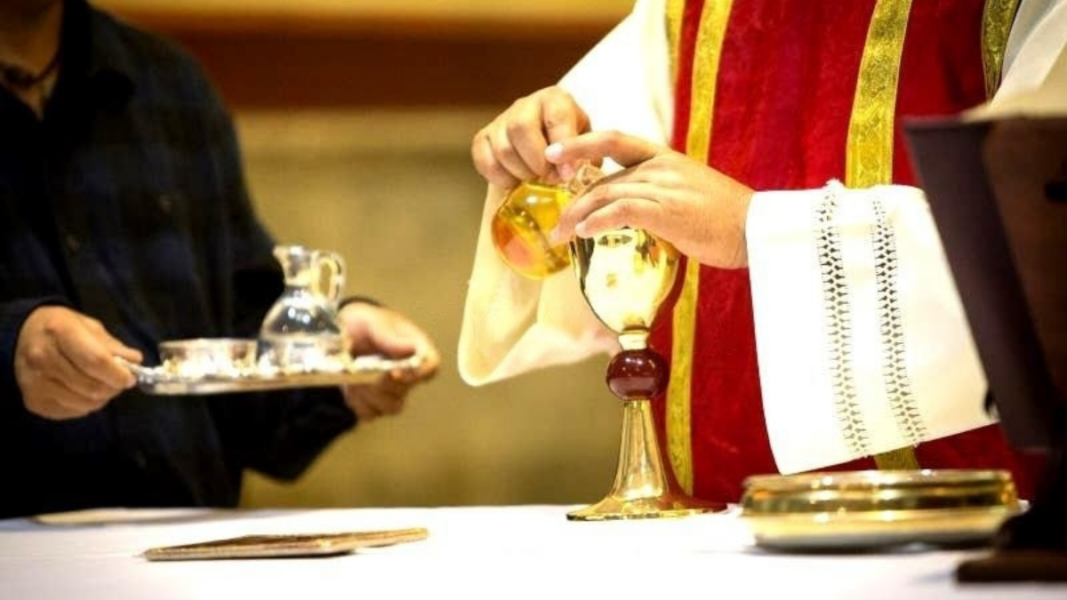
Fr. Joachim Heimerl von Heimthal, a German priest known for his defense of liturgical tradition and his criticism of the doctrinal deviations present in the contemporary Church, has published a forceful analysis in Stilum Curiae on the meaning of the Offertory and the crisis of the 1969 liturgical reform, which—according to Heimerl—would have doctrinally weakened the Offertory, replacing it with a “preparation of the gifts” that no longer clearly expresses the Eucharistic sacrifice.
A “new Mass” for a “new faith”: Heimerl’s diagnosis
In his analysis, the priest Joachim Heimerl von Heimthal argues that the liturgy reformed after the Second Vatican Council constitutes, in many aspects, the expression of a “new Church” and a “new faith,” distinct in fundamental elements from the Catholic tradition. In his view, this rupture is perceived with particular clarity in the Holy Mass, reformed in 1969, whose structure and contents would have diluted the doctrinal language proper to Christ’s sacrifice.
Heimerl emphasizes that this difference affects not only the external rites but also—and above all—the prayers of the Missal, in which the Church expresses its faith and its understanding of the liturgical act.
From the Offertory to the preparation of the gifts: a decisive doctrinal change
The priest centers his criticism on the Offertory, the moment in which the priest prepares and offers the sacrifice to God. In the traditional Mass, this part explicitly expresses the sacrificial nature of the Eucharistic act, linking it directly to the Cross.
In the 1969 reform, however, the Offertory was replaced by the so-called preparation of the gifts. According to Heimerl, this change is not merely terminological: it implies a profound theological shift. The Mass would have ceased to clearly show the unbloody renewal of the sacrifice of Calvary to adopt a perspective closer to a communal meal with Protestant accents.
The result, he asserts, is a distorted image of the faith, a practice that no longer manifests the character of propitiatory sacrifice and praise directed to the Most Holy Trinity.
Prayers reduced to table blessing formulas
Heimerl denounces that the prayers of the “preparation of the gifts” describe the bread and wine as simple “fruits of the earth and of man’s labor,” offering a horizontal vision that omits any explicit reference to Christ’s redemptive sacrifice. These expressions, he argues, could apply to any generic religious act and leave in the shadows the sacrificial identity of the Mass.
The priest also highlights the absence of the Trinitarian invocation and the near disappearance of Christ’s name. It is only mentioned in passing during the mixing of water and wine, and even there the Trinitarian formula has been eliminated. According to Heimerl, this omission constitutes a severe doctrinal loss: if the Church’s faith is expressed in its prayers, the lack of these references leaves the preparation of the offerings empty of specific content, which “floats in a vacuum.”
The traditional Offertory: sacrificial clarity and confession of faith
In contrast to this loss, Heimerl contrasts the traditional Offertory, whose first prayer—Suscipe, sancte Pater—expresses with clarity the core of the Catholic faith. In it, the priest supplicates the Father “almighty and eternal” to accept the “immaculate host,” offered not as a mere symbol, but as a true sacrifice.
The priest acknowledges his own unworthiness—ego indignus famulus tuus—recalling that the most sacred act of the faith is performed by human and sinful hands. Moreover, the traditional Offertory specifies that the offering is made “for my innumerable sins, offenses, and negligences” and for all the faithful, living and deceased. In a few phrases, the redemptive universality of the Mass and its ultimate purpose appear condensed: ut mihi et illis proficiat ad salutem in vitam aeternam —“that it may bring salvation to me and to them in eternal life.”
The following prayers continue to develop these central truths: God’s omnipotence, Christ’s unique mediation, the necessity of sacrifice for salvation, and the transcendent dimension of worship. Everything culminates in the final prayer Suscipe, sancta Trinitas, a supplication addressed to the Trinity that recalls the Passion, the Resurrection, and the Ascension, and that recognizes the value of the sacrifice for the glory of the Virgin and of all the saints.
A reduced Offertory that leads to an ambiguous liturgy
For Heimerl, the new liturgy omits these essential contents, mentioning the term “sacrifice” only once and without doctrinal clarity. The loss of sacrificial language would not be accidental: it constitutes, according to him, the core of the problem of the “new Mass,” which “obscures the essence of the Holy Mass and leads, ultimately, to a heretical drift of the Protestant type.”
The priest recalls that Cardinal Alfredo Ottaviani already warned in 1969, in his famous critical study, that the traditional Mass is the “complete monument” of the Catholic faith, while the liturgical reform could be understood as an incomplete or deformed presentation of that same faith.
The moral dilemma of priests who celebrate the reformed Mass
Heimerl states that many priests today face a real difficulty: one who understands the nature of the Eucharistic sacrifice cannot pronounce certain prayers of the reformed rite without feeling that he compromises the Catholic faith. Some celebrants choose to pray the traditional Offertory silently within the new Mass, taking advantage of the fact that this option does not generate visible conflict during the celebration.
He himself confesses to having done so, although he considers this practice a stopgap solution. For the author, the only fully coherent way out is to return to the traditional form of the Mass, where the Offertory preserves intact the doctrinal expression of the Catholic faith.
A call to safeguard the liturgy as a heritage of faith
In his conclusion, Heimerl exhorts priests to recover the traditional form of the Mass, even if it implies sacrifices or difficulties. He reminds them that, as ministers of Christ, they have the obligation to defend and preserve the Holy Mass, as well as the other sacraments.
The question of the Offertory—he asserts—is not an aesthetic or disciplinary matter, but a doctrinal problem that affects the very heart of the Mass: Christ’s redemptive sacrifice present on the altar.