


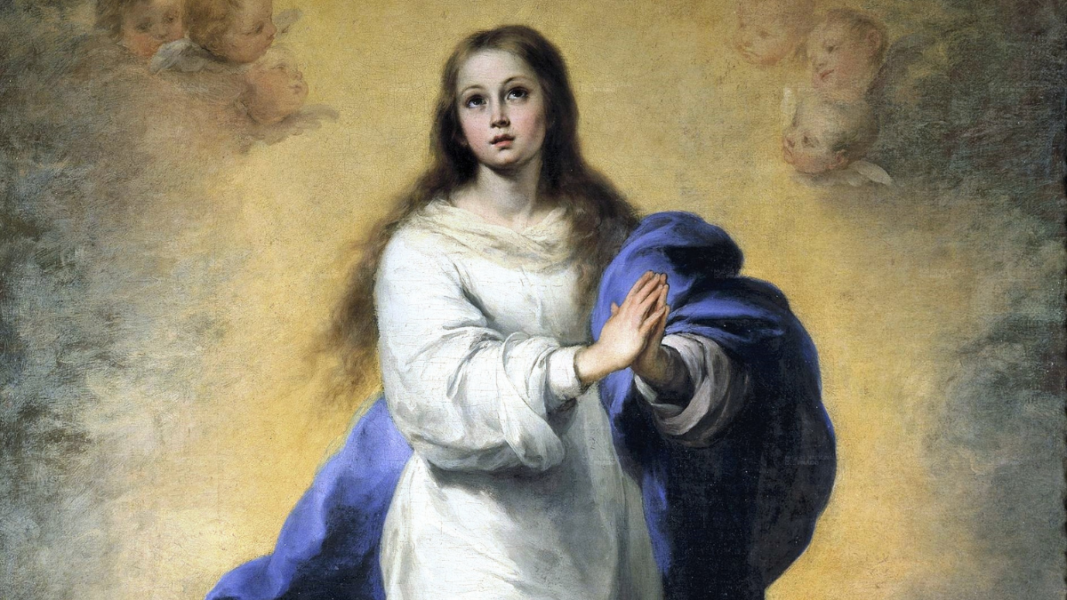
Every year, in celebrating the solemnity of the Immaculate Conception, the Church does not recall only a Marian privilege, but a decisive truth for understanding the divine plan of Redemption. Mary does not appear isolated in the economy of salvation; her mission is inseparably united to that of Christ. The tradition—from the Church Fathers to the contemporary Magisterium—has seen in Her the New Eve, she who accompanies the New Adam at the beginning of the new creation.
Far from being a devotional detail, this truth affects the heart of Christian dogma. Just as the first humanity was fractured by the disobedience of Adam and Eve, the new humanity is inaugurated by the obedience of Christ and by the singular cooperation of Mary. Therefore, the Church, with increasing clarity over the centuries, has recognized that the Immaculate is not only the Mother of God, but also the Woman associated with the Redeemer in the restoration of the human race.
The logic of the new creation: if there is a new Adam, there must be a new Eve
St. Paul teaches that Christ is the “last Adam”, principle of renewed humanity. It is natural, then, the question that Christian theologians have posed since the early centuries: if there is a new Adam, where is the new Eve?
The answer arises from Scripture itself. The “protoevangelium” of Genesis 3:15 announces not only the victory of the Messiah, but also the presence of a Woman associated with Him in the struggle against evil. The patristic tradition, from St. Irenaeus to St. Ephrem, recognized in this Woman Mary, whose mission cannot be understood without her intimate and permanent relationship with Christ.
The new creation, a work superior to the first, had to manifest an even more perfect harmony between divine action and human response. Just as the fall affected humanity through a couple, the restoration had to begin also with an original cooperation: a Redeemer and a Woman completely open to grace.
The Immaculate Conception: foundation of Mary’s mission
The preservation of Mary from original sin was not a sentimental gesture from Christ toward His Mother, but an internal exigency of the salvific plan. For the new Eve to collaborate fully in the work of the new Adam, it was necessary that her freedom be intact, not wounded by original guilt.
The Immaculate is not, therefore, a theological ornament, but the sign that God inaugurates a renewed humanity from its very beginning. In Mary appears, for the first time, the reconciled creature, capable of saying “yes” without shadow of sin. She is the first fruit of redemption, anticipated by the merits of Christ and prepared to accompany Him in His mission.
Mary Co-Redemptrix: the singular collaboration of the New Eve
The ancient Eve cooperated in the disobedience that introduced sin into the world. In an analogous way—but in the inverse and superior sense—Mary cooperates in the work of Christ’s redemptive obedience. Her collaboration does not compete with the action of the Redeemer, but derives entirely from Him and remains subordinate to His sacrifice.
When the Church calls Mary Co-Redemptrix, it does not propose a dogma parallel to Christ’s unique mediation, but recognizes her maternal cooperation in all the key moments of salvation: from the Incarnation to Calvary. She is not an equal to the Redeemer, but the Woman associated with Him by virtue of grace.
On the cross, this truth reaches its fullness: the Mother who delivers the Son also becomes Mother of redeemed humanity. Her union with Christ is so intimate that the tradition does not hesitate to affirm that, if Adam and Eve were co-responsible in the fall, Christ and Mary appear as the two visible principles of the new reconciled humanity.
A truth that claims to be announced
Returning to the perennial teaching of the Church on the Immaculate and co-redemption helps us recover the depth of the Gospel. Mary is not a spiritual accessory, but an essential figure of Christianity: where Christ is, there is also the Mother who cooperates with Him.
Recognizing Mary as the new Eve and co-redemptrix is not a devotional excess, but the logical consequence of the mystery of Redemption. Through Her, God shows that humanity—in its femininity and maternity—has a central place in the salvific plan. And through Her, the Church learns what it means to say “let it be done” in perfect obedience to the Father’s will.
Source: La Nouva Bussola Quotidiana