


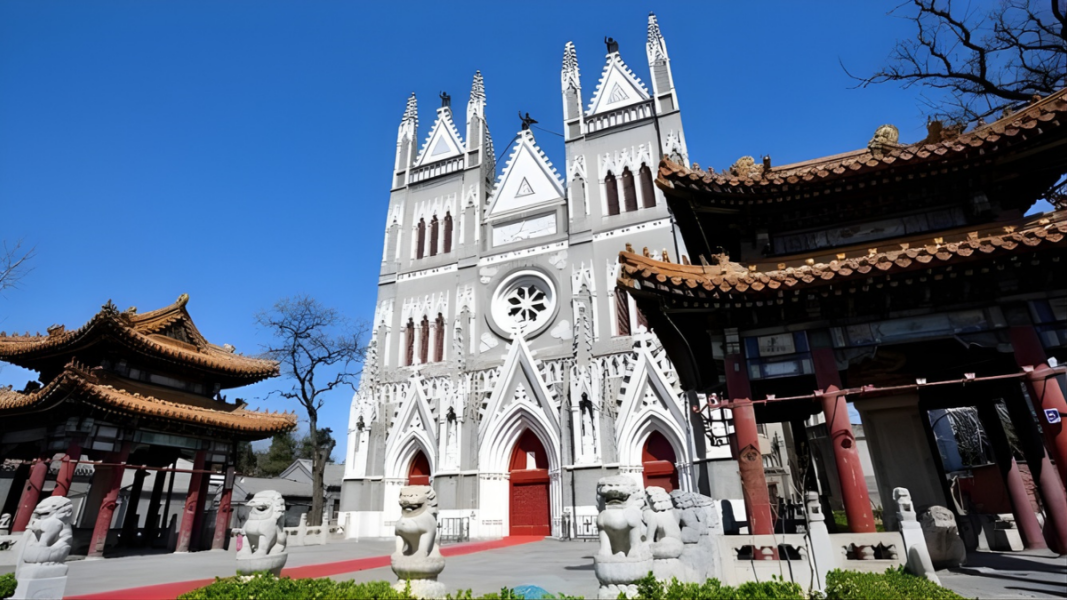
According to a statement from the Holy See today, this Friday, December 5, the episcopal consecration of Father Francesco Li Jianlin took place, appointed by the Pope on August 11 as the new bishop of the Apostolic Prefecture of Xinxiang, in China’s Henan province. His appointment was approved under the framework of the Provisional Agreement between the Holy See and the People’s Republic of China, in force since 2018 and periodically renewed.
The ordination took place after the acceptance of the pastoral resignation of Mons. Giuseppe Zhang Weizhu, who had governed the prefecture in a particularly delicate context for the underground Church and for communities not recognized by the Chinese State.
A Priest Formed in Henan and Hebei
Francesco Li Jianlin was born in 1974 in Huixian, into a firmly traditional Catholic family. His priestly formation began in the early 1990s, first at the Zhengding seminary and then at the Yixian seminary, in Hebei province, a typical path for many priests in northern China. He was ordained in 1999 and since then has held various pastoral roles in the Apostolic Prefecture of Xinxiang: first as parish priest in Qinyang, then as formator of seminarians and religious sisters, and finally as parish priest in Jiaozuo. His trajectory shows a deep knowledge of the Catholic fabric in Henan, a region where the faith has resisted political pressures and state controls for decades.
Closeness to the State’s Religious-Political Apparatus
Li’s biography is not limited to his pastoral work. Very soon he began to integrate into the official bodies that the Chinese regime uses to supervise faith communities. He participated in several structures of the Chinese People’s Political Consultative Conference (CPPCC), both at the local and municipal levels, and took on responsibilities within the Patriotic Association and the provincial committees in charge of religious affairs. These bodies are not neutral: they are part of the institutional framework designed to ensure that Catholic communities remain under the direction of the Communist Party.
This sustained participation over the years indicates that Li Jianlin has been considered by the authorities as a reliable figure, capable of representing an ecclesial line compatible with the political objectives of the State. His appointment in 2013 as local leader of the “official” Church—in an act supervised by the Religious Affairs departments and the United Front—confirmed his profile as a priest aligned with the patriotic structure.
The Conflict with Mons. Zhang Weizhu and the Break with the Underground Church
The recent history of Xinxiang cannot be understood without mentioning the long conflict between the official clergy and the clandestine clergy. In 2011, the then legitimate bishop of the prefecture, Mons. Joseph Zhang Weizhu, published a letter denouncing the conduct of Li Jianlin, whom he accused of acting without obedience to the bishop and of administering sacraments without valid jurisdiction. Zhang stated that these actions broke ecclesial communion and, consequently, declared Li separated from the local Church, prohibiting the faithful from participating in celebrations with him.
That letter had a great impact among the underground communities in Henan, which from then on saw Li as a priest too close to state control. While Zhang suffered constant detentions and pressures for remaining faithful to Rome, Li rose in the government-recognized official structure.
An Episcopal Election under Political Pressure
After the death of Pope Francis, in April 2025, Chinese authorities pushed for Li’s election as “bishop” of Xinxiang during the period of sede vacante. That designation, carried out through the usual political channel, was interpreted by many analysts as a show of strength intended to demonstrate that the state apparatus maintains control over the appointment of pastors. Xinxiang, moreover, is a particularly sensitive circumscription: its legitimate bishop, Mons. Zhang, had been subjected to arrests and intimidations for years for refusing to submit the local Church to the control of the Party.
Vatican Recognition and New Stage
The landscape changed in August 2025, when Rome announced that Father Francesco Li Jianlin had been officially appointed bishop of Xinxiang, under the framework of the Provisional Agreement between the Holy See and China. At the same time, the Holy See accepted the resignation of Mons. Zhang Weizhu, a reference figure for the underground community. With Li’s consecration this December 5, the prefecture enters a new stage, marked by the regularization of a situation that for years had been a source of tension between the Vatican and Beijing.