


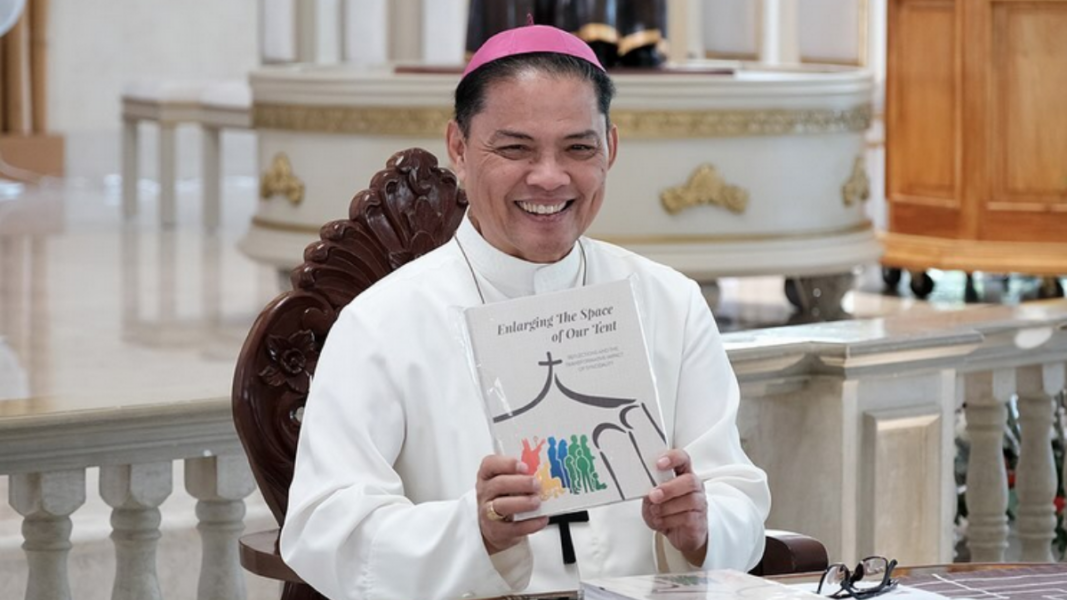
According to National Catholic Register, Archbishop Gilbert Garcera of Lipa officially assumed the presidency of the Catholic Bishops’ Conference of the Philippines (CBCP) this Monday following his election at the 130th plenary assembly of the episcopate, held on July 5. The decision represents a break with tradition, which normally provided for the election of the outgoing vice president—in this case, Mons. Mylo Hubert Vergara—something that had not occurred since 2011. His term, along with that of the new vice president, Archbishop Julius Tonel of Zamboanga, will extend until November 30, 2027.
A leadership marked by the synodal agenda
Garcera has developed a profile strongly linked to synodality, a concept he has promoted insistently in recent years. In January 2024, he published a 271-page document titled Enlarging the Space of Our Tent, where he defends the need for “a more inclusive perspective” within the Church and encourages valuing “the richness and diversity of human experience”.
Garcera’s election takes place in a delicate context for the Philippines, marked by government corruption and repeated natural disasters. His predecessor, Cardinal Pablo Virgilio David, exhausted two consecutive terms, leaving a presidency also characterized by synodal enthusiasm that will now be reinforced under the new leadership.
Pastoral openness toward people with same-sex attraction
The new president of the CBCP, according to the same source, has publicly advocated for a “pastoral sensitivity” toward those who experience same-sex attraction. Garcera maintains that priests and pastoral agents must accompany them “toward a deeper union with Christ”, ensuring that parishes are “communities of welcome, healing, and love”.
Although he claims to uphold the Church’s teaching on marriage between a man and a woman, he insists that the truth “should not become a reason for exclusion”, but rather a call to a “deeper commitment to love”. This approach, which avoids openly confronting the growing cultural pressure, raises questions about its doctrinal and pastoral implications in a traditionally Catholic country.
Trajectory: between commissions and episcopal structures
Before being appointed bishop of Daet in 2007, Garcera served as assistant general secretary of the CBCP and as executive secretary of the Episcopal Commission for the Missions, a commission he later presided over. As a bishop, he also headed the Episcopal Commission for the Family and Life. Since 2017, he has occupied the metropolitan see of Lipa.
An election that confirms a direction
Garcera’s election not only breaks an internal custom of the Filipino episcopate; it also confirms that the synodal agenda is consolidating as the dominant line within the CBCP. His insistence on a Church that is “more inclusive” and “broader” fits into a pastoral language that, although it does not explicitly contradict doctrine, opens ambiguous spaces that are often exploited to dilute it.
The emphasis on accompanying without confronting, on welcoming without defining, and on expanding the “tent” without clarifying its limits, reflects a trend that has already generated confusion in other episcopal conferences. In a social context increasingly marked by moral and political instability, the Church in the Philippines needs firmness, doctrinal clarity, and apostolic courage, not endless documents that substitute teaching with rhetoric.