


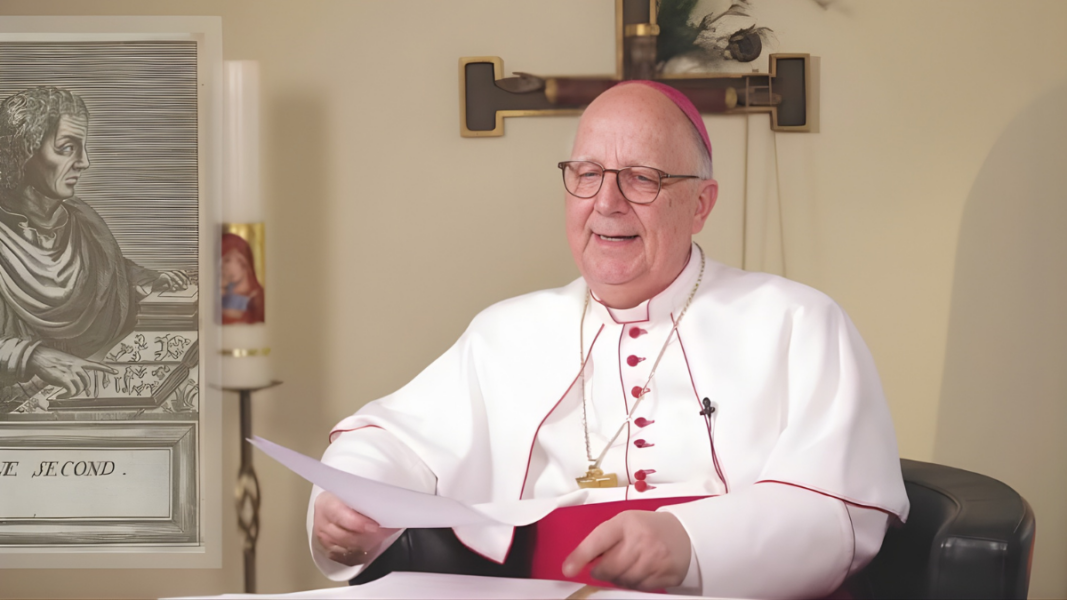
In an intervention at the Rome Life Forum on December 4, 2025, reported by LifeSite, the Swiss bishop Marian Eleganti warned that the so-called “universal fraternity” cannot be detached from Jesus Christ without falling into religious relativism that empties the Gospel of its content. In the face of the idea that all religions would be equally paths to God, the prelate recalled that the only saving mediation is that of Christ and that the Church’s mission cannot be diluted into a mere interreligious dialogue without truth.
From Assisi to the “spirit of Assisi”: risk of syncretism
Msgr. Eleganti reviewed the origin and development of the interreligious encounters in Assisi promoted by St. John Paul II starting in 1986, recalling that from the beginning there were reservations in the Curia and among bishops about the danger of the “heresy of syncretism” and of giving the impression that all religions are on the same level.
According to the text disseminated by LifeSite, the bishop cites both the clarifications of John Paul II—who wanted to avoid a “common universal prayer”—and the concerns of then-Cardinal Ratzinger and the subsequent warnings of Benedict XVI, who tried to close the door to relativist interpretations by recalling the teaching of the declaration Dominus Iesus.
Eleganti emphasizes the weight of media images: for many poorly formed faithful, seeing leaders of different religions praying together for peace can foster the idea that “one religion is as good as another” and that Jesus Christ would be just one more among several mediators. In this sense, he speaks of the so-called “spirit of Assisi” as a vague label that, in practice, has served some to justify relativist tendencies within the Church.
Direct criticism of Francis’s words in Singapore and the Abu Dhabi Declaration
The bishop goes a step further and openly criticizes certain statements by Pope Francis. In particular, he describes as “objectively scandalous” his words at the Catholic Junior College in Singapore in September 2024, when the Pope told young people that “all religions are a path to God” and compared them to “different languages” to reach the same God, insisting that “God is God for everyone” and that we would all be “children of God” by nature.
For Eleganti, that vision contradicts the Catholic faith, as it dilutes the uniqueness of Christ as the only way to the Father and transforms the mission into simple accompaniment without conversion. In his view, it is a form of religious pluralism that considers it offensive to speak of a “true” religion in the face of others, and that rejects the idea that Christianity must proclaim the truth of Christ to all peoples.
In the same vein, he harshly criticizes the Declaration of Abu Dhabi, especially the passage that states that the pluralism of religions would be part of the “wise divine will.” Eleganti argues that it is impossible to attribute to God, as a positive will, religions that deny the divinity of Christ or the Trinity, and he points particularly to Islam as a religion structurally opposed to Christianity, both in theory and in historical practice. He describes as “false” the claim that “religions never incite war or hatred,” recalling that the foundational texts and history of some religions openly contradict this formulation.
Mission, dialogue, and truth: against the practical renunciation of the missionary mandate
In his conference, Eleganti denounces that, for decades, in many circles the concept of mission has been replaced by that of “dialogue,” “collaboration,” or “intercultural learning,” to the point that it is no longer considered acceptable to try to convince others of the truth of Christ. According to the text published by LifeSite, the bishop sees this as a concession to a culture that detests claims to truth and considers it offensive to affirm that Jesus Christ is the only Savior.
The prelate recalls that Christ’s mandate to “make disciples of all nations” remains in force and cannot be abandoned without ceasing to be truly Catholic. Preaching no longer means— he warns— engaging in sociopolitical activism for generic causes (climate, migrations, etc.), but proclaiming Jesus Christ dead and risen, the only Way, Truth, and Life.
In his view, “dialogue” understood as relativism, in which no party can claim a truth superior to the other, ends up being useless, because it renounces in advance the search for truth. Eleganti recalls that for the Church, dialogue is linked to witness and proclamation, and that conversion is produced by God, not by human rhetoric.
Children of God by faith and baptism, not by mere nature
In the final part of the speech, the Swiss bishop insists on a key point: not all men are “children of God” in the Christian sense merely by the fact of existing, but rather those who receive Christ through faith and baptism. He quotes the prologue of the Gospel of St. John: to those who believe in Him “he gave power to become children of God, who are born not of blood nor of the will of the flesh nor of the will of man, but of God.”
For this reason, he warns against projects of “universal fraternity” that dispense with Christ and reduce faith to a humanitarian ethic or a kind of “secularized Kingdom of God” based only on tolerance and political consensus. Such a fraternity, he states, is not Christian, because it requires hiding or downplaying the unique mediation of Jesus Christ in order to be signed by all.
Eleganti concludes that only in Christ, the true Light that comes into the world, is authentic fraternity among men founded, and that any model of human unity that replaces or relativizes this truth ends up being one more ideological construction, sustained on amputated fragments of the Gospel.