


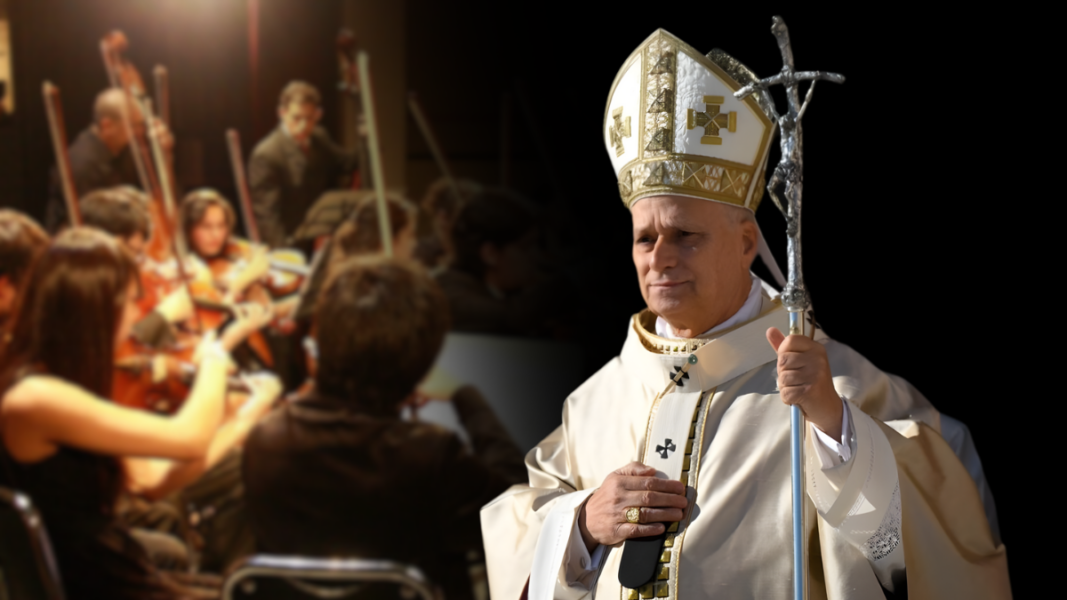
Leo XIV received today in the Apostolic Palace the organizers and artists of the Concert with the Poor, which will celebrate its sixth edition this Saturday in the Paul VI Hall. The Pontiff placed this meeting in the context of preparation for Christmas and recalled that the center of these celebrations is not a cultural gesture, but the closeness of God who becomes poor to save humanity.
The Incarnation, icon of divine love
The Pope recalled that the Incarnation is the most eloquent proof of God’s love, citing Benedict XVI in his encyclical Deus caritas est, where he presents Christ as the Good Shepherd who seeks the “lost sheep.” By becoming a child and surrendering to human fragility, the Pontiff explained, God reveals that his love is not abstract, but concrete and willing to sacrifice.
Leo XIV insisted that the commandment of love is not a pious ideal, but the key to understanding who the human being truly is: “God is love,” he affirmed, and only when one loves as He has loved does one reach one’s own fullness.
A concert that is not charity, but living Gospel
The Pope warned that the Concert with the Poor should not be reduced to an artistic exhibition or a charitable action intended to ease one’s conscience. He recalled the words of Jesus in the Gospel—“whatever you did for one of these least brothers of mine, you did for me”—to emphasize that the relationship with the poor is a direct encounter with the Lord.
He cited his exhortation Dilexi te to stress that contact with those who lack power is “an immediate way of encountering the Lord of history” and that human dignity is not measured by possessions, but by the condition of beloved children of God. For this reason, he explained, the most fragile occupy the first places in this musical encounter.
Music as a path to God
In another passage of his speech, the Pope highlighted the importance of music in the Christian tradition. He emphasized that in the liturgy, singing is not an addition, but a means to lift the heart toward the mystery being celebrated. He cited St. Augustine and his exhortation to “sing with art,” recalling that beauty, when authentic, becomes a bridge to God.
In a close tone, he asked the artists to sing and play “with art and with the heart,” because music can express love and become a true via pulchritudinis, a path to beauty that leads to the Lord.
Thanks and final blessing
Leo XIV thanked those who make the Concert with the Poor possible, mentioning Cardinal Vicar Baldo Reina, Msgr. Marco Frisina, the Choir of the Diocese of Rome, the Orchestra and the Nova Opera Foundation, as well as the participating artists, including Serena Autieri and Michael Bublé.
Finally, he entrusted those present to the intercession of the Immaculate Virgin, “gate of Advent and woman of hope,” and to the protection of St. Cecilia, patroness of musicians, wishing that the Lord bless this work and the commitment of all those involved.
We leave below the full speech of Leo XIV:
In the name of the Father, of the Son and of the Holy Spirit.
Peace be with you!
Welcome and thank you for your patience. I am glad to meet you today, on the eve of the sixth edition of the Concert with the Poor. The happy intuition of Pope Francis is becoming a beautiful tradition, which is inserted into the context of preparation for Holy Christmas, in which we celebrate the Lord Jesus Christ who draws near and becomes poor for us (cf. 2 Cor 8:9).
The mystery of the Incarnation of the divine Word is the revelation of the love that God the Father has for each one of us. As Pope Benedict XVI wrote in his first Encyclical, published precisely on Christmas Day, “this action of God now acquires its dramatic form in the fact that, in Jesus Christ, God himself pursues the ‘lost sheep,’ suffering and lost humanity.” [1] God who becomes a child, who entrusts himself to human parents, who offers himself for each one of us, is the Icon of divine love that comes to save us.
How beautiful it is to be able to say with heart and mind: God is charity, is love! (cf. 1 Jn 4:16). Looking to Him we can learn to love as He has loved us; we can discover that the commandment of love responds to our most authentic needs, because it is when we love that we truly realize our being.
The Concert with the Poor, then, is not merely an exhibition of good artists or a simple musical display, however beautiful, nor even a moment of solidarity to quiet our conscience in the face of society’s injustices. I would like that, in participating in this encounter, we remember the words of the Lord: “Whatever you did for one of these least brothers of mine, you did for me” (Mt 25:40). That is how it is! If we love concretely those who are hungry and thirsty, those who have no clothes, the sick, the stranger, the imprisoned, we are loving the Lord. This is the Gospel: “We are not in the horizon of charity, but in that of Revelation: contact with those who have no power or greatness is an immediate path of encounter with the Lord of history. In the poor He still has something to say to us” (Apostolic Exhortation Dilexi te, 5). It reminds us that the dignity of men and women is not measured by what they possess: we are not our goods or our things, but beloved children of God; and that same love must be the measure of our acting toward our neighbor. For this reason, in our Concert the most fragile brothers and sisters occupy the first places.
Music has always played an important role in the Christian experience. In the liturgy, in particular, singing is never a “soundtrack,” a simple accompaniment, but is intended to lift the soul to lead it as close as possible to the mystery being celebrated. [2] St. Augustine, speaking precisely of singing in prayer, wrote in his Commentary on the Psalms: “You must sing to Him, but not out of tune. He does not want his ears to be offended. Sing with art, brothers.” [3] How much care, effort, art, and finally the harmony that derives from them matter in music: it is truly a precious gift that God has given to all humanity.
Allow me, then, brothers and sisters, a joke: tomorrow, please, sing well! Sing and play with art and, above all, with the heart, because truly music can represent a form of love, a via pulchritudinis that leads to God, since “beauty is a gift of his to all human beings, united by the same dignity and called to fraternity.” [4]
Finally, it is my desire to thank all those who are working for the good realization of the Concert, in particular Cardinal Vicar Baldo Reina, Msgr. Marco Frisina, together with the Choir of the Diocese of Rome, the Orchestra and the Nova Opera Foundation, the actress Serena Autieri, Michael Bublé and his Band, and each of the artists, without forgetting all the collaborators, who with their generous support make the event possible.
In giving you my blessing, I entrust you to the maternal intercession of the Most Holy Immaculate Mary, gate of Advent and woman of hope, and I invoke for all of you the protection of St. Cecilia, patroness of musicians.
May the Lord continue to bless your commitment and this most beautiful work! Thank you!