


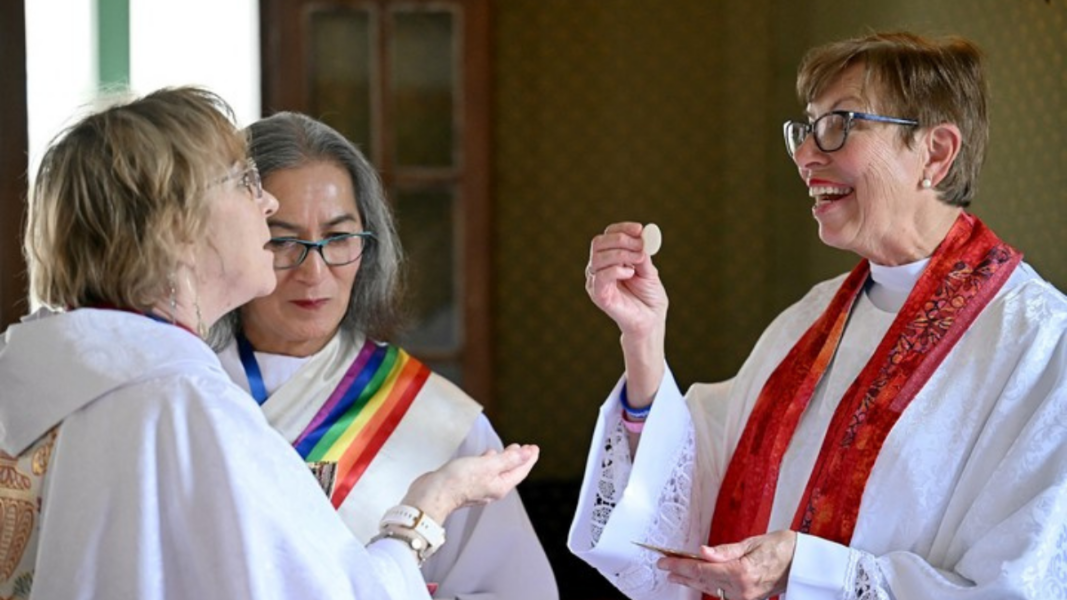
Representatives of lay organizations in Germany and the “Wir sind Kirche” movement reacted—as expected—with annoyance and disappointment to the Vatican commission’s ruling on the female diaconate. According to Katholisch.de, the report presented this Thursday by the theological commission concludes that, “in the light of Sacred Scripture, Tradition, and the Magisterium,” the ordination of women as deaconesses is not possible at this time.
Irme Stetter-Karp, president of the Central Committee of German Catholics (ZdK), described this stance as “a sign of stagnation” and insisted that “the Church cannot begin its future from immobility.” She added that it is “disastrous” that women around the world continue to receive no positive response to their demand: «Where will the women who commit to the Church come from if they are still being told that they are second-class people?»
The continuity of the ordained ministry as the central argument
Stetter-Karp acknowledged that the Vatican has been promoting greater female participation in various ecclesial areas for some time. However, in her view, this does not change the fact that Scripture and Tradition continue to be interpreted in such a way that the ordained ministry remains reserved for men. “I do not understand why a woman cannot be a credible witness in this ministry,” she stated.
The ZdK vice president, Thomas Söding, agreed in describing the ruling as a “missed opportunity.” He emphasized that the report offers an “intermediate balance” that does not constructively incorporate the impulses from the worldwide synodal assembly. According to him, although the commission clearly presents the arguments in favor of deaconesses, the final rejection relies almost exclusively on the idea that Christ, being male, can only be sacramentally represented by a male, a reasoning he considered “philosophically and theologically weak.” He added that he hopes the discussion will continue without more women leaving ecclesial life.
“Wir sind Kirche” calls the ruling “theologically questionable”
The “Wir sind Kirche” movement positively valued the publication of the report but described the “no” announced by the commission as “theologically, anthropologically, and pastorally highly questionable,” even if it does not constitute a definitive decision. The organization called for reopening the debate, recalling that women have exercised diaconal tasks for centuries without formal recognition.
According to this group, if the Church wants to authentically live its diaconal identity—as affirmed by Pope Francis and Pope Leo XIV in their exhortation Dilexi te—the equal and co-responsible participation of women is essential.
The arguments put forward by the promoters of the female diaconate are not new. They have been repeated for decades: equality, recognition, representativeness. But none of them touches the central issue: the sacrament of Holy Orders is not a right, nor a civil office, nor a leadership position subject to quotas, but a gift received, not fabricated by the Church.