


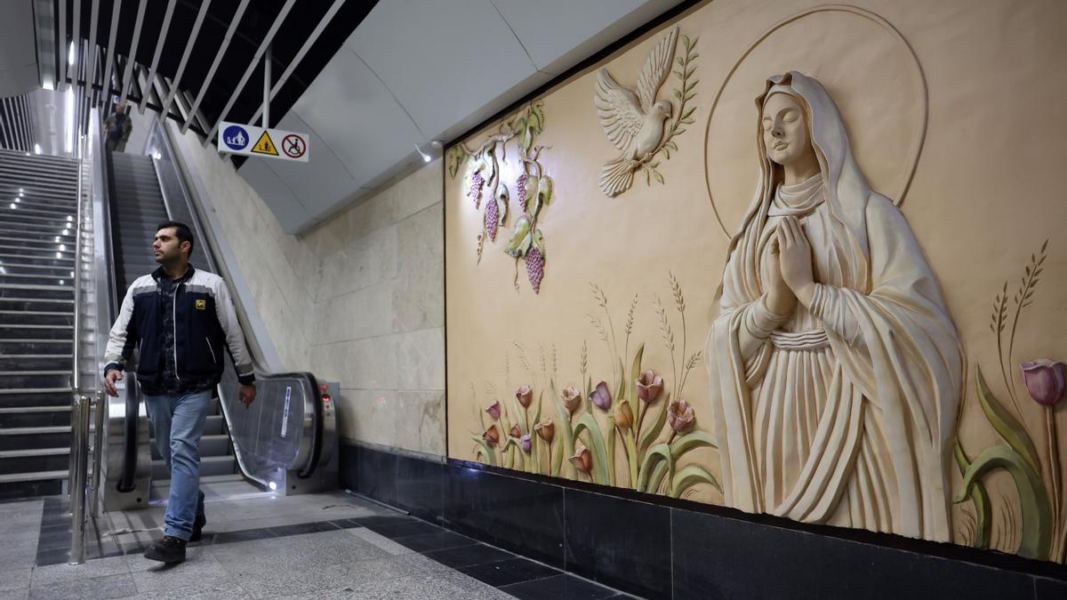
The Iranian capital inaugurated last Saturday, November 29, the Santa María metro station, a space that combines traditional Persian architecture and spiritual references to offer an environment that seeks to unite the community in one of the most transit-heavy areas of Tehran.
Located at a key intersection in the city, the new station not only alleviates passenger traffic but has become, even before its opening, a point of reference due to its symbolic charge: a place where cultural identity, interreligious dialogue, and media presence converge.
The architecture of the facility incorporates characteristic elements of Iranian art, integrating tones and decorative details that evoke the visual identity of Christians in the country. The space presents itself as warm and welcoming, designed to invite the traveler to contemplate the surroundings and recognize the cultural richness of the city.
The ornamental elements include ceramic and metallic panels with Quranic verses, along with sculptures on religious themes, seeking to express the spiritual dimension that the project aims to convey. The station is thus presented as a space where public transportation coexists with collective memory and cultural identity.
In practical terms, authorities estimate that between 35,000 and 70,000 passengers will use the station daily during its first weeks. Santa María presents itself as a place where the everyday meets the emblematic, offering citizens a more human experience of urban transportation and a reminder of the shared history that unites the different communities present in Tehran.
What the West Does Not Dare to Do
Meanwhile, in numerous Western countries, historically Christian, the presence of religious symbols in public spaces is eliminated or hidden due to ideological pressures, fear of controversy, or a militant secularism that seeks to erase all traces of the faith that shaped their cultural identity. The contrast is inevitable: what in Europe or America would be a sign of «imposition» by religion—a large metro station called “Santa María”, with religious art and spiritual references—becomes possible in an Islamic country.
How is it possible that in a context where Christianity is a minority and often persecuted, public reverence toward the Virgin is shown, while in societies of Christian roots that same presence is considered unacceptable? The Santa María station, beyond its practical or architectural aspects, highlights a cultural reality: even under restrictions, some recognize the figure of Mary as a bridge of unity, while in the West many renounce it for fear of offending.