


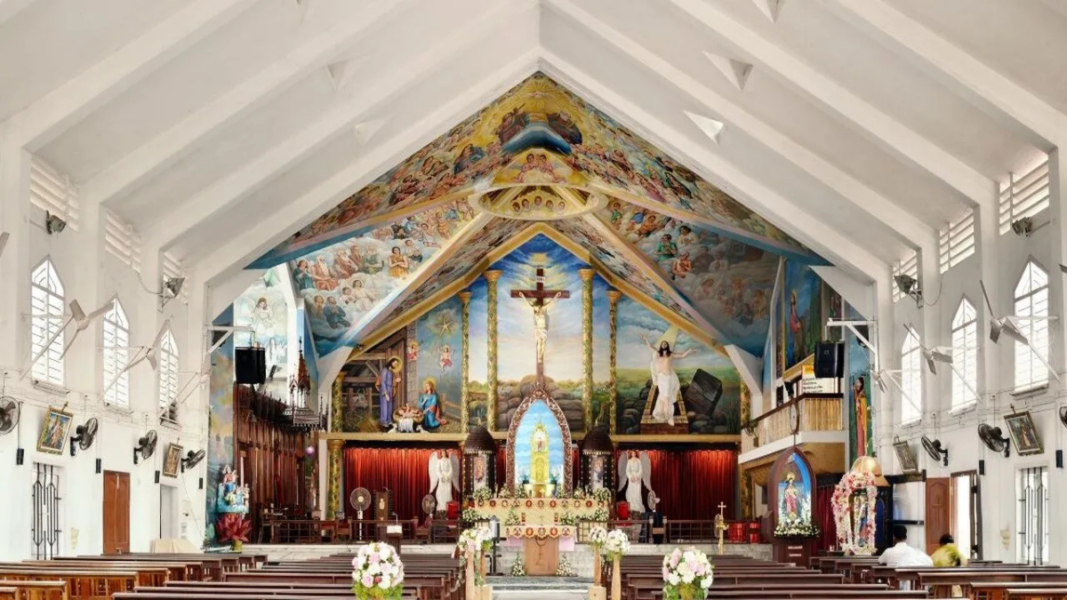
The basilica cathedral of Santa María, located in Ernakulam, in the state of Kerala (southern India), has resumed the public celebration of the Santa Qurbana—the Eucharistic liturgy proper to the Syro-Malabar Church—after three years of suspension. The reopening, which occurred on December 1, puts an end to a period marked by one of the most serious liturgical conflicts that this Eastern Catholic Church in full communion with Rome has faced.
According to The Pillar, since December 2022, the basilica had remained practically paralyzed due to the confrontation between two sectors: supporters of the new “uniform liturgy” approved by the Syro-Malabar Synod and defenders of continuing to celebrate with the priest facing the people (versus populum), a practice rooted for decades in the archeparchy of Ernakulam–Angamaly. The dispute led to disturbances inside the temple, physical confrontations, police intervention, and a prolonged closure that forced many faithful to pray for days in front of the blocked doors.
The return of the Santa Qurbana under judicial supervision
The administrator of the basilica, Father Thomas Mangatt, celebrated the Santa Qurbana at six in the evening on December 1 after the Kerala High Court authorized the police to guarantee order. The measure was considered necessary due to fears of new protests inside the temple, which in the past had prevented the normal development of the celebrations.
The liturgy was celebrated versus populum, the modality preferred by the majority of priests and faithful in the region. This gesture had strong symbolic weight, as it shows the willingness to respect local pastoral sensitivity without renouncing dialogue with the Syro-Malabar hierarchy, which since 2021 has been promoting the adoption of a uniform rite in all the eparchies of the country.
The uniform liturgy: the origin of a deep fracture
The conflict that led to the closure of the basilica did not arise overnight. In 2021, the Synod of the Syro-Malabar Church—the supreme authority of this Eastern Catholic Church—approved the introduction of a uniform liturgy. This rite establishes that the priest faces the people during the Liturgy of the Word, turns toward the altar (ad orientem) during the Eucharistic Liturgy, and faces the assembly again after Communion. The proposal sought to unify dispersed practices and preserve elements of the Eastern tradition, but in Ernakulam–Angamaly it provoked strong resistance from priests and faithful, who considered it illogical to abandon a mode of celebration that had been in use for decades.
The insistence on imposing the new rite led to episodes of increasingly intense tension. In 2022, during several attempts to apply the uniform liturgy, groups of protesters blocked accesses, occupied the temple, and staged confrontations that forced the police to intervene inside the sanctuary. In one of the most serious incidents, the faithful pushed a portable altar used by St. John Paul II during his visit to India in 1986, causing the knockdown of sacred objects. The situation became unsustainable, and the ecclesiastical authorities indefinitely suspended public liturgies.
Years of closures, failed reopenings, and tense negotiations
After the initial closure, an attempt was made to reopen the basilica in June 2023, but the agreement broke down almost immediately. It was necessary to wait until March 2024 for a court to order that the faithful be allowed access to the temple again. Even so, the Santa Qurbana could not be celebrated publicly, and activities were limited to the rosary, the way of the cross, and confessions. The situation evidenced that the root of the conflict remained unresolved.
In 2025, negotiations intensified between representatives of the local clergy and the Syro-Malabar bishops. The pastoral pressure was enormous: the largest archeparchy of the Syro-Malabar Church had been divided for years, the main temple was without public liturgies, and the scandal had gained international repercussion. Finally, in June 2025, a compromise was reached that allowed progress toward normalization.
The 2025 agreement: a middle path to recover peace
The pact that was reached established that the priests of the archeparchy could continue celebrating the Santa Qurbana versus populum, as had been done, provided that each parish offered at least one Sunday celebration according to the uniform liturgy. This agreement, although imperfect for some parties, opened the door to the total reopening of the temple and at the same time allowed safeguarding the unity of the Syro-Malabar Church and respecting the local pastoral reality.
In the basilica of Santa María, the application of the agreement means that every Sunday a liturgy will be celebrated in the uniform mode, while the others may continue according to the form preferred by the community. The reopening also coincides with the start of the new liturgical year, a gesture that many faithful interpret as an opportunity to leave behind years of division.