


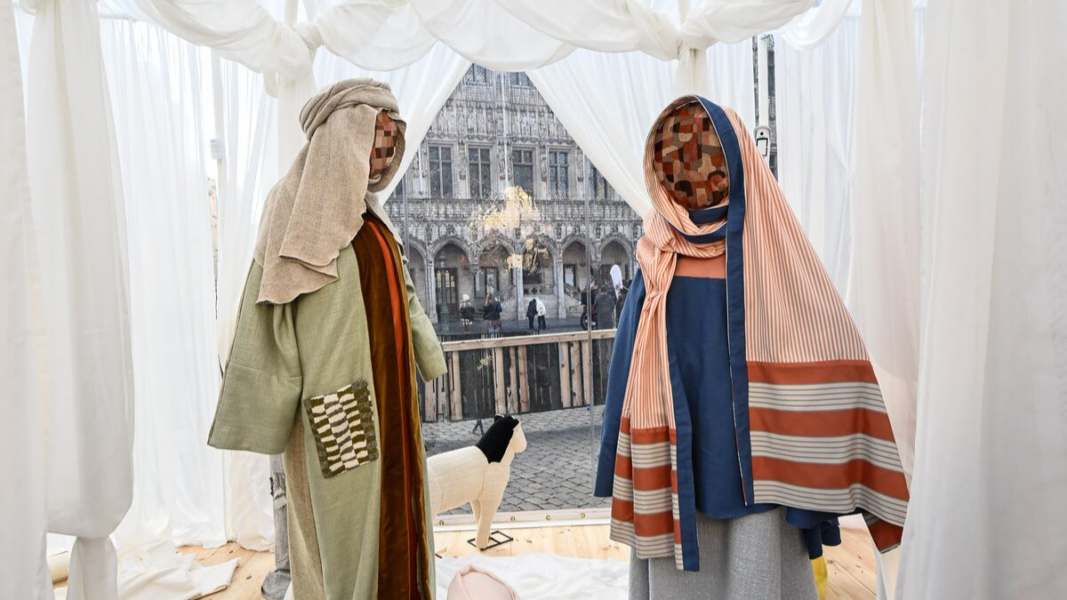
The Nativity scene installed this year in the Grand Place of Brussels has provoked growing indignation inside and outside of Belgium. It’s not surprising. The traditional wooden figures have been replaced by faceless fabric silhouettes, devoid of identity, stripped of any explicit reference to the mystery they represent: the birth of Jesus Christ. In their place, an abstract installation that could appear in any contemporary exhibition… or in none.
The work, titled “Fabrics of the Nativity” and designed by the artist Victoria-Maria Geyer, was endorsed by both the city hall and the dean of St. Michael and St. Gudula Cathedral. However, the result has not managed to inspire devotion or convey the Christian message of Christmas. On the contrary, it is a clear sign of Europe’s growing renunciation of its religious symbols and Christian roots.
The situation worsened this weekend, when the face—or rather, the fabric head—of the Baby Jesus was torn off and stolen, an act that only reflects the fragility and bewilderment generated by replacing a traditional Nativity scene with a depersonalized installation.
The theft of the Baby Jesus’s head is not just an uncivic act: it is the symptom of a deeper drift. When the sacred is reduced to a meaningless cultural object, it becomes dispensable, manipulable, even ridiculeable. No traditional Nativity scene would have provoked such contempt precisely because, although it bothers some, it conveys a recognizable truth and identity.
Criticism from all social spectrums: “An insult”, “A zombie scene”
The reactions gathered by ACN range from the international footballer Thomas Meunier, who spoke of “hitting rock bottom”, to intellectuals like Rod Dreher, who compared the scene to the traditional Nativity scenes of Hungary, pointing out the difference between a country that protects its faith and another that seems ashamed of it.
In the political sphere, the criticism has been even more forceful. Georges Dallemagne, from the Christian democrats, described the absence of faces as “very shocking” and warned that the Nativity is not an exercise in minimalist aesthetics, but a universal message of hope. The liberal Georges-Louis Bouchez went further: “It is an insult to our traditions”. His party has launched a formal campaign to demand the recovery of an authentic Christian Nativity scene.
Professor Wouter Duyck pointed out what many think and few dare to say: the fear of upsetting the city’s Muslim population is behind this decision. He recalled that in Islam, the faces of prophets are not represented, suggesting that the installation seeks to avoid conflicts at the cost of disfiguring a millennia-old Christian tradition.
The City Hall justifies the unjustifiable
The mayor of Brussels, Philippe Close, defended the work by appealing to the need to “tone down” Christmas. A justification hardly understandable for those who consider that Christmas is not an exercise in political correctness, but the celebration of the birth of Jesus Christ, the spiritual and cultural foundation of Europe.
The dean Benoît Lobet tried to offer a symbolic interpretation, assuring that the wrinkled fabrics evoke the precariousness of Jesus, Mary, and Joseph. But the deliberate absence of faces—which in the Christian tradition embody the reality of the Word made flesh—transforms the Nativity into an undefined object, without message, without identity, and without faith.