


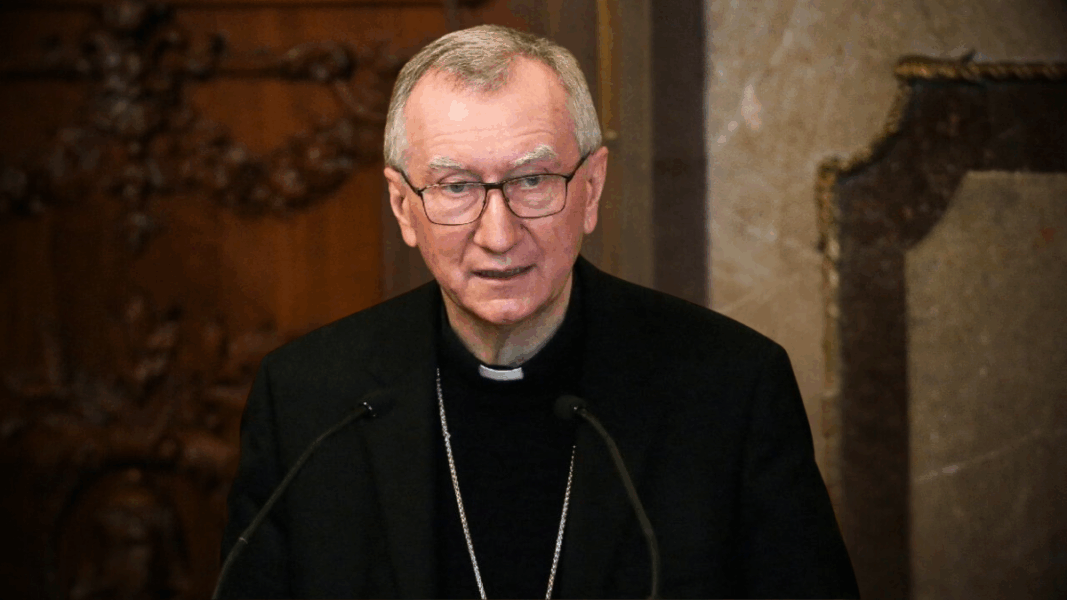
Cardinal Pietro Parolin, the Vatican’s Secretary of State, has been harshly criticized by Emeka Umeagbalasi, president of the board of directors of the Nigerian organization Intersociety, for his statements about the extreme violence suffered by Christians in Nigeria. In an interview published by Crux on November 27, the human rights official accused the cardinal of providing “diplomatic cover” to jihadist groups and weakening the Church’s moral position in the face of religious persecution.
The criticisms date back to October, when Parolin downplayed the influence of Islam in the anti-Christian violence in Nigeria by describing it as a “social conflict” and not a religious one. His statements were made during a Vatican event dedicated to the 2025 Report on Religious Freedom published by Aid to the Church in Need (ACN), in which Nigeria is listed among the countries with the highest violations of religious freedom.
Read also: Parolin downplays the blood of Nigerian martyrs
“Provides cover to the perpetrators”
According to Umeagbalasi, downplaying the religious motivation driving the massacres leaves persecuted Christians without moral protection and encourages extremists to continue the attacks. He points out that the diplomatic language used by Parolin “weakens the gravity of the situation” and sends a dangerous message: that the Church is not publicly acknowledging the genocidal nature of Islamist violence.
The activist emphasizes that this stance contradicts the reality documented by international organizations. The ACN report, which analyzed 196 countries, concludes that two-thirds of the world’s population live in places where religious freedom is severely violated. Nigeria appears in the most severe category—“persecution”—and the document highlights that the violence stems from a combination of Islamic extremism and state failures.
Umeagbalasi states that Cardinal Parolin’s approach “demoralizes” Christians who expect clarity and leadership from the Church. According to him, minimizing the religious dimension of the genocide also contradicts Nigeria’s constitutional obligations and the demands of international law on religious freedom.
Data that dismantles the official narrative
The Nigerian activist also refuted the claim that the violence affects Muslims and Christians equally. He explained that when Muslims are killed, it is usually due to internal conflicts between Islamic groups in Muslim-majority states like Zamfara, Sokoto, or Katsina. In contrast, Christian victims are systematically attacked for their faith.
The figures cited by Umeagbalasi are compelling: for every ten people killed for religious reasons in Nigeria, seven are Christians and three are Muslims. This proportion reflects, according to him, the systematic intentionality of the anti-Christian violence.
A genocide sustained for decades
The persecution of Christians in Nigeria is not a recent phenomenon. Sporadic attacks have been recorded since the 1950s, but the situation began to worsen dramatically starting in 1999, when twelve northern states adopted sharia. The emergence of Boko Haram in 2009—responsible for the mass kidnapping of girls in 2014, of whom 87 remain missing—marked a turning point in the violence.
Priests and seminarians have also been targets of these attacks. In July, the diocese of Auchi reported the assault on the minor seminary of the Immaculate Conception, where terrorists killed a security guard and kidnapped three seminarians. In August, Islamic militants attacked a Christian village, killing three people and leaving several injured, just two months after a massacre in the same area that left more than 200 dead.
According to the 2025 report of the U.S. Commission on International Religious Freedom (USCIRF), anti-Christian violence in Nigeria continues to be favored by the government’s lack of response, which “sometimes seems unwilling to act,” fostering impunity.
Parolin’s stance, aligned with the Nigerian official discourse
Umeagbalasi also expressed concern that Parolin’s statements coincide with the official narrative of the Nigerian government, which for years has denied that the violence has a religious component. He considers it particularly grave that the Secretary of State of the Holy See adopts this discourse, contributing to reinforcing a version that hides the systematic persecution of Christians.
Reactions within the Church: Viganò denounces a “betrayal”
Parolin’s words have generated rejection among various figures in the Church. Among them is Archbishop Carlo Maria Viganò, who was apostolic nuncio in Nigeria from 1992 to 1998. For him, describing the situation as a “social conflict” distorts the reality of a “fierce and genocidal” persecution against Catholics. Viganò maintains that the killers act “out of hatred for the faith” and are part of an Islamist agenda that seeks to impose sharia and reduce Christians to the status of infidels.
The prelate stated that this policy of minimization constitutes an abandonment of the persecuted faithful in one of the most violent countries in the world for Christians.