


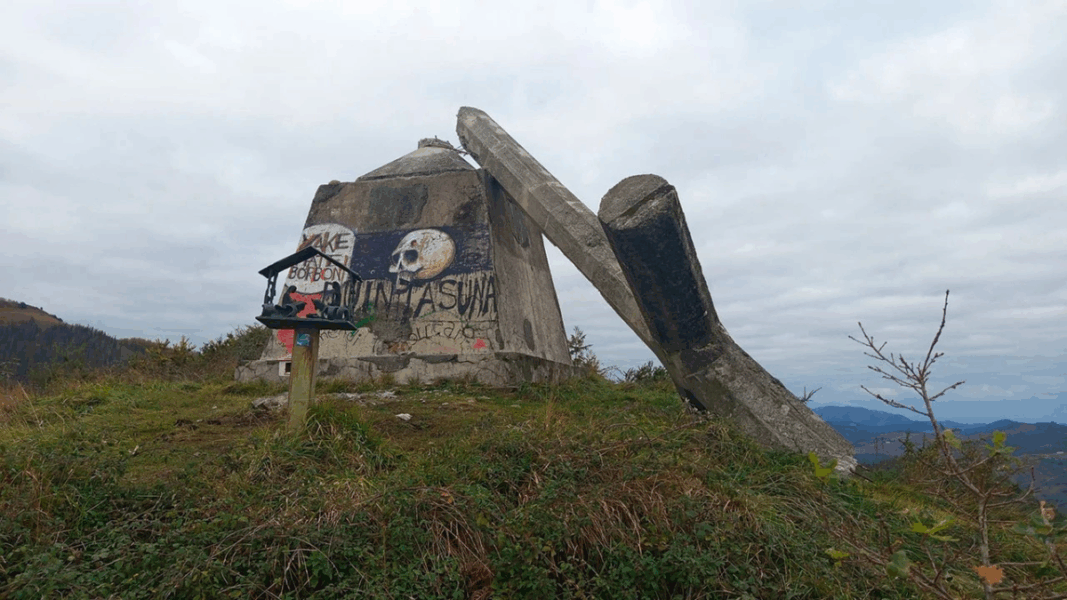
The cement cross located on Mount Morkaiku in Elgoibar, a visible element of the Gipuzkoan landscape for decades, was toppled on November 18—two days before the 50th anniversary of Francisco Franco’s death. The Basque Department of Security confirmed the facts and stated that the Ertzaintza has opened an investigation, after the Municipal Police alerted them to the attack. The officers dispatched to the site confirmed the collapse of the structure, although no suspects were found and no arrests have been made.
Organized action: tools, planning, and anti-religious graffiti
The investigations point to an organized action. According to the available information, a group of independentist activists accessed the summit of the mountain in a coordinated and premeditated manner, equipped with an angle grinder, a ladder, and high-powered spotlights. With this equipment, they managed to cut and fell the cross, which collapsed amid shouts of celebration.
Graffiti in Basque with ideological and anti-religious content also appeared at the base of the monument, which reinforces the theory that it was a deliberate attack against a Christian symbol, and not just a mere prank.
A monument reinterpreted by the City Council as a “witness to an era”
The cross had been erected during the Franco dictatorship in memory of Carlos de Borbón y Orleans, uncle of Juan Carlos I, who died in combat in September 1936. Although it appeared in a 2019 report by the Institute of Memory, Coexistence and Human Rights, Gogora, dedicated to the removal of Francoist symbology in Euskadi, its presence on the mountain had acquired a different meaning over time for most of the neighbors. For the people of Elgoibar, the monument was part of the usual landscape and was mainly recognized as a reference point for mountaineering and local identity.
After the toppling became known, the Elgoibar City Council—governed by the PNV—convened a Spokespersons’ Board and issued a statement in which it defended that the cross had ceased to be seen by the public as a political symbol. In that context, it explained that its historical memory policy had bet on reinterpreting the monument, removing the original inscription but keeping the structure as a “witness to an era”.
The consistory defended its preservation for pedagogical purposes
The City Council assured that the decision to keep the cross followed technical recommendations from experts, who considered that preserving it could help contextualize the events of the Civil War and highlight, by contrast, the totalitarian nature of the Franco regime. With that objective, it installed an explanatory panel and integrated the monument into a historical memory route.
A new attack on the Christian presence in public spaces
The fall of the cross once again highlights a worrying phenomenon that repeats itself in various areas of Spain: the violent elimination of Christian symbols in public spaces. Beyond the debate about its historical origin, the cross represents a fundamental religious sign, rooted in the country’s cultural tradition and present in the Basque landscape long before 1936. Its toppling, carried out in a planned manner and with a celebratory intent, reveals a growing climate of hostility toward faith and its visible expression.