


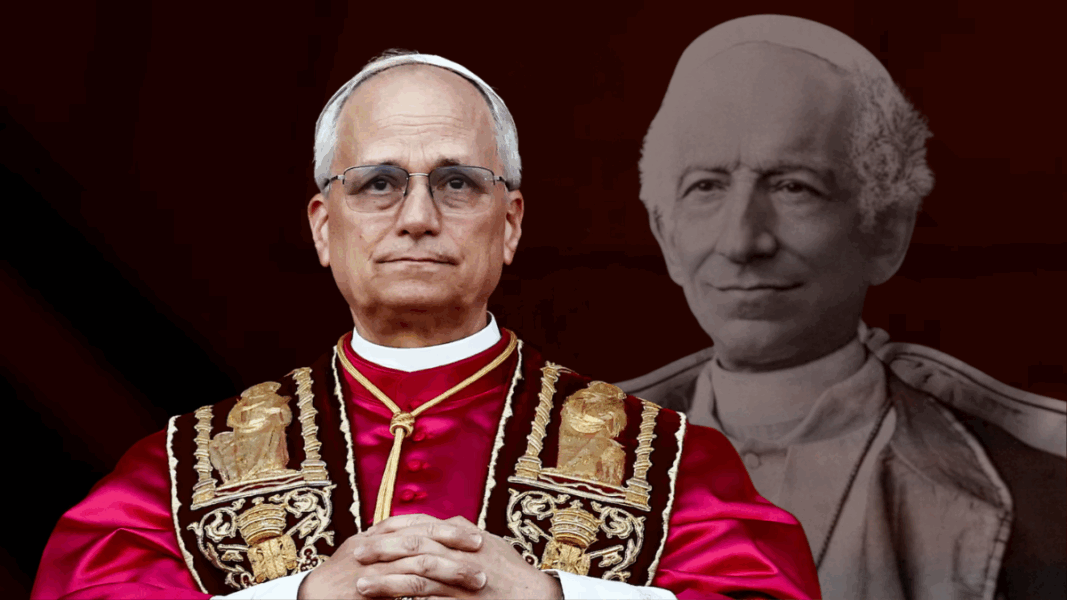
The election of Pope León XIV, which took place on May 8, 2025—the day of the Supplication to the Virgin of the Rosary of Pompeii—marked a spiritual sign that did not go unnoticed by Mons. Alberto José González Chaves. The new pontiff began his ministry by praying an Ave Maria and placing the rosary at the center of his public life, in the same way that León XIII had done more than a century earlier. That coincidence is not a devotional detail, but the reflection of a deep continuity between two critical moments in the Church: while León XIII faced modern anticlericalism and the social decomposition of the 19th century, León XIV finds himself before a humanity fragmented by the technological revolution and the loss of faith. Both, in different contexts, turn their gaze to Mary as a guarantee of spiritual victory.
León XIII: the Pope of the Rosary
The Church has seen in León XIII the great renewer of contemporary Mariology. His insistence on the rosary, expressed in twelve Marian encyclicals, offered the faithful an accessible and profound path of contemplation. In Supremi apostolatus officio, León XIII recalled that this prayer had united Christians of all conditions in the most difficult moments, such as in the victory of Lepanto, where the invocation of the rosary was understood as a true heavenly aid. For him, the rosary was not a sterile repetition, but a “pedagogy of love” capable of introducing even the simplest into the contemplation of the mysteries of Christ. Praying each mystery was, according to the pontiff, to unite oneself to the ministry of the angels and to spiritually accompany all the steps of the Lord’s life and that of his Mother. It is no exaggeration to say that León XIII restored to the Church the awareness that the rosary is a permanent school of holiness.
León XIV: a pope born of the rosary
The new Pope, by choosing the name León XIV, wanted to express an explicit spiritual continuity. His first words, his first gesture, and his first public prayer were Marian. Mons. González Chaves recalls that the very day of his election—the day of the Supplication of Pompeii—evoked the figure of the blessed Bartolo Longo, who spread devotion to the rosary as a sure path for the Christian people. The Marian atmosphere was reinforced when the pontiff explained that his name was intended to connect with the mission of León XIII and with the need to illuminate the new “industrial revolution,” the digital and technological one, with the light of the Gospel.
One of the most significant acts of his first weeks was his visit to the sanctuary of the Madonna del Buon Consiglio in Genazzano, a place that León XIII had promoted and loved. That gesture, discreet but laden with meaning, revealed that his spiritual program does not seek to invent anything new, but to recover the power of the rosary as an instrument of unity and interior renewal. Even his pontifical motto—“In illo uno unum”—expresses that desire to build ecclesial unity under Mary’s guidance.
The rosary as the axis of apostolic continuity
Throughout the book, Mons. González Chaves shows that the connection between both pontiffs goes beyond personal affinities. The rosary becomes an axis of apostolic continuity that has allowed the Church to traverse eras of profound darkness. León XIII resorted to it as doctrinal and spiritual defense in times of aggressive ideologies. León XIV proposes it as an antidote to the interior dispersion of Christians, doctrinal confusion, and affective rupture left behind by digital culture.
The rosary thus appears as a common language that spans centuries, capable of uniting rich and poor, learned and simple, young and old. It is also a spiritual weapon against the powers that oppose faith, and a humble and profound way of contemplating the heart of the Gospel. The fact that two pontificates so distant resort to the same spiritual method reveals that true ecclesial renewal does not arise from human strategies, but from returning to the essential.
Mary, the one who unites the times
Mons. González Chaves finally emphasizes that the bond between León XIII and León XIV cannot be understood merely as devotion or personal sympathy, but as a theological continuity: Mary is the one who unites the times, the one who keeps the Christian anchored in the mystery of Christ, and the one who prevents the Gospel from becoming an ideology. Through the rosary, the Church has found a simple—but inexhaustible—path to remain faithful amid any crisis.
In this way, from León XIII to León XIV, a spiritual line is drawn that spans more than a century, reminding us that the prayer of the humble is the force that sustains the Church, and that the rosary remains, as always, the weapon of difficult times.
In De León XIII a León XIV. Unidos por el rosario (Ed. Homo Legens), Mons. Alberto José González Chaves clearly reveals the spiritual continuity between two pontiffs separated by more than a century, showing that the true strength of the Church remains the humble and persevering prayer of the rosary.