


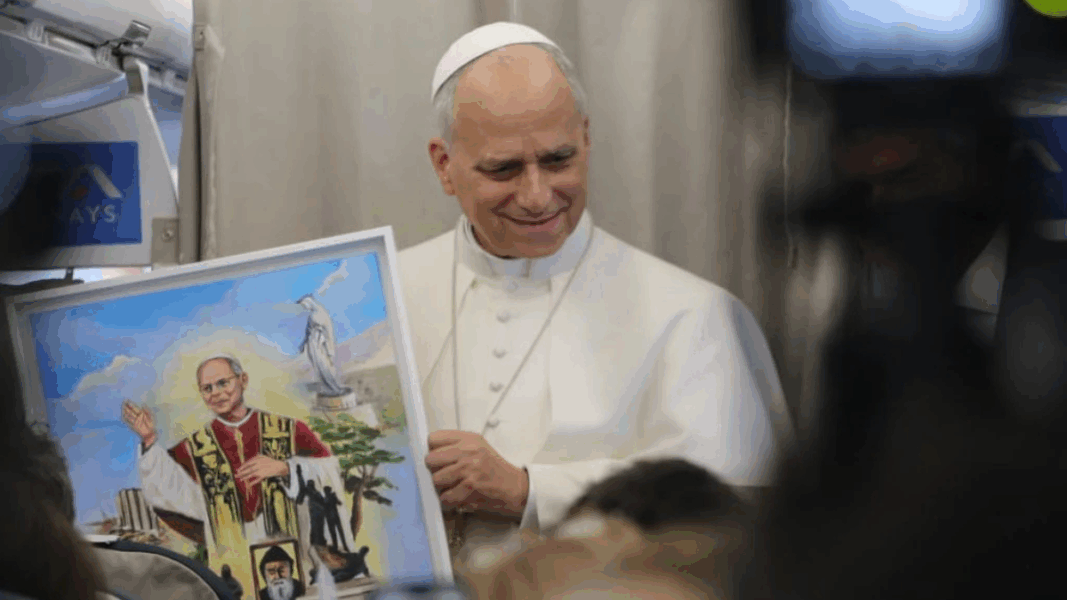
During the return flight from Beirut to Rome, at the end of his apostolic journey to Lebanon, Pope Leo XIV held a press conference with the journalists accompanying him on the plane. Before more than eighty communicators, the Pontiff answered questions about the situation in the Middle East, the war in Ukraine, Europe’s role in peace negotiations, the crisis in Venezuela, and the call for dialogue between religions, especially between Christians and Muslims.
We leave below the complete transcription of the questions and answers disseminated by Vatican News:
Pope Leo XIV: First of all, I want to thank everyone who has worked so hard. I would like you to convey this message to the other journalists as well, both in Turkey and in Lebanon, who have worked to communicate the important messages of this journey. You all deserve a strong round of applause for this trip too.
Joe Farchakh (LBC International): You are an American Pope who is leading a peace process. My question is whether you will use your contacts with President Donald Trump and Prime Minister Benjamin Netanyahu. On the plane, you said that the Vatican is a friend of Israel. Will you raise the issue of stopping Israel’s aggression against Lebanon? Is sustainable peace possible in the region?
Pope Leo XIV: First of all, yes, I believe that sustainable peace is possible. I believe that when we talk about hope, when we talk about peace, when we look to the future, we do so because it is possible for peace to return to the region and to your country, Lebanon.
In fact, I have already had some conversations with some of the leaders of the countries you mentioned, and I intend to continue doing so, personally or through the Holy See, because the fact is that we have diplomatic relations with most of the countries in the region and, without a doubt, it would be our desire to continue raising this call for peace that I spoke about at the end of today’s Mass.
Imad Atrach (Sky News Arabia): In your last speech, there was a clear message to the Lebanese authorities to negotiate. Negotiate, dialogue, build. Will the Vatican do something concrete in this regard? Last night you met with a Shiite representative. Before your trip, Hezbollah sent you a message, I don’t know if you received it, if you read it. What can you tell us about it? Thank you very much for visiting Lebanon, it was a dream for us.
Pope Leo XIV: One aspect of this trip that was not the main reason, because the trip arose thinking about ecumenical issues, with the theme of Nicaea, the meeting with the Catholic and Orthodox patriarchs and the search for unity in the Church. But, in fact, during this trip I also had personal meetings with representatives of different groups that represent political authorities, people or groups that have something to do with internal or even international conflicts in the region.
Our work is not mainly something public that we declare in the streets, but rather it develops a bit behind the scenes. It is something we have already done and will continue to do to convince the parties to put down their weapons, violence, and sit together at the table of dialogue. To seek answers and solutions that are not violent, but that can be more effective.
(The message from Hezbollah)
Yes, I have seen it, evidently there is a proposal from the Church for them to put down their weapons and for us to seek dialogue. But beyond that, I prefer not to make comments at this time.
Cindy Wooden (CNS): Holy Father, a few months ago you said that there is much to learn to be Pope. When you arrived yesterday in Harissa, with a warm welcome, you had the expression of someone saying: “Wow!” Can you tell us what you are learning? What is the most difficult thing to learn to be Pope? And you have never told us anything about what you felt in the conclave when it became clear what was happening. Can you tell us something about it?
Pope Leo XIV: Well, my first comment is that just one or two years ago I was also thinking about retiring someday. Evidently, you have received this gift, while some of us will continue working (a joke referring to the fact that his colleague will retire in December, n.d.r.).
Regarding the conclave, I firmly believe in the secrecy of the conclave, although I know that there have been public interviews in which some things have been revealed. The day before being elected, a journalist who stopped me on the street asked me if I had gone to lunch with the Augustinians. And she asked me: “You have become one of the candidates! What do you think about that?” And I simply replied: “Everything is in God’s hands.” And I deeply believe that.
One of you, who is a German journalist, told me the other day here: “Tell me a book, besides St. Augustine, that we can read to understand who Prevost is.” There are many, but one of them is a book called The Practice of the Presence of God.
It is a very simple book, by someone who doesn’t even sign with his last name, Brother Lawrence, written many years ago. But it describes a type of prayer and spirituality in which one simply surrenders one’s life to the Lord and allows the Lord to guide it.
If you want to know something about me, about what my spirituality has been for many years, in the midst of great challenges, living in Peru during the years of terrorism, being called to serve in places where I never thought I would be called to serve. I trust in God and this message is something I share with all people.
So, how was it? I surrendered when I saw how things were going and said that this could become a reality. I took a deep breath and said: here we are, Lord, you are the boss, you guide the way.
I don’t know if I said “wow” last night (in Harissa). In the sense that my face is very expressive, but I often amuse myself with how journalists interpret my face. It’s interesting, sometimes I get great ideas from you, because you think you can read my thoughts or my face. You’re not always right.
I was at the Jubilee of Youth, there were more than a million young people there. Last night there was a small crowd. For me, it is always wonderful. I think to myself: “These people are here because they want to see the Pope,” but then I tell myself: “They are here because they want to see Jesus Christ” and they want to see a messenger of peace, especially in this case. Therefore, just feeling their enthusiasm and hearing their response to that message is impressive. I only hope I never get tired of appreciating everything these young people are showing.
Gian Guido Vecchi (Corriere della Sera): These are hours of great tension between NATO and Russia, talk of hybrid war, prospects of cyberattacks and the like. Do you see the risk of an escalation, of a conflict carried out with new means as denounced by NATO leaders? And, in this climate, can there be a negotiation for a just peace without Europe, which has been systematically excluded by the US presidency in these months?
Pope Leo XIV: This is evidently an important topic for peace in the world, but the Holy See does not participate directly because we are not members of NATO, nor of all the dialogues held so far. Although many times we have called for a ceasefire, dialogue and not war. And a war with many aspects, now even with the increase in weapons, all the production there is, cyberattacks, energy.
Now that winter is coming, there is a serious problem there. It is evident that, on one hand, the President of the United States believes he can promote a peace plan that he would like to carry out and that, at least initially, does not include Europe. However, Europe’s presence is important and that first proposal was also modified by what Europe was saying.
Specifically, I believe that Italy’s role could be very important. Culturally and historically, Italy has the capacity to act as a mediator in a conflict between different parties. Also Ukraine, Russia, the United States… In this sense, I could suggest that the Holy See promote this type of mediation and that we seek together a solution that can really offer peace, a just peace, in this case in Ukraine.
Elisabetta Piqué (La Nación): Thank you, Holy Father, for this first international trip, first of all. Then, well, the Lebanese flag has the same colors as the Peruvian flag. Is it a sign of, is this trip to Latin America going to happen, theoretically in the second half of next year along with Argentina and Uruguay which are pending? No, joking aside, we wanted to ask you what trips you are preparing for next year really. And then, speaking of Latin America, it is worrying a lot, there is a lot of tension over what is happening in Venezuela. There is an ultimatum from President Trump to Maduro to leave, to step down from power, and a threat to overthrow him with a military operation. We wanted to ask you what you think about it. Thank you.
Pope Leo XIV: Regarding the trips, nothing is certain, I hope to make a trip to Africa. Possibly it will be the next trip.
Where to?
Africa, Africa. Personally, I hope to go to Algeria to visit the places of St. Augustine, but also to be able to continue the dialogue, the building of bridges between the Christian world and the Muslim world. Already in the past, on another occasion, I had the opportunity to speak on this topic.
It is interesting, the figure of St. Augustine helps a lot as a bridge because in Algeria he is very respected as a son of the homeland. That is one. Then, there is some other country, but we are working on it. Evidently, I would very much like to visit Latin America, Argentina and Uruguay, which are waiting for the Pope’s visit. Peru, I think they will receive me, and if I go to Peru also many neighboring countries, but the project is not yet defined.
Regarding Venezuela, at the level of the Episcopal Conference, with the nuncio, we are seeking ways to calm the situation, seeking above all the good of the people because, many times, those who suffer in these situations are the people, not the authorities. The voices coming from the United States change and quite frequently, sometimes you have to see.
On one hand, it seems there has been a phone conversation between the two presidents. On the other hand, there is that danger, that possibility of some activity, some operation, even invading Venezuelan territory.
I don’t know more, I again believe that it is, let’s say, better to seek ways of dialogue, perhaps pressure, even economic pressure, but seeking another way to change, if that is what the United States decides to do.
Mikail Corre (La Croix): Thank you for this interesting trip. You have said that bridges must continue to be built between different worlds. I would like to ask you: some Catholics in Europe believe that Islam is a threat to the Christian identity of the West. Are they right or what would you say to them?
Pope Leo XIV: All the conversations I have had these days, both in Turkey and in Lebanon, including those I have had with several Muslims, have focused on the theme of peace and respect for people of different religions. I know that it has not always been this way.
I know that in Europe there are many fears, but most of the time they are generated by people who are against immigration and who try to keep out people who may come from another country, another religion, another race. And in this sense, I would like to say that we all need to work together.
One of the positive things about this trip is having drawn the world’s attention to the possibility that dialogue and friendship between Muslims and Christians are possible. I believe that one of the great lessons that Lebanon can teach the world is precisely to show a land in which Islam and Christianity are present and respect each other, and in which there is the possibility of living together and being friends.
The stories and testimonies we have heard in these last two days are of people who help each other. Christians and Muslims, both have seen their villages destroyed, for example, and they told us that we can be together and work together.
I believe this is an important lesson that we must listen to in Europe and North America. Perhaps we should have a little less fear and seek ways to promote authentic dialogue and respect.
Anna Giordano (Ard Radio): The Church in Lebanon also counts on the support of the Church in Germany. For example, there are some German aid agencies active in Lebanon. From this point of view, it is important that the Church in Germany remains a strong Church. As you surely know, there is a synodal way, Synodaler Weg, a process of change in the Church in Germany, which is advancing. Do you think this process can be a way to strengthen the Church or is it the opposite? And why?
Pope Leo XIV: The synodal way is not the only one in Germany, the whole Church has celebrated a synod and synodality in recent years. There are great similarities, but also some marked differences between how the Synodaler Weg has been carried out in Germany and how it could better continue in the Universal Church.
On one hand, I would like to say that there is room for respect for inculturation. The fact that in one place synodality is lived in one way and in another in another way does not mean that there has to be a break or a fracture. I think it is very important to remember this.
At the same time, I fear that many Catholics in Germany believe that certain aspects of the synodal way celebrated so far in Germany do not represent their hopes for the Church or their way of living the Church.
Therefore, greater dialogue and listening within Germany itself is necessary, so that no voice is excluded, so that the voice of the most powerful does not silence the voice of those who may be very numerous, but who do not have a place to speak and be heard. In this way, it will be ensured that their own voices and expressions of participation in the Church are heard.
At the same time, as you surely know, the group of German bishops has met in recent years with a group of cardinals from the Roman Curia. There too, a process is being carried out to try to ensure that the German Synodal Way does not stray, so to speak, from what should be considered a path of the universal Church.
I am sure it will continue. I believe there will be some adjustments on both sides in Germany, but I sincerely hope that things will be resolved in a positive way.
Rita El-Mounayer (Sat-7 International): We are four different Christian broadcasting channels in the Middle East and North Africa, two in Arabic, one in Farsi and one in Turkish. First of all, I would like to thank you for dedicating your time to the Lebanese people. I myself am a daughter of war and I know what it means to receive a hug from Your Holiness, a pat on the back and to be told that everything will be fine. What has impressed me is your motto In Illo Uno Unum. This motto speaks of building bridges between different Christian confessions, between religions and even between neighbors, which can sometimes be a bit difficult. From your point of view, what unique gift can the Church in the Middle East—with all its tears, its wounds, its challenges and its past history—offer to the Church in the West and to the world?
Pope Leo XIV: I would like to start by saying that nowadays people have grown up in a very individualistic society. Young people, who have spent a lot of time (in front of the computer, n.d.r.) during the Covid pandemic and who often have very isolated personal relationships, because they only communicate through computer screens or smartphones, sometimes ask themselves: “Why should we want to be one? I am an individual and I am not interested in others.”
And I believe that here there is a very important message to convey to all people: unity, friendship, human relationships, communion are extremely important and extremely valuable. If nothing else, for the example you cited of someone who has lived through war or has suffered and is suffering, what a hug can mean for them. That very human, real and healthy expression of personal care to heal another person’s heart.
At a personal level, this can become a community level that unites us all and helps us understand and respect each other, going far beyond the simple: “You stay away, I stay here, you stay there and we don’t interact.” It means, instead, building relationships that enrich all people.
With this message, without a doubt, my motto is thanks to Christ in Illo it is “in Christ, who is one, we are all one.” But it is not only for Christians.
In fact, it is an invitation to all of us and to others to say that the more we can promote authentic unity and understanding, respect and human relationships of friendship and dialogue in the world, the greater the possibility that we will set aside the weapons of war, that we will set aside distrust, hatred and animosity that have so often developed, and that we will find a way to unite and promote authentic peace and justice throughout the world.
Good trip to all and thank you all.