


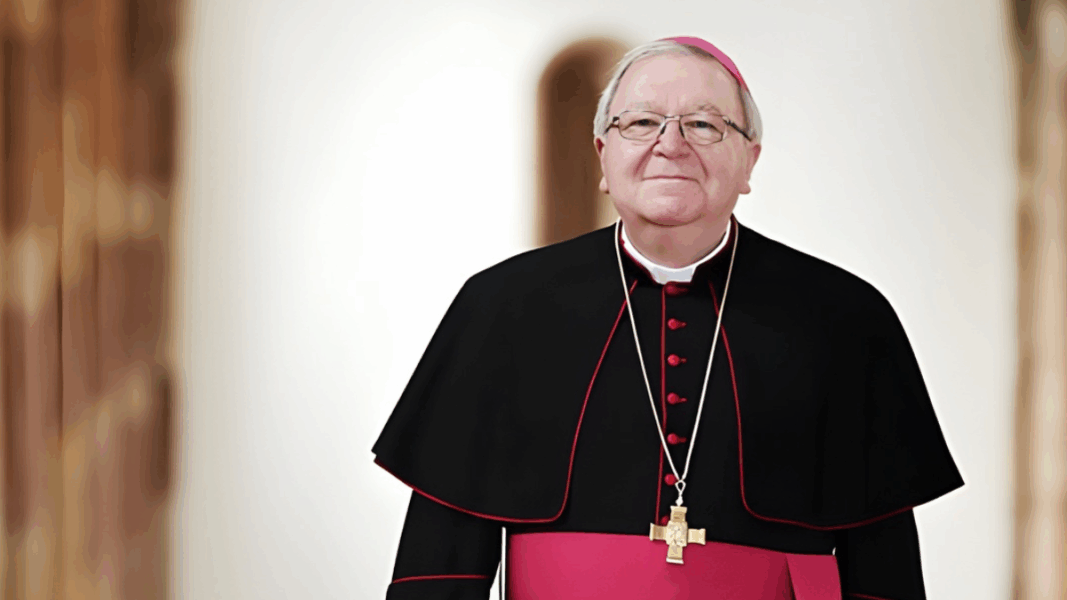
The Vatican announced this Tuesday that the Pope has accepted the resignation of Mons. Otto Georgens, auxiliary bishop of Speyer (Germany), who is leaving the position after turning 75, as provided for by Canon Law. This is a replacement that has been anticipated for months by the diocese itself, which had reported that the prelate would submit his resignation upon reaching the age limit established for bishops.
The decision does not respond to any disciplinary reason or extraordinary circumstances: it is part of the Church’s usual practice and marks the end of a stage of more than three decades of episcopal service.
An “in-house” auxiliary with more than thirty years of service
Mons. Georgens is a well-known figure within the Bistum Speyer, where he was born, trained, and developed practically his entire priestly life. Ordained in 1977, he served for years as secretary to two bishops of the diocese before taking on pastoral responsibilities as a parish priest and dean.
In 1995, St. John Paul II appointed him auxiliary bishop and titular bishop of Gubaliana. Since then, he has accompanied four decades of diocesan life, both in times of stability and moments of transition. In 2007, after the resignation of Bishop Anton Schlembach, the chapter elected him diocesan administrator, entrusting him with interim governance until the arrival of his successor, Mons. Karl-Heinz Wiesemann.
In addition to his work in Speyer, Georgens has held responsibilities within the German Episcopal Conference, particularly in the commissions on Liturgy and the Universal Church, as well as in issues of cooperation and development linked to episcopal works.
A critical view of the episcopal model and faith in real synodality
Beyond his institutional duties, in December 2020—upon turning 70—Georgens gave an interview to the German portal katholisch.de, in which he spoke openly about his reservations regarding the structure of the German Episcopal Conference (DBK) and offered a prudent but positive reading of the Synodal Way.
In that interview, he stated that the DBK suffers from an excess of centralism: there is “too much focus on the president” and the dynamic “does not favor plurality or authentic debate.” According to Georgens, the Church in Germany should learn from the French experience, where the separation of Church and State has forced a more humble Church, closer to the people and not dependent on large structures, but on real presence in the communities.
Regarding the Synodal Way, Georgens declared: the questions that emerge—about the exercise of power, participation, priestly life, women’s access to offices, sexual morality, the Church in society—“are the right ones.” He defended that these topics must be debated publicly, with sincerity, and that internal divergence should not be seen as enmity, but as part of the path toward unity. But he warned: synodality cannot be reduced to administrative or structural changes; it must above all be a spiritual process, of interior conversion, humility, and mercy.
For him, the challenge is not to impose uniformity, but to build a unity that accepts the legitimate diversity of voices, with freedom to express differences but with mutual respect. In his words: the Church needs less “green papers with decision pre-projects” and more “discussion in small groups,” more closeness and real listening.
A foreseen resignation and an active retirement
The Diocese of Speyer had confirmed weeks earlier that Mons. Georgens would submit his resignation due to age upon turning 75, as stipulated by canon 401 §1. Leo XIV’s acceptance occurs on the same day as his birthday.
Far from a complete withdrawal, the diocese has indicated that the new emeritus bishop will continue to collaborate in local pastoral life, celebrating Mass in the cathedral and various parishes, as well as helping with preaching and celebrations when necessary.
For his part, Bishop Wiesemann has indicated that, for the time being, he will not request a new auxiliary bishop from the Vatican, a decision that responds to the process of simplifying pastoral structures that many German dioceses are implementing in the face of the decrease in clergy and territorial reorganization.
A figure appreciated for his discreet service
Throughout his episcopal ministry, Mons. Georgens has been characterized by a discreet style, focused on sacramental life, the training of consecrated life, and attention to parishes. His spiritual affinity with authors like Madeleine Delbrêl, about whom he has written and edited texts, has marked his preaching and pastoral vision, especially oriented toward the everyday life of the laity.
His prolonged stay in diocesan governance—he is one of Germany’s most veteran auxiliaries—explains the positive appreciation expressed by both Bishop Wiesemann and the cathedral chapter.