


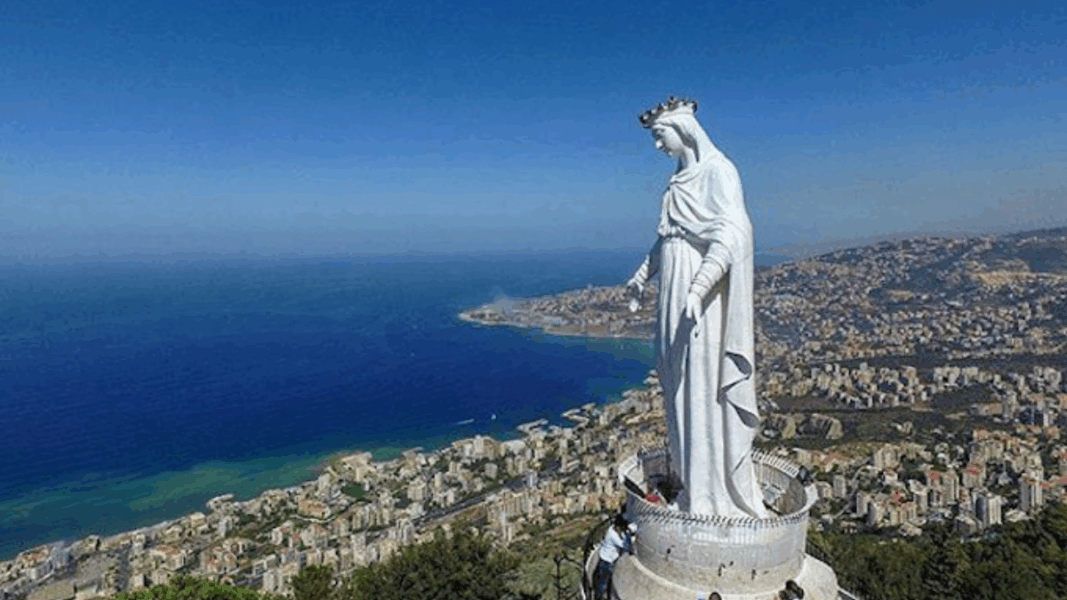
After his visit to Annaya, Pope Leo XIV moved this morning to the sanctuary of Our Lady of Lebanon, in Harissa, for a meeting with bishops, priests, religious men and women, and pastoral agents of the country. Upon his arrival, the Pontiff was received at the main entrance by the apostolic vicar of the Latins in Beirut, the superior of the Congregation of Lebanese Missionaries, and the rector of the sanctuary, who presented him with the cross and holy water for the aspersion.
The Pope then walked down the central nave to the presbytery, where he was welcomed by the patriarch of the Armenian Catholic Church while the choir intoned a hymn. The Patriarch of Cilicia of the Armenians offered an initial greeting, followed by interventions from a priest, a pastoral agent, the director of a Catholic school, and a penitentiary chaplain. After the reading of the Gospel, Leo XIV delivered his homily.
Subsequently, the Holy Father presented the Golden Rose to the sanctuary, imparted the blessing, and received the scheduled gifts before posing for photos with the bishops of the APECL. Before departing, he blessed the cornerstone of the “City of Peace” project, promoted by Tele Lumière and Noursat. Afterward, he traveled by car to the apostolic nunciature.
A Church Responsible for Hope
In his homily, the Pope recalled that the motto of his trip—“Blessed are the peacemakers”—also defines the vocation of the Church in Lebanon, which he described as “an icon of these words.” He quoted St. John Paul II, who stated that the Lebanese are “responsible for hope” and called to create a fraternal climate capable of overcoming division through forgiveness and mercy.
Leo XIV thanked the testimonies heard during the meeting, which show— he said—that communion continues to be built amid difficulties. He pointed out that the root of this perseverance is found in the life of prayer, guided by the intercession of the Virgin Mary and the example of St. Charbel.
Faith as an Anchor in Times of Uncertainty
The Pope developed the image of the anchor—one of the symbols of the trip—as a sign of the faith that sustains in moments of darkness. Quoting his predecessor Francis, he recalled that the life of the believer is “anchored in heaven,” and that this certainty allows one to love without fear and give without measure even in difficult circumstances.
From that solid faith, compared to the depth of the Lebanese cedars, springs— he affirmed—the capacity to generate lasting works of solidarity.
Testimonies of Charity Amid the Crisis
The Holy Father mentioned the testimony of Father Youhanna in Debbabiyé, where Christians and Muslims coexist and help each other despite poverty and bombings. The Syrian coin found in the parish collection, he indicated, symbolizes that in charity everyone has something to offer and receive. He quoted Benedict XVI to recall that, even in trial, love can overcome hatred and the desire for revenge.
He also highlighted the work of those who support migrants, mentioning the testimony of Loren and the story of James and Lela, which— he said—show both the horror of war and the light of God that shines even in the darkest night. He insisted that no one should be forced to flee their country and that those who arrive in Christian communities must be welcomed with respect and closeness.
Education, Mercy, and Commitment to Youth
The Pope valued the testimony of Sister Dima, who kept a school open amid the violence, turning it into a place of welcome and learning. He emphasized the importance of the Church’s educational mission in Lebanon and asked for decisions guided by charity to attend especially to those who lack means.
He recalled that “the first school is the cross and the only Teacher is Christ,” and asked to give prominence to young people in ecclesial structures, offering them real prospects for the future.
In reference to prison apostolate, he noted that in the faces of inmates is reflected the mercy of the Father. That spirit of closeness and consolation— he said—is the perfume of Christ that Christians must bring to the world, an aroma accessible to all and the fruit of shared life.
We now leave below the complete homily of Leo XIV:
Dear brothers in the episcopate,
priests, religious men and women,
brothers and sisters, good morning!
With great joy I meet with you during this trip, whose motto is “Blessed are the peacemakers” (Mt 5:9). The Church in Lebanon, united in its multiple faces, is an icon of these words, as St. John Paul II affirmed, so affectionate toward your people: “In the Lebanon of today—you are responsible for hope” (Message to the citizens of Lebanon, May 1, 1984); and he added: “Believe, where you live and work, in a fraternal climate. Without naivety, know how to trust in others and be creative so that the regenerating force of forgiveness and mercy may triumph” (ibid.).
The testimonies we have heard—thank you to each one of you—tell us that these words have not been in vain, but have found listening and response, because here communion continues to be built in charity.
In the words of the Patriarch, whom I thank from the heart, we can grasp the root of this tenacity, symbolized by the silent grotto in which St. Charbel prayed before the image of the Mother of God, and by the presence of this Sanctuary of Harissa, a sign of unity for all the Lebanese people. Remaining with Mary at the foot of Jesus’ cross (cf. Jn 19:25), our prayer—invisible bridge that unites hearts—gives us the strength to continue hoping and working, even when around us the noise of weapons rumbles and the demands of everyday life become a challenge.
One of the symbols featured in the “logo” of this trip is the anchor. Pope Francis often evoked it in his speeches as a sign of faith, which allows us to always go further, even in the darkest moments, to heaven. He said: “Our faith is the anchor in heaven. We have our life anchored in heaven. What must we do? Grab the rope […]. And we go forward because we are sure that our life has, as it were, an anchor in heaven, on that shore to which we will arrive” (Catechesis, April 26, 2017). If we want to build peace, let us anchor ourselves to heaven and, firmly directed toward it, love without fear of losing the ephemeral and give without measure.
From these roots, strong and deep like those of the cedars, love grows and, with God’s help, concrete and lasting works of solidarity come to life.
Father Youhanna spoke to us about Debbabiyé, the small village where he exercises his ministry. There, despite extreme need and under the threat of bombings, Christians and Muslims, Lebanese and refugees from across the border, live peacefully together and help each other mutually. Let us pause on the image he himself suggested, that of the Syrian coin found in the alms bag along with the Lebanese ones. It is an important detail: it reminds us that in charity each of us has something to give and to receive, and that giving ourselves to one another enriches us all and brings us closer to God. Pope Benedict XVI, during his trip to this country, speaking of the unifying power of love even in moments of trial, said: “Now is precisely the time to celebrate the victory of love over hatred, of forgiveness over vengeance, of service over domination, of humility over pride, of unity over division. […] Know how to convert our suffering into a cry of love to God and of mercy toward our neighbor” (Speech during the visit to the Basilica of St. Paul in Harissa, September 14, 2012).
It is the only way not to feel crushed by injustice and oppression, even when, as we have heard, we are betrayed by people and organizations that unscrupulously speculate on the desperation of those who have no alternatives. Only in this way can we hope again for tomorrow, despite the harshness of a present that is difficult to face. In this regard, I think of the responsibility we all have toward young people. It is important to foster their presence, also in ecclesial structures, appreciating their contribution of novelty and giving them space. And it is necessary, even amid the rubble of a world with painful failures, to offer them concrete and viable prospects for rebirth and growth for the future.
Loren spoke to us about her commitment to helping migrants. She herself a migrant, long committed to supporting those who, not by choice but by necessity, have had to leave everything to seek, far from home, a possible future. The story of James and Lela, which she told us, deeply moves us and shows the horror that war produces in the lives of so many innocent people. Pope Francis has reminded us on several occasions, in his speeches and writings, that in the face of such dramas we cannot remain indifferent, and that their pain concerns us and challenges us (cf. Homily on the World Day of Migrants and Refugees, September 29, 2019). On one hand, their courage speaks to us of the light of God that, as Loren said, shines even in the darkest moments. On the other hand, what they have lived obliges us to commit ourselves so that no one has to flee their country due to absurd and ruthless conflicts, and so that whoever knocks on the door of our communities never feels rejected, but welcomed with the words that Loren herself quoted: “Welcome home!”.
This is also what the testimony of Sister Dima speaks to us about, who in the face of the outbreak of violence decided not to abandon the field, but to keep the school open, turning it into a place of welcome for refugees and an educational center of extraordinary effectiveness. In those classrooms, in addition to offering assistance and material help, one learns and teaches to share “bread, fear, and hope,” to love amid hatred, to serve even in tiredness, and to believe in a different future beyond all expectation. The Church in Lebanon has always paid great attention to education. I encourage you all to continue this praiseworthy work, assisting above all those in need and those who lack means, those in extreme situations, with decisions guided by the most generous charity, so that the formation of the mind is always united to the education of the heart. Let us remember that our first school is the cross and that our only Teacher is Christ (cf. Mt 23:10).
Father Charbel, in this regard, speaking of his experience of apostolate in prisons, said that precisely there, where the world sees only walls and crimes, in the eyes of the inmates—sometimes lost, sometimes illuminated by a new hope—we see the tenderness of the Father who never tires of forgiving. And so it is: we see the face of Jesus reflected in the face of those who suffer and of those who care for the wounds that life has caused. In a short while we will perform the symbolic gesture of presenting the Golden Rose to this Sanctuary. It is an ancient gesture that, among other meanings, has that of exhorting us to be the perfume of Christ with our life (cf. 2 Co 2:14). Before this image, the perfume that emanates from Lebanese tables comes to mind, typical for the variety of foods they offer and for the strong communal dimension of sharing them. It is a perfume composed of thousands of aromas, surprising for their diversity and, sometimes, for their ensemble. Thus is the perfume of Christ. It is not an expensive product reserved for a few who can afford it, but the aroma that comes from a generous table with many different dishes from which everyone can serve together. May this be the spirit of the rite we are about to celebrate and, above all, the spirit with which each day we strive to live united in love.