


«In Spain a secularism has been born, an anticlericalism, a strong and aggressive secularism, as we saw precisely in the thirties»
Benedict XVI (November 6, 2010)
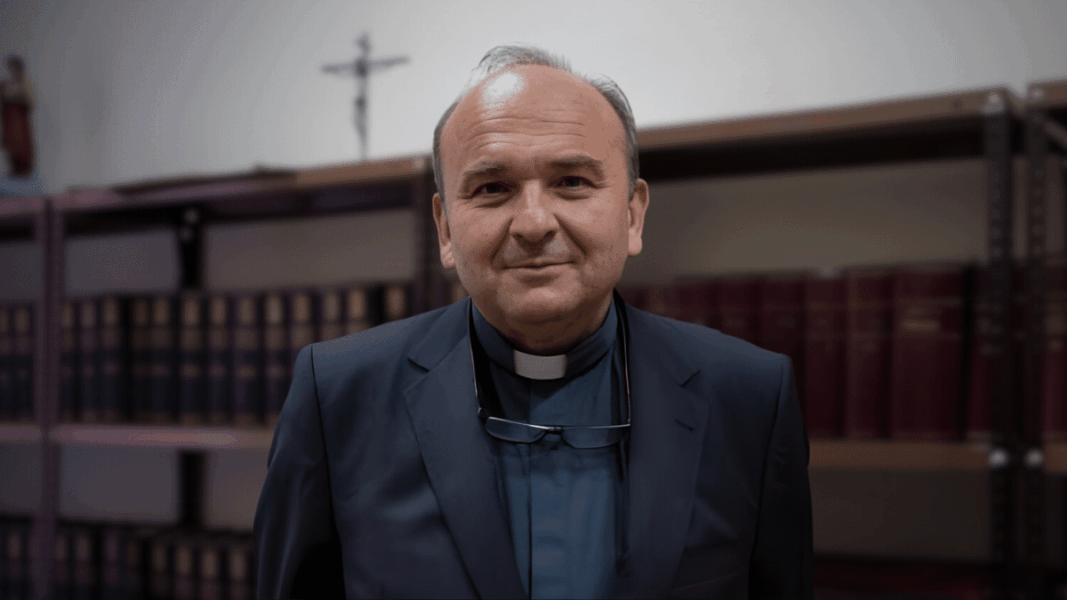
Recalling the words of Benedict XVI, the priest Juan Carlos Guirao —former chaplain of the Faculty of Philosophy and Philology at the Complutense University of Madrid— reflects on the political and social situation in Spain, denouncing an ideological drift that —in his view— erodes fundamental freedoms and dangerously recalls the darkest episodes of our recent history. His critique, published in Periodista Digital, anchored in the words of Ratzinger and in the testimony of martyrs and confessors of the 20th century, denounces the advance of a “strong and aggressive” secularism that threatens to transform the Rule of Law into a regime subjected to ideological engineering.
Guirao evokes the statements of Benedict XVI from November 6, 2010, when the Pope warned that in Spain a pattern similar to the anticlericalism of the thirties was emerging. Fifteen years later, he maintains that this warning not only retains full validity, but the situation has worsened. The priest calls for an active vigilance stance on the part of all the country’s institutions —judges, journalists, political leaders, security forces, and civil society— to prevent crossing the border that separates a democracy from an authoritarian model.
The priest also recalls the warnings of those who live under dictatorial regimes: the first thing that is lost is the perception of danger. Cuba, Venezuela, or Nicaragua —he says— are concrete examples of societies that underestimated the threat and ended up trapped in systems that are difficult to reverse. For Guirao, Spain must learn from that experience and not allow ideological discourse to supplant legality, real historical memory, or freedom of conscience.
In this context, he expresses explicit thanks to those who, from their public responsibility, continue to act with integrity: judges who maintain their independence despite pressures, journalists who report with rigor, police forces that do not allow themselves to be intimidated, and citizens who serve on popular juries without yielding to threats or attempts at manipulation. For the priest, that “silent bulwark” is today an essential piece in the defense of the constitutional order.
Men of faith who stood firm
Guirao places this resistance in continuity with the testimony of great figures of the Church who confronted the totalitarianism of the 20th century. He cites Mindszenty, Van Thuan, the blessed Wyszynski, Saint Maximilian Kolbe, Saint John Paul II, Saint Óscar Romero, the blessed Jerzy Popieluszko, and the blessed Clemens von Galen, “the lion of Münster”. All of them —he recalls— were men of faith who “did not act for praise or out of fear”, and remained incorruptible in the face of regimes that persecuted religious freedom and human dignity. Their example, he adds, is an antidote to the “social, cultural, and ecclesial inanity” left behind by ideologized systems.
The priest also includes the nearby testimony of two Spanish presbyters —Federico Santamaría Peña and Lucio Herrero Camarena— executed during the religious persecution of the thirties and now in an advanced beatification process. In them he sees a reminder that fidelity to the priestly mission sometimes requires a total self-giving.
The Democratic Memory Law
Guirao directly points to the Democratic Memory Law as one of the contemporary instruments of that secularist drift. He considers that its ideological orientation curtails freedoms, rewrites history, and even affects ecclesiastical assets, operating under criteria that attack the truth and the dignity of people. To substantiate his critique, he cites the thought of Saint John Paul II in Memory and Identity, where the Pontiff stated that no society can build its future by destroying its roots, and that positive law must always be subordinated to universal ethical principles.
The priest culminates with a forceful reflection on the role of the Church. Paraphrasing Thoreau, Guirao maintains that, when a State promotes unjust laws or acts as an agent of immorality, “the only house in which one can remain with honor is jail”. That is, fidelity to the truth and the defense of human dignity do not admit collaboration with structures that seek to impose an ideology contrary to the Christian foundations of society.
With his warning, Guirao invites a deep reflection on the moment Spain is going through: a time that demands moral clarity, civic courage, and a firm defense of freedom in the face of the pressure of ideological projects that seek to reconfigure society from a reinterpreted memory and an exclusionary secularism.