


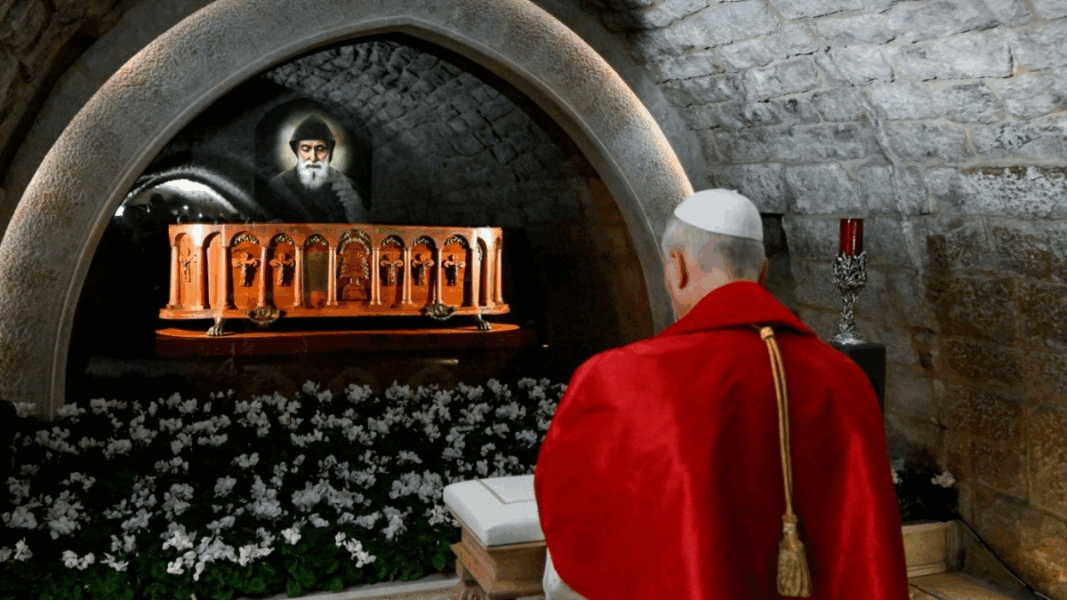
Pope Leo XIV visited the Maronite monastery of Saint Maron, in Annaya, this Monday, December 1, where the remains of Saint Charbel Maklouf rest. The Pontiff arrived at the site by car and popemobile in the morning. Upon his arrival, he was received by the superior of the convent and by the superior general of the Lebanese Maronite Order, who accompanied him inside the premises.
Before entering the chapel that houses the saint’s tomb, the Pope was greeted by the President of the Republic of Lebanon and his wife. After an entrance chant and a moment of silent prayer before the tomb, the superior general, Abbot Mahfouz Hady, gave the official welcome to the Holy Father, who later delivered his greeting.
The Pope’s message: prayer, humility, and conversion
In his address, Leo XIV thanked for the welcome and stated that he was arriving as a pilgrim to the tomb of Saint Charbel, whose testimony he defined as a legacy for the universal Church. He highlighted that, despite having led a hidden and silent life, the Lebanese saint teaches essential attitudes for Christian life: prayer for those who live far from God, silence amid noise, modesty in the face of appearances, and poverty in the face of the desire for riches.
The Pope emphasized that the example of Saint Charbel particularly challenges bishops and priests due to the evangelical radicality of his coherence, although his message—as he said—reaches all the baptized.
He also recalled the importance of the saint’s intercession, who in life was sought by numerous faithful in search of consolation and advice, and whose devotion, after his death, has grown to the point of turning Annaya into a monthly pilgrimage destination for thousands of people.
Prayer for the Church, Lebanon, and the Middle East
Leo XIV asked to place under the intercession of Saint Charbel the needs of the Church and the world. For the Church, he especially requested communion and unity—from families to parish communities and the universal Church—while for the world he implored the gift of peace, with a particular remembrance for Lebanon and the entire Middle East.
The Pope affirmed that “there is no peace without conversion of the heart” and called to ask for that gift for all the faithful, trusting in the help of the Lebanese saint to orient life toward God.
As a symbolic gesture, Leo XIV offered a votive lamp to the monastery, stating that it represents the light that Saint Charbel spiritually kindled in the country. He entrusted to the saint the protection of the Lebanese people “so that they may always walk in the light of Christ”.
Visit to the museum and continuation of the itinerary
After the final prayer and the delivery of a gift to the Pope, the superior of the convent accompanied Leo XIV on a visit to the monastery museum, where historical objects and relics linked to the saint’s life are preserved.
Upon concluding the visit, the Pontiff departed by car to the sanctuary of Our Lady of Lebanon, in Harissa, to continue with his official program in the country.
We leave below the complete words of Leo XIV:
Dear brothers and sisters:
I thank the Superior General for his words and his hospitality in this beautiful Monastery of Annaya. The nature surrounding this house of prayer also attracts us with its austere beauty.
I give thanks to God for granting me to come as a pilgrim to the tomb of Saint Charbel. My predecessors—especially Saint Paul VI, who beatified and canonized him—would have desired it greatly.
Dear brothers, what does Saint Charbel teach us today? What is the legacy of this man who wrote nothing, who lived hidden and silent, but whose fame spread throughout the world?
I would like to summarize it like this: the Holy Spirit molded him to teach prayer to those who live without God, silence to those who dwell amid the hustle and bustle, modesty to those who live to appear, and poverty to those who seek riches. They are all countercultural behaviors, but precisely for that reason they attract us, like fresh and pure water attracts one who walks through the desert.
In particular, to us, bishops and ordained ministers, Saint Charbel reminds us of the evangelical demands of our vocation. However, his coherence, as radical as it is humble, is a message for all Christians.
And then, there is another decisive aspect: he never ceased to intercede for us before the heavenly Father, source of all good and all grace. Already from his earthly life, many came to him to receive from the Lord consolation, forgiveness, and advice. After his death, all this multiplied and has become a river of mercy. Also for that reason, every 22nd of the month, thousands of pilgrims come here from different countries to spend a day of prayer and rest for the soul and body.
Sisters and brothers, today we want to entrust to the intercession of Saint Charbel the needs of the Church, of Lebanon, and of the world. For the Church we ask for communion, unity; starting from families, small domestic churches, and then in parish and diocesan communities; and also for the universal Church. Communion, unity. And for the world we ask for peace. We especially implore it for Lebanon and for the entire Middle East. But we know well—and the saints remind us—that there is no peace without conversion of hearts. Therefore, may Saint Charbel help us to orient ourselves toward God and to ask for the gift of conversion for all of us.
Dear brothers, as a symbol of the light that God has kindled here through Saint Charbel, I have brought a lamp as a gift. In offering it, I entrust to the protection of Saint Charbel Lebanon and its people, so that they may always walk in the light of Christ. Thanks to God for the gift of Saint Charbel. Thanks to you who preserve his memory. Walk in the light of the Lord!