


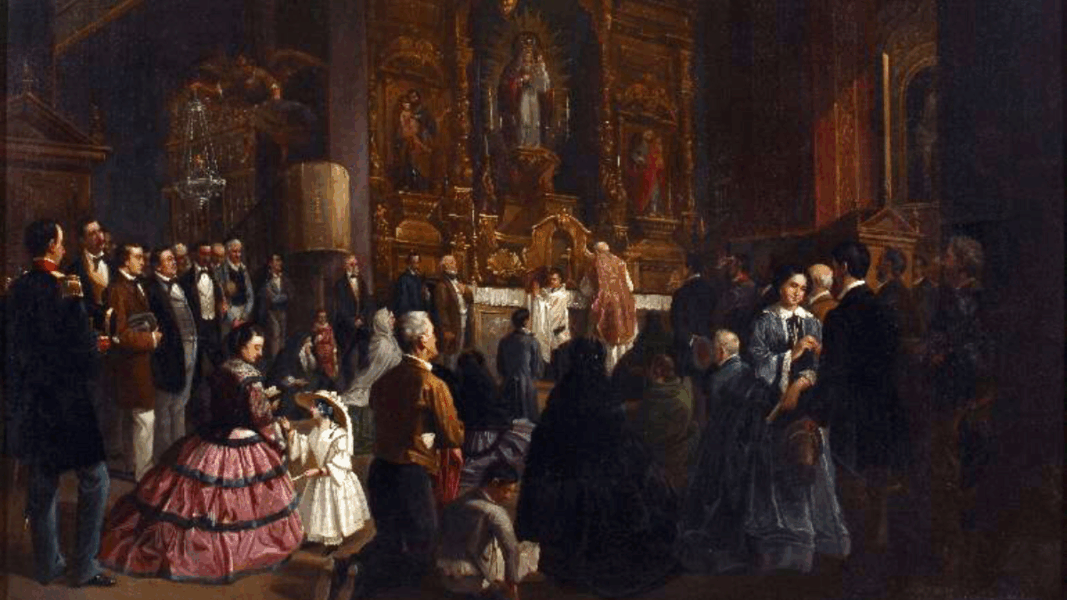
The writer and specialist in sacred music Peter Kwasniewski, one of the most well-known voices in defense of traditional liturgy, has published an extensive analysis on the current situation of the Traditional Latin Mass (TLM) and the reasons that, in his view, explain the restrictions that continue to affect these communities. His reflection comes at a time marked by rumors of a pastoral shift under the pontificate of León XIV, which could relax the conditions imposed by Traditionis Custodes. Although there is no official confirmation, these comments—as the author himself recalls—do not alter the current legal reality: the continuity of the Traditional Mass ultimately depends on each diocesan bishop. This scenario, he notes, maintains a fragility even greater than that which existed with the 1988 indult and allows bishops opposed to the ancient rite to continue closing communities, as has recently occurred in various U.S. dioceses.
A central question: why restrict a living and fertile rite
Kwasniewski starts from a concern that he himself says he has experienced for years: why the ecclesiastical hierarchy—or at least an influential part of it—seems hostile toward those Catholics whom it considers among the most practicing and faithful. For him, the question arises from a fact that is hard to ignore: communities that celebrate the Traditional Mass tend to be young, numerous, committed, and generators of vocations. However, far from being valued for their vitality, they are frequently subjected to restrictive measures. This apparent contradiction leads the author to propose a harsh and controversial thesis: in his opinion, these communities suffer pressures precisely because of their fidelity, because their spiritual fruitfulness is uncomfortable for certain ecclesiastical sectors that do not share their vision of the faith or of the liturgy.
A tension between tradition and ecclesiastical modernity
The author frames this conflict in what he considers a profound clash of conceptions about the Church. According to his interpretation, much of the hostility toward the TLM comes from ecclesiastical currents that, for decades, have sought to reformulate doctrine, morality, and liturgy in a sense more aligned with contemporary culture. In contrast to this trend, traditional communities emphasize doctrinal continuity, liturgical solemnity, and moral clarity.
Kwasniewski sees here a frontal opposition: while the traditional liturgy sustains—in his view—a way of living the faith that preserves the deposit received, modernizing sectors would be promoting a profound adaptation that dilutes Catholic identity. For him, the Traditional Mass embodies a visible and theologically grounded resistance to that process. That is why he argues that, far from being a mere liturgical disagreement, what underlies it is a clash with broader doctrinal and spiritual consequences.
Traditionis Custodes and its practical consequences
Kwasniewski’s analysis also reviews the repercussions of Traditionis Custodes and the subsequent documents that have regulated its application. According to the author, the limitations on the use of the TLM have caused the closure of communities, the reduction of places of worship, and a considerable increase in pastoral uncertainty. In his view, although there may be informal flexibilizations in some dioceses, the document’s guiding lines remain and support a theological vision—that he considers gravely erroneous—on the relationship between the two missals. That vision, he asserts, remains operational and maintains constant pressure on those who celebrate or attend the traditional rite.
Kwasniewski emphasizes that, despite the good pastoral results of these communities, such restrictions are justified by appealing to arguments that, from his perspective, are not applied with the same rigor to practices or currents that contradict much more central teachings of the Church. For him, it is striking that severity is exercised toward a rite “of proven orthodoxy” while attitudes and practices openly contrary to the magisterium are tolerated in other areas.
A spiritual reading of the crisis
Beyond his institutional criticisms, Kwasniewski interprets the situation from a broader spiritual key, which he frames in the “mysterium iniquitatis” mentioned by St. Paul. As he explains, the Church is going through one of the darkest periods of its recent history with regard to doctrinal clarity, clerical morality, and liturgical stability. However, he maintains that this situation, as painful as it may be, does not contradict Christ’s promise about the indefectibility of the Church.
The author recalls that, for the Catholic faith, indefectibility does not imply eras free of crisis or confusion, but the guarantee that the true faith and the sacraments will remain accessible to those who remain faithful. In that sense, he considers that the Traditional Mass and the spirituality that accompanies it are a manifestation of that continuity that God preserves even in times of great internal disorder.
Tradition as a seed of renewal
Kwasniewski extends his gaze toward history, where he finds precedents of decay and recovery. He affirms that God can allow prolonged periods of darkness, in which parts of the local Church weaken or even disappear, as happened in regions once Christian. But he insists that the liturgical tradition—especially the Roman one—has demonstrated an extraordinary capacity for resistance and resurgence. For him, this continuity is not only a historical reality, but an implicit promise: the liturgy that has formed saints for centuries will continue to produce fruits even if it is temporarily marginalized.
The author concludes by affirming that the currents opposed to tradition will end up weakening due to their own inconsistency, while fidelity to the perennial faith will endure. In his view, the Traditional Mass will not disappear because it represents a solid expression of the Catholic faith that, even in times of darkness, preserves its strength and its capacity to transform souls.