


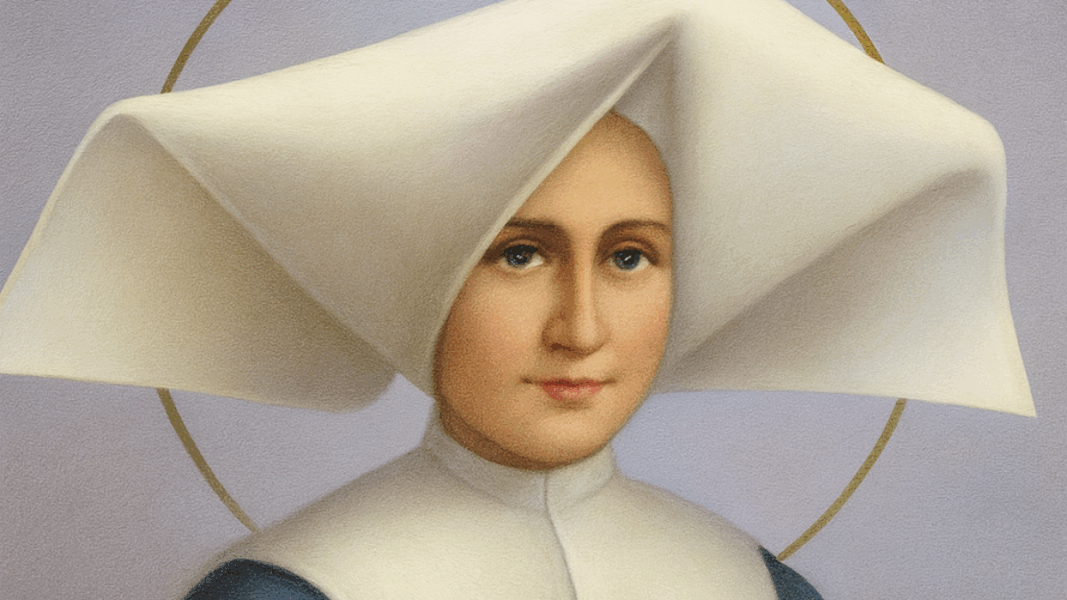
Today, November 28, the Church celebrates the memory of Saint Catherine Labouré, the young religious daughter of peasants who, without seeking notoriety or recognition, received one of the most well-known and widespread Marian revelations of the last two centuries: that of the Miraculous Medal. Her life, marked by silent humility and obedience, recalls the simplicity with which God acts in those who allow themselves to be molded by Him.
A Vocation Born in Simplicity
Catherine Labouré was born in 1806 in Fain-lès-Moutiers, France, into a deeply Christian family. Her mother died when Catherine was nine years old, and from then on the girl sought spiritual support in the Virgin Mary, whom she took as her Mother. At the age of 24, she entered the Daughters of Charity, the congregation founded by Saint Vincent de Paul and Saint Louise de Marillac, known for its service to the poor, the sick, and the most abandoned.
Catherine did not stand out for her education or extraordinary talents. Her life was that of a simple sister, dedicated to serving the elderly in the Reuilly hospice. It was precisely there, in the silence of a hidden life, that the Virgin chose her for an extraordinary mission.
The Apparitions of 1830
Between July and December of 1830, the Virgin Mary appeared to Catherine on several occasions in the motherhouse of the Daughters of Charity, on rue du Bac in Paris. In the second apparition—on November 27—the Blessed Virgin asked the young religious to have a medal struck with the image that She Herself showed her, promising abundant graces for those who wore it with confidence.
The medal spread quickly among the faithful, extending throughout France and then around the world. The graces, conversions, and favors received led the people to begin calling it “Miraculous,” a name it retains to this day.
Humility in Anonymity
The most striking aspect of Catherine’s figure is her anonymity. Although she was the protagonist of an event decisive for Marian piety, no one outside her confessor knew her identity until shortly before her death. She never sought to be the center of attention, nor did she want to appear as a visionary or protagonist. Her life unfolded in the simplicity of daily service.
She died in 1876, and when her tomb was opened in 1933, her body was found incorrupt. Her remains rest in the chapel of the rue du Bac, where millions of faithful visit each year to pray.