


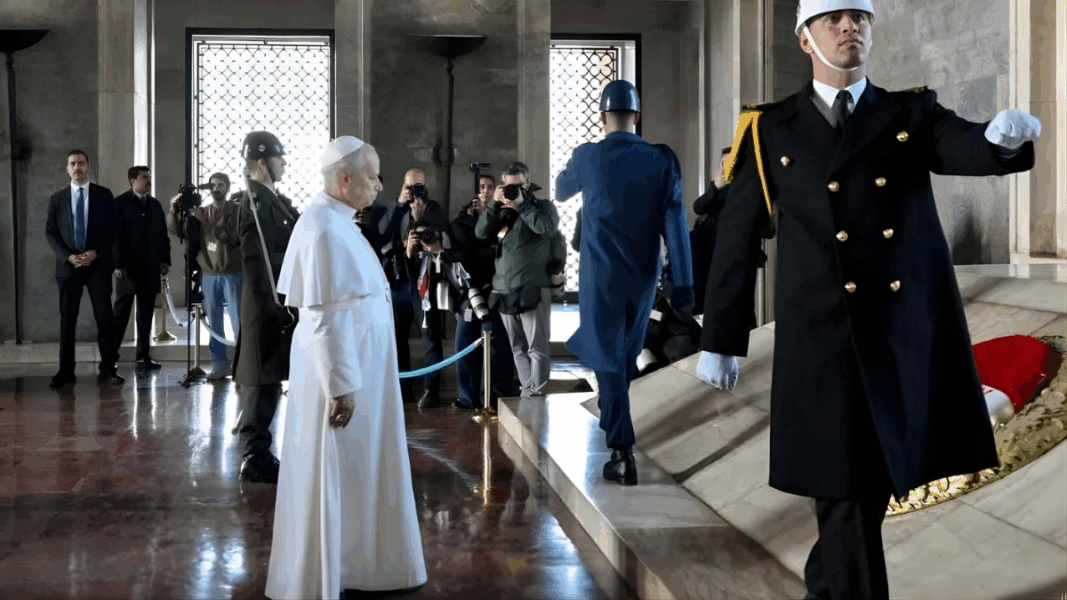
Nevertheless, the Pope is not just another head of state. He is the Successor of Peter, spiritual father of millions of faithful, and any public gesture acquires for Christians a deeper meaning than the merely diplomatic one.
The Armenian Genocide and Historical Responsibility
It is worth being precise: the Armenian Genocide in the strict sense took place between 1915 and 1916, under the government of the Young Turks and the triumvirate of the so-called “Three Pashas.” It was that regime that organized mass deportations and systematic massacres of Christian Armenians.
However, after the First World War, violence against Christian minorities—especially Greeks and Armenians—continued. During the Turkish War of Independence (1919-1923) and the years leading to the Republic, the nationalist movement led by Mustafa Kemal assumed the continuity of a policy of expulsion or elimination of Christian populations from Anatolia, in what many historians consider the final phase of the destruction of the Armenian and Greek communities of Asia Minor.
This stage is expressed in painful facts: the persecution and expulsion of Christian communities, the burning of Smyrna in 1922—which devastated mainly the Greek and Armenian neighborhoods—and the subsequent forced expulsion of the Orthodox Greek population after the Lausanne Convention of 1923.
For many Armenians and Greeks of Asia Minor, Atatürk remains the figure that symbolizes the tragic end of their millennia-old historical presence in Anatolia. That memory deserves sensitivity.
A Wound That Demands Delicacy
Armenia, the first Christian nation in history, and the Greek communities of Asia Minor have endured persecutions, deportations, and forced exiles for generations. For them, seeing the Pope—though it be for protocol—paying honors before that tomb can be painful.
That Benedict XVI performed the same gesture in his time does not eliminate that sensitivity, but it does invite placing today’s scene in a diplomatic continuity, rather than in an isolated decision by Pope Leo XIV.
Even so, from a pastoral perspective, this image continues to raise questions and generates legitimate confusion among those who expect the Church to accompany the wounds of the Christian peoples of the East with particular closeness.
The Balance Between Diplomacy and Pastoral Mission
The Church does not live for protocol, but for the salvation of souls. However, throughout modern history, the Vatican has also had to navigate complex diplomatic scenarios. The precedent of Benedict XVI demonstrates that, at times, popes accept certain protocolary gestures without that implying ideological adherence or historical approval.

The Pope is not asked for unnecessary confrontation with governments. But yes, special attention to the symbolic weight of his actions, especially when they refer to figures linked to painful episodes for Christian communities.
The language of pontifical gestures must always aspire to convey consolation and clarity, avoiding the Church appearing to yield to worldly dynamics that do not correspond to its mission.
A Beginning That Invites Deeper Reflection
Leo XIV’s journey to Turkey will include moments of great importance: encounters with small Christian communities, ecumenical gestures, and words addressed to those who live their faith as a minority. What remains of the journey offers a clear opportunity to compensate for this first scene.
The lesson is clear: not all protocols are innocuous, not all homages are simple, and not all images are read the same in hearts marked by history.
The children of the Church, especially those who carry a memory of persecution, expect the common mother to be especially careful when paying honors, even protocolary ones, when controversial historical figures are at stake.
May the Pope’s upcoming gestures show the pastoral depth that this first act has not managed to convey with full clarity. The Church has the capacity—and the duty—to accompany history with delicacy, to honor the martyrs, and to care for its own symbolic language without letting itself be absorbed by the logic of temporal powers.