


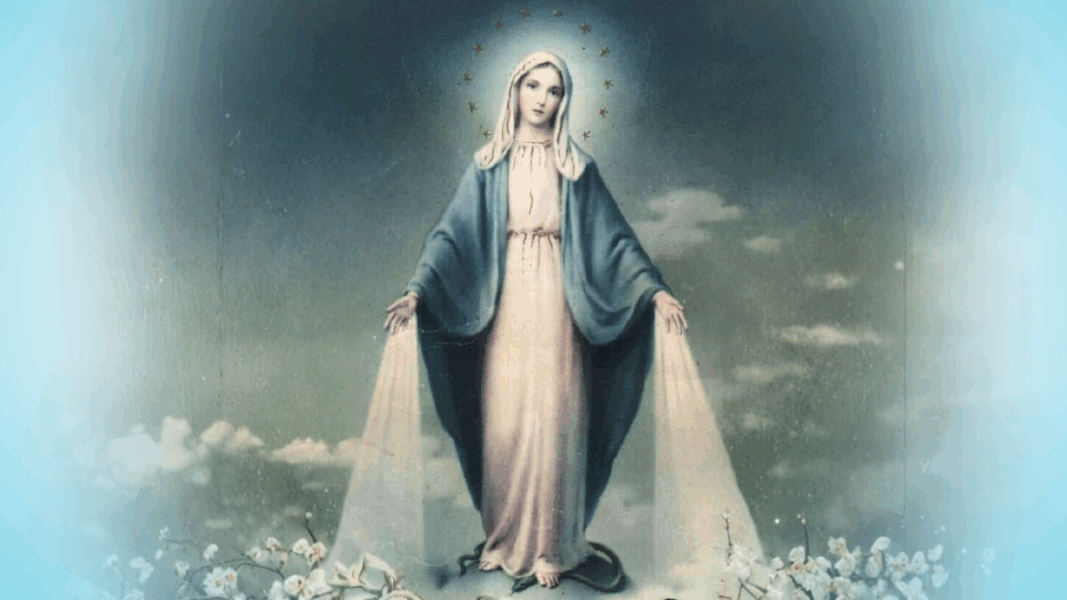
Devotion to the Miraculous Medal is not a pious accessory or a devotional amulet, but a forceful reminder that the Virgin Mary intervenes in the decisive moments of history to call for conversion, strengthen faith, and lead the Church toward its essential mission.
A Call from Heaven in a Turbulent Century
In 1830, France was shaken by political tensions, growing anticlericalism, and a rapid loss of the supernatural sense. In that climate of uncertainty, a young Vincentian religious sister, Catherine Labouré, received a series of apparitions of the Virgin Mary on Rue du Bac, in the heart of Paris. The Virgin’s words and the symbol she asked to be spread—the Miraculous Medal—cannot be understood apart from the historical context: they were a supernatural response to rationalism, aggressive secularism, and the spiritual crisis in Europe.
The Virgin requested a medal with a clear promise: «All those who wear it will receive great graces.» It was not about magic, but an effective instrument of evangelization and conversion, which directly refers to the central mystery of the faith: Christ the Redeemer and Mary intimately associated with the work of salvation.
A Profoundly Christological and Marian Message
The Miraculous Medal is not an isolated devotional object, but a theological compendium. On its obverse, Mary appears as the Immaculate, with her hands open pouring forth graces. It is a visual reminder of the dogma proclaimed 24 years later, in 1854. Mary presents herself not as a decorative figure, but as the Mediatrix of the graces that come from Christ, the only Savior.

The reverse condenses Christian doctrine: the intertwined M and cross affirm Mary’s intimate union with the redemptive sacrifice; the two hearts—the one of Jesus crowned with thorns and that of Mary pierced by a sword—express the profound communion between Mother and Son in the work of redemption; the twelve stars evoke the Church sustained by grace. In a single sign, the Church recognizes a luminous synthesis of the Gospel.
A Providential Instrument of Conversion
The history of the medal is full of conversions, healings, reconciliations, and returns to the faith. One of the most famous cases is the conversion of Alphonse Ratisbonne in 1842, a young Jew who, after accepting to wear the Miraculous Medal at the insistence of a friend, experienced an apparition of the Virgin in the church of Sant’Andrea delle Fratte in Rome. That encounter transformed his life and led him to consecrate himself as a priest.
But the importance of these graces must not overshadow the underlying message: the medal is a call to live in a state of grace, to love the Eucharist, to pray for the conversion of sinners, and to trust in the Virgin’s intercession. It is a tangible reminder that grace acts in history when hearts open to God.
A Simple Sign for a Profound Faith
The spiritual power of the medal lies precisely in its simplicity. It is a humble object that, however, contains dense teaching: God acts in the everyday, transforms hearts, grants graces, and guides the Church through the Mother of his Son. Wearing the Miraculous Medal does not guarantee success or absence of suffering, but it does ensure companionship: that of Mary, who never abandons those who have recourse to her protection.
Conversion, Trust, Intercession, and Grace
Our Lady of the Miraculous Medal speaks to the concrete present of the Church. Her message is clear, profound, and timely: conversion, trust, intercession, and grace. In a world that obscures the sacred, this Marian sign restores light; in a Church tempted by self-sufficiency, it reminds of the need to turn to the Mother; in a society that lives with its back to God, it silently proclaims that salvation still comes from Christ.
“O Mary, conceived without sin, pray for us who have recourse to you”.