


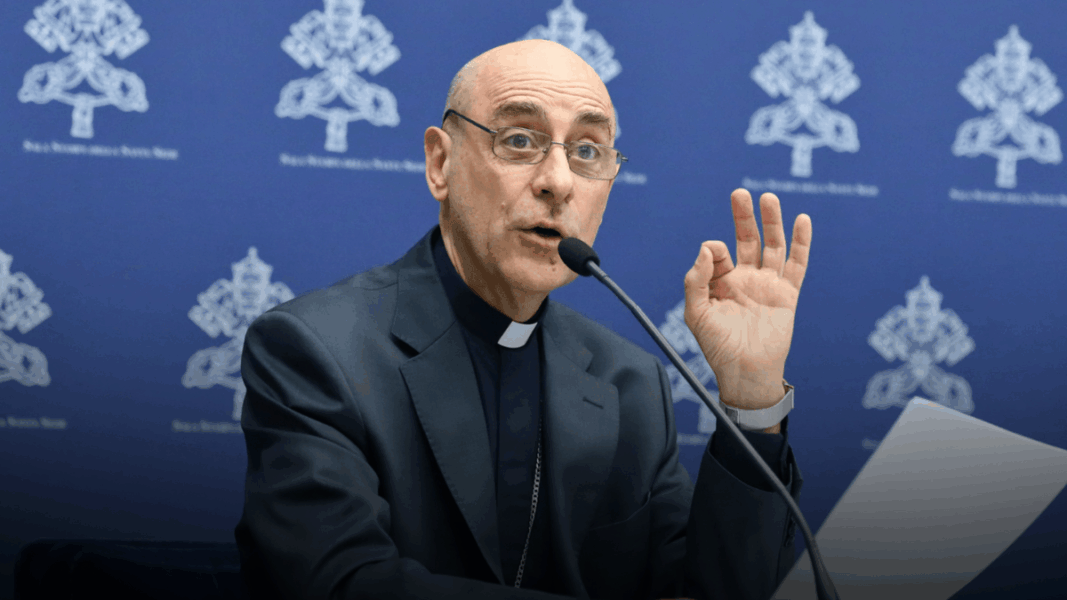
The prefect of the Dicastery for the Doctrine of the Faith (DDF), Cardinal Víctor Manuel Fernández, clarified the scope of the expression “always inappropriate” used in Mater Populi Fidelis to refer to the Marian title “Co-Redemptrix”, a definition that has generated controversy since the publication of the document. As he explained, the restriction affects only the official use in Vatican documents and liturgical texts, without annulling its use in the personal devotion of the faithful.
Clarification after the controversy over Mater Populi Fidelis
Three weeks after the publication of the document, which generated debate among theologians and Mariologists, the prefect stated that the term “always” should not be interpreted as a negative judgment on previous theological tradition. Saints, Doctors of the Church, and pontiffs used the title at various times in the last century, and that heritage —he said— is not being questioned.
According to Fernández, the DDF concluded after decades of study that the term “Co-Redemptrix” can generate pastoral confusions today, although its doctrinal content —Mary’s unique cooperation in the work of Redemption— remains affirmed. For this reason, the dicastery decided to exclude the expression from future magisterial and liturgical texts.
But he insisted that the decision does not limit the use of the title in personal prayer or in informed discussions among faithful who know its traditional meaning. The norm affects only the official language of the Holy See and the liturgy.
Mariologists: contradictory versions on whether they were consulted
Fernández affirmed that the DDF consulted “many” Mariologists and Christologists to prepare Mater Populi Fidelis. However, Father Maurizio Gronchi —a Christologist and consultant to the Dicastery— told ACI Prensa that “no collaborating Mariologist was found”, also pointing out the silence of relevant Marian institutions during the presentation of the text.
Father Salvatore Maria Perrella, a recognized Mariologist linked to the Marianum and advisor in previous debates on the “Co-Redemptrix” title, stated that the document would have required greater review and the participation of specialists in the matter.
A theological debate that continues
Although he recognized the legitimacy of the title in personal piety, Cardinal Fernández did not address its use in theological discussions. However, experts like Fr. Perrella affirmed that even controversial documents can stimulate doctrinal development and open new spaces for dialogue.
The prefect’s clarifications occurred in a conversation with journalist Diane Montagna after a Vatican conference, where he reiterated that the expression “always inappropriate” should be understood as “from now on”.
We leave below the full interview and translation:
Diane Montagna: Eminence, no. 22 of Mater Populi Fidelis says, in the original Spanish, that it is “always inopportune” to use the title “Co-Redemptrix” to define Mary’s cooperation in the work of Redemption. This was translated into Italian as “è sempre inappropriato”. Meanwhile, the English text originally said “it would be inappropriate” but was later changed to “it is always inappropriate”…
Cardinal Fernández: The translator made a softer [English] translation, but then told us: “Look, I’m not sure about this”, and so it was changed.
Diane Montagna: But why did they use the word “always”, especially given that saints, Doctors of the Church, and popes have used the “Co-Redemptrix” title, particularly in the last century? What do they seek to communicate to the clergy and the faithful through the use of “always”?
Cardinal Fernández: That at this moment, after these thirty years of study by the dicastery, there have been various interventions as questions arose. Pope John Paul II himself asked Ratzinger to study the issue. Until that study was completed, John Paul II occasionally used “Co-Redemptrix”. After that study, and Ratzinger’s response —which we now know—, he no longer used it. But he preserved the positive aspects of the content, that is, Mary’s unique cooperation in the work of redemption.
We use this phrase —“Mary’s unique cooperation in the work of redemption”— I think 200 times in the document; that is, we preserve and make explicit this positive aspect in the text. But, after the study carried out by Ratzinger at the request of John Paul II, he no longer used it. Then there were other occasions when the dicastery, under Ratzinger and later, studied the topic because it was linked to certain apparitions, etc., and Pope Ratzinger closed [the case of] those apparitions with a “Negative” vote. The same happened afterward.
With the apparitions, we have been, let’s say, a bit more generous. We try, even if there are aspects that can be confusing, to find the positive aspects and allow the piety of the faithful. However, on this topic, after thirty years of work by the dicastery, the time had to come to make it public —and that’s what we have done—.
Diane Montagna: Yes, but why did they use the term “always”? Does this refer to the past, especially given that it was used by the saints, doctors, and the ordinary magisterium?
Cardinal Fernández: No, no, no. It refers to this moment. Just as John Paul II himself used it at one time and then no longer used it. What we believe is that, in the substance behind that word, there are elements that can be accepted and continue to be upheld.
Diane Montagna: So, does “always” mean “from now on”?
Cardinal Fernández: From now on, certainly. It does not intend to judge the past at all. It means “from now on”. And furthermore, it means above all that this expression [“Co-Redemptrix”] will not be used either in the liturgy, that is, in liturgical texts, or in official documents of the Holy See. If one wishes to express Mary’s unique cooperation in the Redemption, it will be expressed in other ways, but not with this expression, not even in official documents.
That is something that is known, although it may not be very widespread. If you, along with your group of friends, believe you understand well the true meaning of this expression, have read the document and see that its positive aspects are also affirmed there, and wish to express precisely that in your prayer group or among friends, you can use the title —but it will not be used officially, that is, neither in liturgical texts nor in official documents—.
Diane Montagna: Thank you very much. Just one last question: Did you consult (that is, the DDF) any Mariologist for Mater Populi Fidelis?
Cardinal Fernández: Yes, many, as well as theologians specialized in Christology.
You can check the original publication here.