


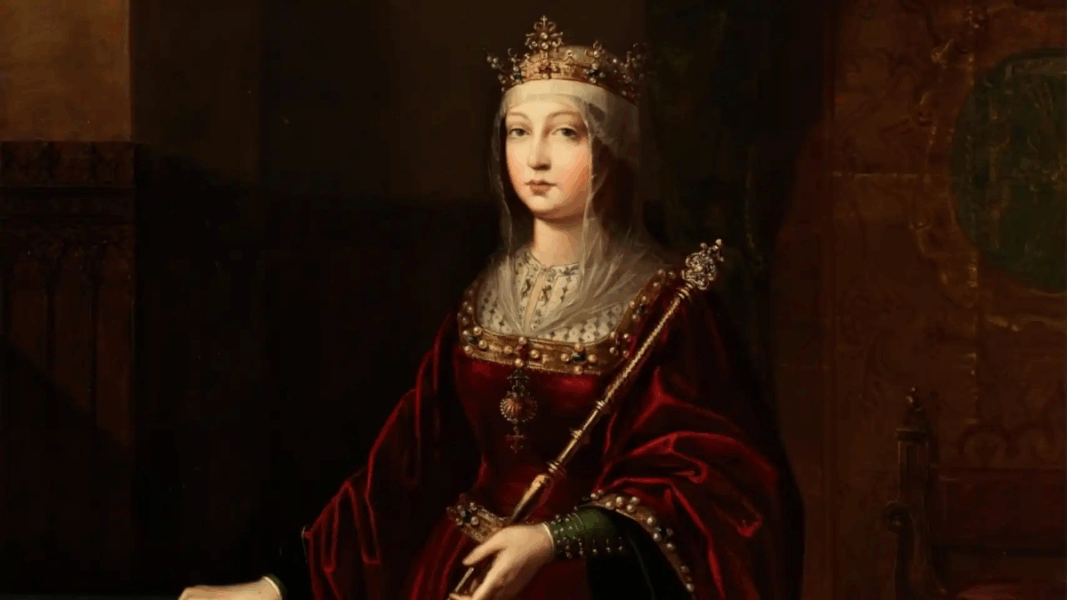
Among the women of the Spanish Golden Age—a world dominated almost entirely by the male voice—there is a name that overflows any category: Isabel la Católica. Her figure has been praised and criticized, mythified and caricatured, cited with admiration and with suspicion. But as Juan Belda Plans reminds us, if there is a case that breaks all the molds of its time, it is that of this queen who transformed the history of Spain and the world forever.
Isabel appears as a character that demands an analysis without prejudices, far from contemporary ideological readings. Neither romantic sanctity nor interested demonization: the Queen acted with an uncommon freedom of judgment even among the men of her time, and her influence was decisive in politics, culture, religion, and society.
Beyond the legend: lights that eclipse the shadows
Isabel’s work cannot be summed up in clichés. The end of the Reconquista, dynastic unity, the Renaissance impulse, ecclesiastical reform, decisive support for Columbus’s project, the organization of the modern State… are immense achievements to which she added her own style of government: direct, firm, and deeply aware of her mission.
Belda Plans explains it clearly: judging Isabel exclusively from modern categories—as some authors obsessed with the Inquisition or the expulsion of the Jews do—leads to evident distortions. The Queen acted within a precise cultural and religious framework, where the spiritual and political unity of the kingdoms was a condition of survival. Pretending to read her through the lenses of the 21st century is to deny history itself.
A woman who ruled, not who accompanied
In a time when women were relegated almost entirely to the domestic sphere, Isabel exercised full political power. She was not a decorative consort or a secondary arm: she was an effective sovereign. She decided her marriage, chose her alliances, led the war in Granada, negotiated with Rome, supported the discovery of America, and personally selected the men to lead her ecclesiastical reform.
Her leadership was not a concession of circumstances, but the result of a formidable personality, sustained by intelligence, prudence, political intuition, and deep faith. She was a queen who knew how to command, but above all, she knew how to govern, which is much more.
Faith as the engine of a historical mission
Isabel’s religiosity was not an adornment or a pious label. According to Belda, it was an essential part of her inner life and her public decisions. From the reform of the religious orders to the establishment of the Inquisition as a mixed instrument to preserve unity, her vision stemmed from a clear conviction: without spiritual foundations, no kingdom can endure.
In the American venture, her hand was also decisive. It was Isabel who defended that the indigenous people were free subjects of the Crown—not booty or slaves—and who oriented the enterprise toward an evangelizing mission rather than an economic one. Her will confirms it: the evangelization of America was for her a primary royal and spiritual duty.
A queen ahead of her time
The Spanish Golden Age, with all its contrasts, would not have been possible without Isabel’s prior work. Belda presents her as a woman without equivalents in her century: learned, political, strategic, deeply religious, and above all, master of her own destiny. Her life unfolds in three stages—dynastic crisis, great achievements, and final suffering—and in all of them she shone with a singular temperament that did not fade in the face of the death of her children, nor the uncertainties of succession, nor the weight of a colossal reign.
Isabel la Católica was, in essence, what few women could aspire to be in her time: a queen who changed history, not from the shadows, but from the very center of power.
In Mujeres fuertes del Siglo de Oro, Juan Belda Plans rescues Isabel without myths or reductions, and shows a woman whose legacy continues to shape the spiritual and cultural identity of Spain. A chapter that encourages rediscovering the feminine strength that molded the foundations of the most decisive empire of the Modern Age.