


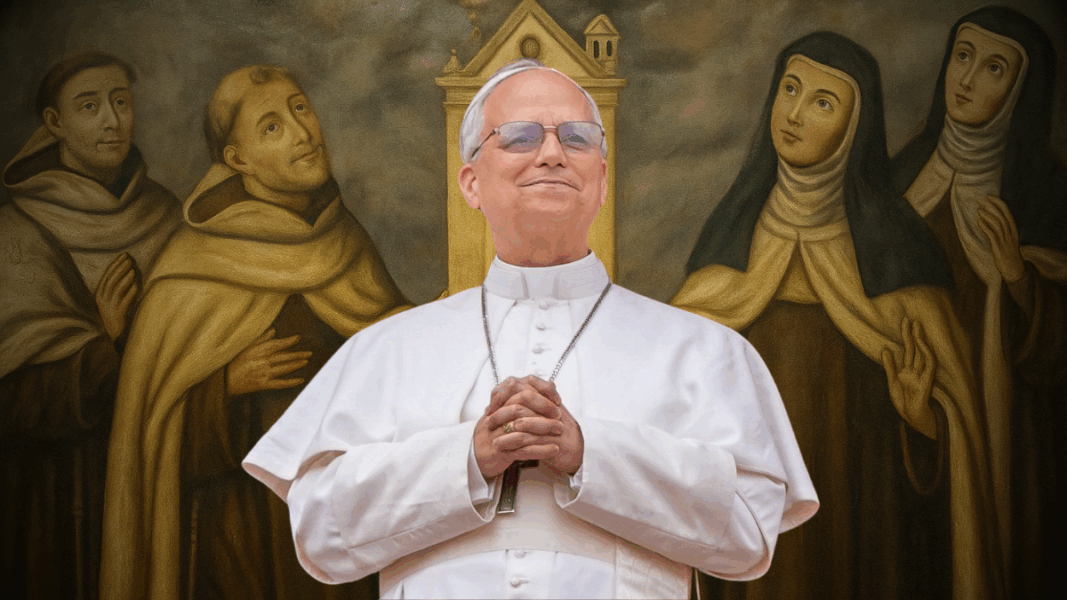
In the general audience of November 26, 2025, held in St. Peter’s Square, Pope Leo XIV continued his cycle of catecheses for the 2025 Jubilee dedicated to Jesus Christ, our hope. On this occasion—leaving behind the ecological references—he delved into the Christian meaning of life, the need to safeguard it as a gift, and the value of hope in the face of a culture marked by distrust and existential weariness.
Throughout his catechesis, the Holy Father warned about the “lack of trust in life” that spreads in many hearts, and called for rediscovering life as a gift from God, inviting the faithful to “generate life” in its multiple dimensions: family, community, social, and spiritual. He emphasized that Christ’s Resurrection sustains the Christian on this path, even in moments of darkness and pain.
We leave below the complete catechesis of Leo XIV:
Dear brothers and sisters, good morning and welcome!
Christ’s Easter illuminates the mystery of life and allows us to look at it with hope. This is not always easy or taken for granted. Many lives, all over the world, appear weary, painful, full of problems and obstacles to overcome. However, the human being receives life as a gift: he does not ask for it, does not choose it, experiences it in its mystery from the first day to the last. Life has its extraordinary specificity: it is offered to us, we cannot give it to ourselves, and it must be constantly nourished: care is necessary to sustain it, make it dynamic, safeguard it, relaunch it.
It can be said that the question about life is one of the abyssal questions of the human heart. We have entered existence without having done anything to decide it. From this evidence, questions flow like a river in flood from all times: Who are we? Where do we come from? Where are we going? What is the final meaning of this whole journey?
Indeed, living invokes a meaning, a direction, a hope. And hope acts as the deep impulse that makes us walk in difficulties, that does not make us give up before the fatigues of the journey, that assures us that the pilgrimage of existence leads us home. Without hope, life runs the risk of appearing as a parenthesis between two eternal nights, a brief pause between the before and after of our passage through the earth. Hoping in life means instead savoring the goal, believing as certain that which we do not see, which we do not yet see or touch, trusting and entrusting ourselves to the love of a Father who created us because He loved us with love and wants us to be happy.
Dear ones, in the world there is a widespread disease: the lack of trust in life. As if we had resigned ourselves to a negative fatality, of renunciation. Life runs the risk of no longer representing a possibility received as a gift, but an unknown, almost a threat from which to protect ourselves so as not to be disappointed. For this reason, the value of living and generating life, of witnessing that God is par excellence “The lover of life”, as the Book of Wisdom (11:26) affirms, is today more than ever an urgent call.
In the Gospel, Jesus constantly confirms his eagerness to heal the sick, to heal wounded bodies and spirits, to give life back to the dead. In this way, the incarnate Son reveals the Father: he restores dignity to sinners, grants forgiveness of sins, and includes everyone, especially the desperate, the excluded, the distant from his promise of salvation.
Generated by the Father, Christ is life and has generated life without sparing himself until giving us his own, and invites us to give our life. To generate means to put life in another. The universe of the living has expanded through this law, which in the symphony of creatures knows an admirable “crescendo” culminating in the duet of man and woman: God created them in his own image and entrusted to them the mission of generating also in his image, that is, out of love and in love.
From the beginning, Sacred Scripture reveals to us that life, precisely in its highest form, the human one, receives the gift of freedom and becomes a drama. Thus human relationships are also marked by contradiction, even to fratricide. Cain perceives his brother Abel as a competition, a threat, and in his frustration he does not feel capable of loving and esteeming him. Here are jealousy, envy, blood (Gen 4:1-16). God’s logic, on the other hand, is different. God remains faithful forever to his design of love and life; He does not tire of sustaining humanity even when, following the traces of Cain, it obeys the blind instinct of violence in wars, discriminations, racism, in the multiple forms of slavery.
To generate then means to entrust oneself to the God of life and to promote the human in all its expressions: first of all in the wonderful adventure of motherhood and fatherhood, also in social contexts in which families struggle to sustain the burdensome everyday life, often truncated in their projects and dreams. In this same logic, to generate is to commit to a solidarity economy, to seek the common good equally enjoyed by all, to respect and care for creation, to offer consolation with listening, presence, concrete and disinterested help.
Brothers and sisters, the Resurrection of Jesus Christ is the strength that sustains us in this challenge, also where the darkness of evil obscures the heart and mind. When life seems to have gone out, blocked, behold, the Risen Lord passes again, until the end of times, and walks with us and for us. He is our hope.