


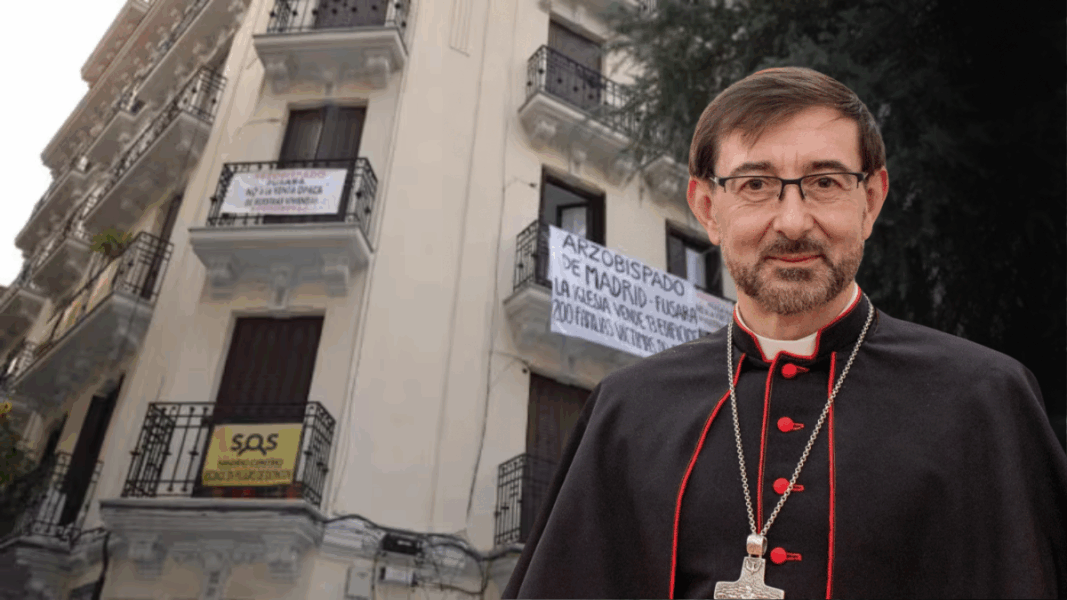
A recent ruling from the Court of Instruction No. 28 of Madrid has rejected the neighbors’ request to charge Cardinal José Cobo and the new FUSARA board in the criminal case investigating the controversial real estate operation carried out in 2019. This judicial resolution marks a significant point within a process that has accumulated suspicions, questioned decisions, and direct consequences for more than two hundred families living in the affected properties. The ruling does not exonerate the previous board but rather delimits the investigated parties to the procedural stage at which the case currently stands. In other words, it does not preclude actions, but it would not be appropriate to initiate them in this same proceeding.
The original operation: an anomalous sale from the start
The root of the case lies in 2019, when FUSARA—a Catholic-inspired foundation whose presidency corresponds to the Archbishop of Madrid—formalized the sale of fourteen buildings located in the center of the capital to the vulture fund Tapiamar and its linked companies. The transaction closed for a price close to 65 million euros, despite expert reports and independent valuations placing the real value of the ensemble above 200 million. The difference between market price and sale price set off all the alarms. Added to this was the intervention of intermediaries who charged million-euro commissions and who are now under investigation. The management of the previous board—appointed by the Archdiocese under the episcopate of Carlos Osoro—was called into question, both for lack of transparency and for the apparent violation of an ethics expected from the Church. The neighbors, some of them nonagenarians born in the homes, received registered letters announcing the change of ownership and potential evictions, which sparked a mobilization that would end up paralyzing the sale in the courts.
The new board’s turn: an out-of-court agreement that does not convince everyone
With the arrival of Cardinal José Cobo to the archbishopric, the board took a different direction. On July 30, 2025, FUSARA reached an out-of-court agreement with the buyers to modify the operation. The new pact excluded one of the buildings—the one on Barquillo Street 22, headquarters of the foundation—and raised the valuation of the rest of the properties to 99 million euros, compared to the initial 64.3 million. The foundation had already received 37 million in 2019 as an advance payment, and according to Fusara’s version, the agreement represented a substantial improvement over the initial operation. This decision was justified by pointing out that the lawsuit could drag on for years, during which time FUSARA would not have the necessary resources to cover its structural losses. As the foundation itself explained, the firm Baker & McKenzie would have recommended accepting this route to ensure its financial continuity. But the agreement has not been without criticism. One of the most controversial decisions was to renounce legal actions against the buyers investigated for fraud. Another, even more polemical, was the request to exclude the neighbors as popular accusation in the criminal proceedings. Although legally possible, this gesture was perceived as unnecessary and contrary to the social commitment that should guide a foundation linked to the Church. The general feeling among those affected is that the new board, although it did not participate in the original operation, has opted for a solution whose practical effect strengthens the position of those who participated in the initial sale.
The gaps that persist: unexplored alternatives and the shadow of “lifting the veil”
One of the points most highlighted by experts and neighbors is that FUSARA did not ask the court for the rents from the properties—or part of them—to be allocated on a precautionary basis to cover the foundation’s deficit while the litigation lasted. This could have allowed sustaining the foundational activity without the need for a premature agreement, and moreover without harming the tenants. In response to questions from Infovaticana, Fusara’s reply has been the following:
«The Foundation could not appear as a particular accusation until January 2021, when the Court had already adopted the precautionary measures. Therefore, FUSARA never raised it nor pronounced on the matter. Nor was the issue of the consignment of rents raised again by any of the parties.
In addition to the above, TAPIAMAR had already disbursed 37 million euros, so the consignment of the rents would have been clearly disproportionate, to the extent that (i) the annotations of prohibition to dispose were already agreed and (ii) it would have implied the bankruptcy of the TAPIAMAR Group without avoiding the bankruptcy of FUSARA (lack of proportionality).»
This response does not explain why prioritizing the risk of bankruptcy (unproven) of a fraudulent group over a solution that would have allowed a fairer situation with the tenants and that would not exonerate the original perpetrators of the crime.
The legal issue of “lifting the veil” also persists: although FUSARA has tried to organically disassociate itself from the Church, its institutional reality shows the opposite. The board is presided over by an archbishop, its purpose is confessional, its activities are aligned with the pastoral mission, and its assets have historically been managed by the Archdiocese. From a legal perspective, these elements could allow attributing direct responsibility to the Church, which has an approximate annual budget of 40 million in Madrid. The question is not theoretical: could the Church have temporarily assumed FUSARA’s losses while the judicial process advanced to avoid an exculpatory agreement with those investigated for maladministration in a crime of such magnitude? The answer is affirmative, although no one took that step.
The failed attempt to charge the new board
The signing of the 2025 agreement led the neighbors to request the expansion of the complaint to include Cardinal Cobo and the new board in the criminal proceedings. The argumentation was based on the fact that, although the origin of the scam corresponds to the previous board, the new agreement consolidates part of the damage and withdraws accusations against some of the beneficiaries. The court, however, rejected the request with a succinct argument of procedural untimeliness. The judicial decision establishes the boundary between criminal responsibility and moral responsibility: while for the moment there are no indications of crime on the part of the current board, the ethical issues and coherence with the Church’s Social Doctrine remain open.
A legally supported decision, ethically questionable
The FUSARA–Tapiamar case continues to be a terrain of friction between legal logic, institutional responsibility, and the human dimension. Although the fraud to the detriment of the Foundation under investigation clearly corresponds to the previous stage, and although the new board has acted within strict legality, this does not erase the fundamental questions. Were all avenues explored to defend the foundation’s assets and social function? Was it necessary to renounce the accusation against the investigated buyers? Why was it not requested that the rents temporarily sustain FUSARA? And why exclude the neighbors as popular accusation? The 2025 agreement closes a judicial chapter, but opens another marked by ethical and social doubts. And in the midst of this debate, hundreds of neighbors remain—some elderly, some born in these homes—who continue living with uncertainty about the future of what for generations they have called home.