


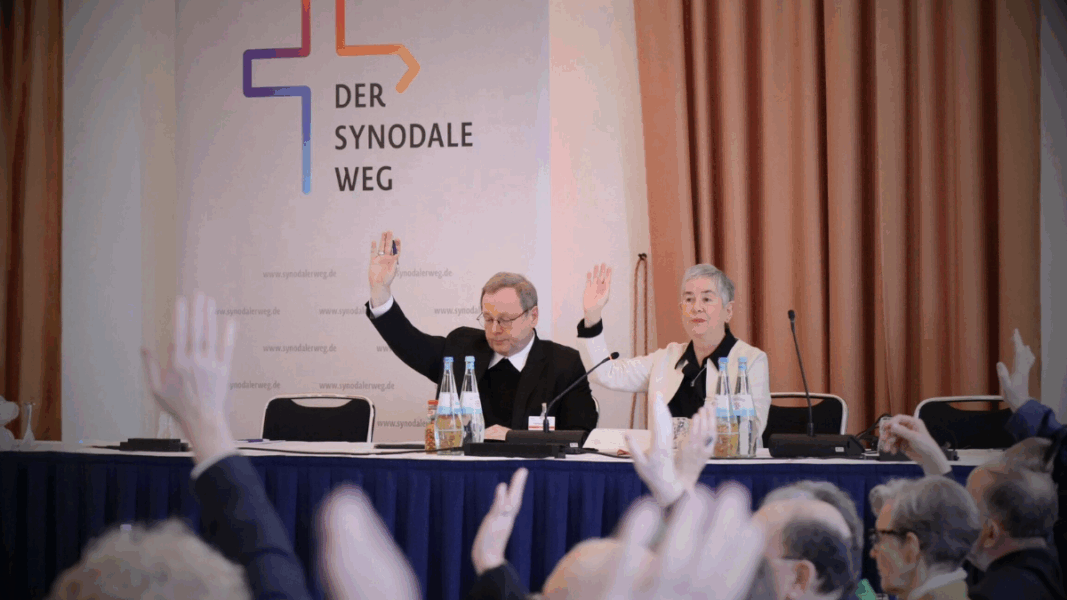
The German synodal process has taken a new step: members of the synodal committee unanimously approved this Saturday, November 22, the statutes of a new permanent national body called the “synodal conference”, designed so that bishops and laity “deliberate and decide together” on issues of national scope. The text, consisting of 12 articles, constitutes the most significant advance toward the structure that the German “synodal way” projected since 2019.
Read also: New step in German synodalism: they will consult laity to elect a bishop
According to information from The Pillar, the unanimously approved document insists that the new conference “respects the constitutional order of the Church and preserves the rights of diocesan bishops and the German Episcopal Conference”, a formula intended to calm the concerns of the Vatican, which on repeated occasions warned that Germany has no authority to create a body that alters the Church’s governance structure.
Adjustments to avoid a confrontation with Rome
The creation of a national body with deliberative and decision-making functions was one of the most controversial points of the synodal path. In January 2023, the Vatican communicated to the German bishops that they had no authority to establish a structure that, in practice, could place itself above the Episcopal Conference. The Holy See warned that this proposal would entail an alteration of the Church’s form of government, in contradiction with what was taught by the Second Vatican Council.
Despite the veto, the synodal committee moved forward and began drafting statutes for a body that, although renamed the “synodal conference”, continues to maintain the idea of a permanent national body for co-responsibility.
Read also: New step in German synodalism: they will consult laity to elect a bishop
The approved document includes numerous corrections suggested by Archbishop Filippo Iannone, prefect of the Dicastery for Bishops, who provided canonical clarifications and references to the final document of the Synod on Synodality.
One of the most sensitive issues was the definition of the new body’s function. Initially, it was established that the conference “deliberates and decides” on issues of national importance. Following the objection from the Permanent Council of the Episcopal Conference, the formula was modified and now states that it decides “in accordance with synodal decision-making processes”, a nuance intended to show greater alignment with Rome’s guidelines.
The most contentious point: financial control of the dioceses
The most visible tension at the Fulda meeting arose around the economic role of the new body. A committee member proposed that the synodal conference assume the functions of the VDD, the Association of German Dioceses, responsible for the financial and administrative coordination of the 27 dioceses. The proposal immediately raised concerns among several bishops, including Franz Jung of Würzburg and Udo Markus Bentz of Paderborn, who acknowledged the need to increase lay participation in economic matters but rejected the idea that the new body could directly replace existing structures.
In the end, the committee approved a more moderate statement expressing the desire for synodality to also permeate the VDD’s economic management. Instead of assuming functions immediately, the synodal conference will recommend reform criteria to be studied by the Episcopal Conference.
Reactions: satisfaction among promoters, reservations among critics
The president of the German bishops, Mons. Georg Bätzing, celebrated the approval of the statutes as “a historic moment”. He stated that the consensus achieved represents an advance over the tensions experienced in the synodal way and expressed his hope that the bishops who have remained on the sidelines will eventually join. He also highlighted that the experience of the synodal committee would have helped them develop “a different form of cooperation”, learning from the conflicts and wounds that marked the previous process.
The president of the ZdK, Irme Stetter-Karp, stated that the synodal conference “will not be a paper tiger” and emphasized that the laity have managed to maintain their fundamental principle: to deliberate and decide together with the bishops on matters of national scope.
However, various voices in the German Catholic media have expressed doubts and warnings. The journalist Regina Einig, in Die Tagespost, pointed out that the diocesan councils responsible for managing the church tax might reject having their decisions reviewed or conditioned by a national body whose members do not know the local reality. The theologian Benjamin Leven, in an analysis published in Communio, considers that the statutes are designed as an intermediate step that leaves the door open to a progressive increase in lay power. He also warns that several relevant details will be referred to a subsequent regulation that will probably not be sent to Rome, which could reignite tensions with the Holy See.
Meanwhile, León XIV continues to hold private meetings with German bishops, showing that the German dossier remains one of the tense issues for the Vatican.