


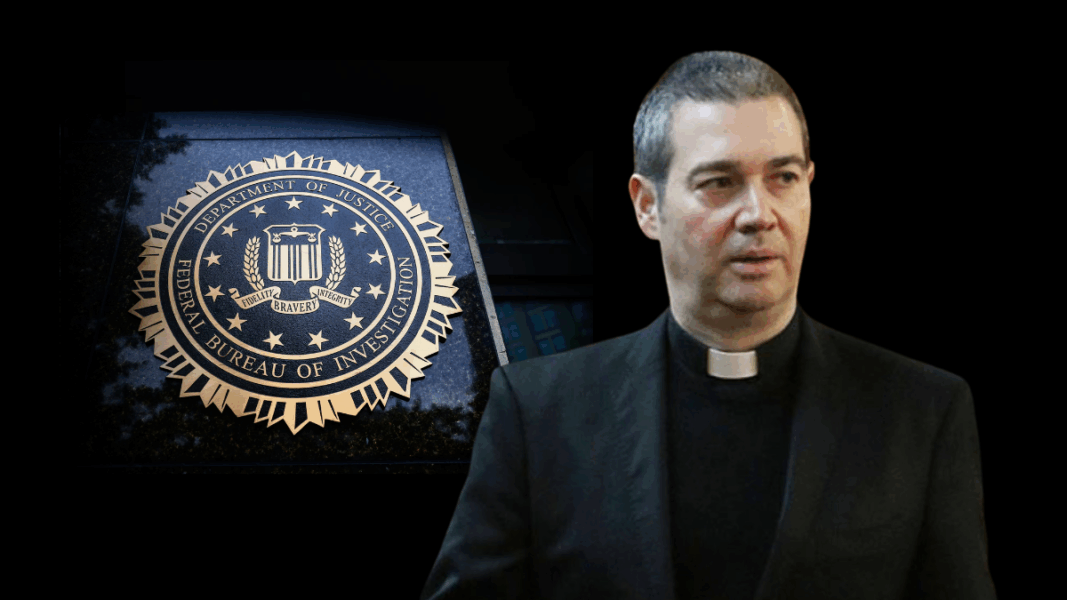
The audio that Infovaticana publishes today reveals a maneuver as clumsy as it is dangerous. In the recording, the official from the Congregation for the Doctrine of the Faith, Jordi Bertomeu, admits that the Vatican knew about an FBI investigation into alleged money laundering related to the Sodalicio de Vida Cristiana. But instead of offering full judicial cooperation, he proposed a “solution” based on payments and donations to victims and dioceses, which would allow the Vatican to present the case to U.S. authorities as «internally resolved».
What Bertomeu describes is not just a dialectical error or an imprudent clumsiness. It is an action that, if carried out, would constitute a federal crime of obstruction of justice: conditioning the delivery of information or collaboration with the FBI on the making of economic transfers or charitable contributions to third parties.
The Vatican knew that the FBI was investigating money laundering
Bertomeu acknowledges in the audio that the Holy See had already been contacted by U.S. authorities and that there were documents with clear indications of irregular financial operations.
“The Vatican has already informed the North American authorities… that in the investigation that was done, documentation appeared in which there were indications of money laundering.”
He even explains that he was summoned by the U.S. Embassy in Lima, in the presence of an FBI delegate.
“There was the FBI delegate here in Lima, who also wanted to know.”
In other words: the Vatican was formally part of the investigation. It knew there was a possible crime and had initiated contact with federal authorities. Any attempt to condition that relationship or influence the course of the investigation is, legally, an extremely serious matter.
A “solution” that involves money in exchange for benevolence
Instead of collaborating transparently, Bertomeu proposes in the recording an alternative path: pay. He explains that, according to the Secretariat of State, the conflict could be “resolved” through economic contributions and a diplomatic document that would close the matter.
“This solution would pass… because this profit they made is reversed to the non-profit. Then a benevolent accompanying letter, where the Vatican states, that is, it guarantees a solution that has been given.”
And he adds:
“The first thing is to satisfy these victims… but you can't satisfy them with a few bucks. Moreover, it would involve returning social work to the dioceses where there were missions that theoretically profited.”
The proposal is clear: make payments, return assets or fund social projects, and with that present a softened version of the facts to the FBI, backed by a “benevolent” letter from the Vatican.
Straightforwardly: if payment is made, the report is presented as resolved. If not, the Vatican could send it as is.
Why this is extremely serious: the legal limit that Bertomeu ignores
U.S. law is clear: no one can condition cooperation with a federal investigation on obtaining benefits or making payments to third parties.
Doing so—even with a “pastoral” intention—can be considered obstruction of justice, a federal crime punishable by imprisonment.
In practice, what Bertomeu proposes amounts to saying: “If those involved pay or make economic reparations, the Vatican commits to sending the FBI a mitigated or favorable report.”
That is unacceptable from any standpoint: a religious power cannot use its position to alter the course of a criminal investigation through money or diplomatic influences.
Money laundering is an autonomous and objective crime. It is not erased with donations, nor is it “cured” with social works.
And much less is it negotiated with a federal agency.
The attempt to justify the unjustifiable
Bertomeu, aware of the implications of his words, tries to justify his proposal by saying:
“It's not blackmail… it's a desire to resolve a problem.”
But the supposed “resolution” he describes has all the elements of an economic conditioning on a criminal investigation. In the audio, the official also insists that the goal is to protect implicated bishops:
“Here the last thing we want is to have to conduct canonical processes against bishops as well… Please reverse this.”
In other words, the money would not only serve to “satisfy” victims or dioceses, but also to prevent the case from affecting the ecclesiastical hierarchy.
A political and financial control operation, not justice.
A diplomatic blunder that compromises the Vatican
From a legal and diplomatic standpoint, what Bertomeu proposes is a blunder of enormous proportions. Not only because it confuses criminal law with pastoral action, but because it exposes the Holy See to the risk of international indictment.
Cooperation with the FBI in financial crime cases is not optional: it is regulated by international agreements, and its manipulation can lead to serious sanctions. Attempting to “accompany” the delivery of information with a political letter in exchange for money would be interpreted as an attempt to unduly influence a federal proceeding.
Beyond its recklessness, the approach reveals a deeply misguided mentality: that of those who believe legal problems are solved with money and diplomacy, rather than with transparency and truth.
The audio makes things clear
The Vatican knew that the FBI was investigating alleged money laundering and, instead of fully collaborating, one of its officials proposed a strategy that mixed payments to third parties to alter the tone of that cooperation.
In legal terms, that is called obstruction. In moral terms, cover-up. And in both cases, it is inadmissible.
Conditioning the delivery of information to the FBI on money transfers, even if they are donations or compensations, is an act that borders on a federal crime.
Neither charity nor reparations substitute for justice.
The Vatican cannot “accompany” a criminal investigation with diplomatic letters nor “resolve” money laundering with alms. If there is money laundering, it is not cured with donations; it is confronted with transparency and collaboration.
The audio that Infovaticana publishes today demonstrates, with the very words of an official from the Doctrine of the Faith, to what extent the Bergoglian plumbing of the Holy See had forgotten that elementary distinction.
The irony, unfortunately, writes itself. Because all this becomes known precisely on the eve of Jordi Bertomeu landing in Madrid to pontificate tomorrow on “best practices” and “management of sexual abuse” in an event organized as if none of this existed. That someone who privately proposes formulas that border on obstruction of justice now comes to give public lessons on transparency and institutional responsibility is not only shocking: it reveals the abyss between the official discourse and the reality shown by his own words. And it turns his visit into an uncomfortable reminder of how much the Holy See has normalized a culture of damage control disguised as pastoral zeal.