


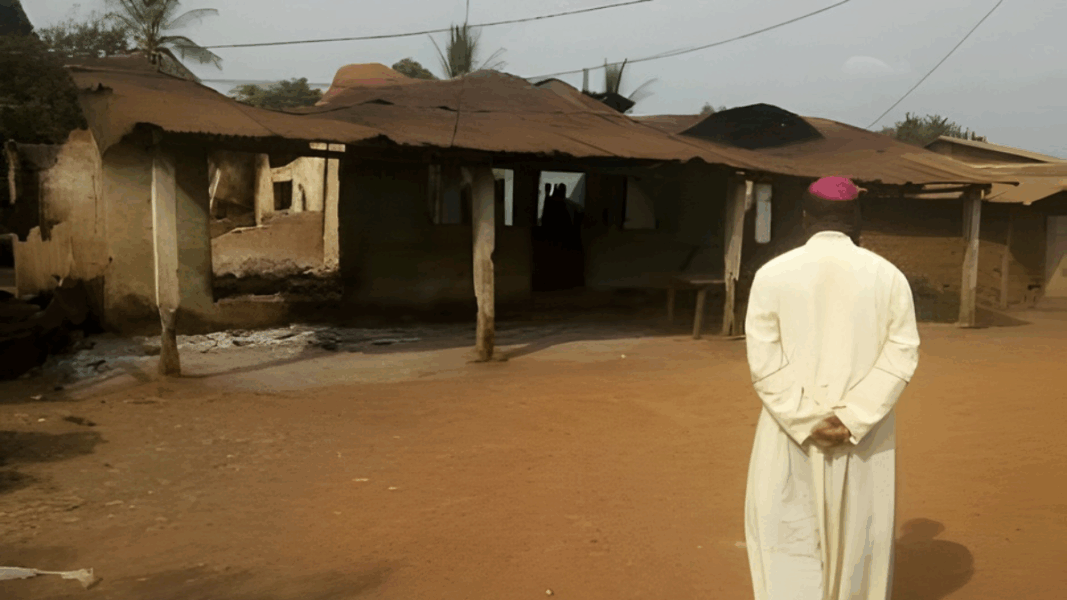
The threat of closing parishes, schools, and Catholic institutions in the Ndop deanery shows to what extent the Church is being pushed to withdraw in the face of violence. According to Agencia Fides, Mons. Andrew Nkea Fuanya, Archbishop of Bamenda, has warned that, if Father John Berinyuy Tatah remains imprisoned on November 26, pastoral life in the area will be suspended: priests will be evacuated for safety and the Blessed Sacrament will be removed from the churches.
The priest, parish priest of Babessi, was kidnapped on November 15 along with his vicar when they were returning from celebrating Mass for the inauguration of the PAX university institute in Ndop. According to the archbishop himself, both were captured in Baba I, about 60 km from Bamenda, by several armed men who claimed to be Ambazonia separatist fighters, and taken to an unknown location.
A worsening crisis: more priests kidnapped
The crisis worsened when, on November 18, four priests and a layperson sent to negotiate the release of the two presbyters were also kidnapped. The vicar, the other four priests, and the layperson were released on November 20. However, the kidnappers continue to hold Father John, and it is precisely this situation that has led Mons. Nkea to raise the tone.
The archbishop’s announcement was disseminated in a statement signed by him and read on Sunday, November 23, in all parishes of the archdiocese. In that text, he also warns that, if Father John remains imprisoned on November 28, he himself, along with the clergy and the lay faithful, will go to Baba I advancing toward the place where he is detained, «and either they will return with him or remain there until he is released».
“We are cornered”: Christians in retreat
The case of Father John is not an isolated incident, but a symptom of a situation that the archbishop himself describes as suffocating. Mons. Nkea denounces that «the frequent kidnappings of our priests and mission personnel have cornered us, and all this must end immediately». And he recalls that «there are many laypeople who have suffered terribly from kidnappings, tortures, and violence» in the archdiocese.
While the Church is forced to prepare the closure of parishes and the evacuation of priests, the prelate also points out the responsibility of the State. He asks the military—who, he emphasizes, should maintain order and protect the population—not to torture civilians or extort money from them. Between armed groups that present themselves as separatists and abuses by those who should guarantee security, the Catholic community lives between two fires.
The result is a clear image of Christians in retreat: a Church that is forced to remove the Blessed Sacrament from the temples, suspend pastoral activities, and remove its priests from the area for sheer survival. The withdrawal is not a free choice, but a direct consequence of the violence, kidnappings, and abandonment of the faithful to their fate.
A paternal call. It is not cowardice
Mons. Andrew Nkea Fuanya is the current metropolitan archbishop of Bamenda, appointed by Pope Francis in December 2019 and taking possession of the office in February 2020. Born in Widikum, in the northwest region of Cameroon, in 1965, he was ordained a priest in 1992 for the Diocese of Buéa.
Before his current pastoral mission, he served as the first bishop of the Diocese of Mamfe from 2014, where he distinguished himself by his closeness to communities affected by violence and his willingness to maintain the Church’s presence in conflict zones. His trajectory has been characterized by a firm stance against kidnappings, attacks, and pressures suffered by priests, religious, and laity in the Anglophone regions.
In Bamenda, Mons. Nkea has become one of the clearest voices in defense of the civilian population trapped between armed separatists and state forces. His leadership is recognized for its direct tone, open denunciation of abuses, and insistence that the Church cannot abandon its people, even in the midst of extreme conditions.