


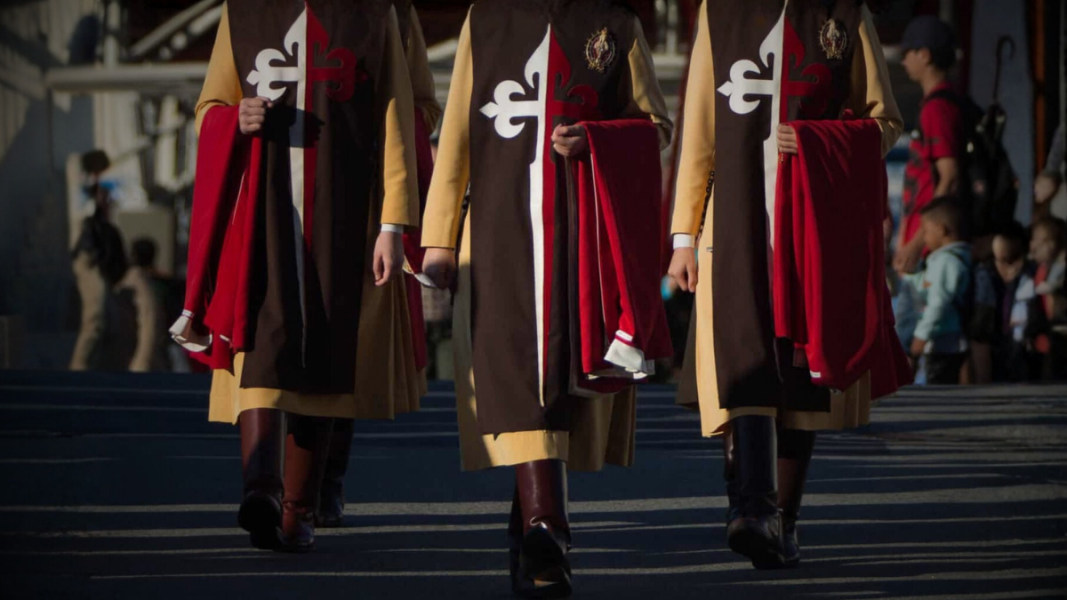
I start by confessing it without beating around the bush: I know almost nothing about the Heralds of the Gospel. Their aesthetic, to be honest, gives me the creeps: fabric armors, giant crosses, a medieval crusade vibe in the 21st century. It’s not, precisely, my sensibility.
But one thing is taste and another is justice. And the more I read about what they’ve done to them and how they’ve responded, the clearer another thing becomes to me: I deeply admire them.
You can’t stand up to power… unless you’re willing to pay for it
We’ve been hearing for years that this is the synodal Church, the Church of dialogue, the Church of listening, the Church of processes. All that is fine for slogans, but in practice, there’s a golden rule that everyone has learned quickly:
you don’t stand up to power.
And even less after twelve years of Bergoglian dictatorship, with a perfectly oiled court to reward the faithful of the regime and crush those who bother. Among the collaborators of that long iron stage was, by the way, the then prefect of the Congregation for Bishops, Cardinal Robert Prevost, today Leo XIV.
In that climate, most Catholic institutions have opted for what we could call the “turtle strategy”: retreat into their shell, save their small interests, avoid problems, and pray in silence for the storm to pass without destroying their house and bank account.
The Heralds have done exactly the opposite: they’ve decided to go all in.
Commissariats… and with the commissioner on the moral bench
The Heralds of the Gospel were commissared. Someone had to be commissared; the system needed a visible enemy, an “exemplary case,” a warning to navigators: this is how it ends for those who don’t align. Nothing new under the sun.
What is new—and almost unheard of—is the response. Instead of bowing their heads, asking forgiveness for existing, and discreetly disappearing from the map, the Heralds have done something that only occurs to those who haven’t lost their faith or respect for the truth:
they’ve compiled, documented, and published a complete chronicle of the outrage.
I’m referring to the volume The Commissariat of the Heralds of the Gospel. Sanctioned without evidence, without defense, without dialogue. Chronicle of the events 2017–2025, coordinated by Prof. Dr. José Manuel Jiménez Aleixandre and Sr. Dr. Juliane Vasconcelos Almeida Campos: more than 700 pages of facts, documents, decrees, notarial acts, canonical reports, letters, legal opinions, and testimonies.
And what they do in those pages is devastating: demonstrate that there was no process, no evidence, no defense, no dialogue. Just a chain of abuses of authority, dark maneuvers, interested leaks to the press, guilty silences, and an artificial construction of suspicions to justify a commissariat that—if the law were minimally respected—could never have been sustained.
Not only that: the book shows how, over time, the commissariat has ended up becoming a caricature of itself, to the point that the commissioner himself is morally “commissared,” put under the spotlight and questioned in his suitability. It’s hard to imagine a more perfect boomerang.
Fifteen terrible years without rights
There’s a phrase that hovers over this whole case, even if it’s not always said out loud: “we’ve lived fifteen terrible years”. Fifteen years in which canon law has been treated as an obstacle, a bureaucratic nuisance that can be twisted or ignored when it’s not convenient.
The Heralds’ book illustrates it with surgical precision: poorly drafted or directly altered decrees; decisions without motivation; generic and never-proven accusations; apostolic visits turned into fishing expeditions in search of crimes that don’t appear; restrictions imposed without basis; civil processes that end up exonerating the institution while in Rome they pretend nothing happened.
In summary: for too long, the law has been replaced by the will of the one in charge. And that, in the Church, is lethal. One thing is to believe in authority; another, very different, is to justify arbitrariness.
While everyone was silent, one institution decided to lose the fear
The most scandalous thing about all this is not that there have been abuses. That, unfortunately, we know and have seen in too many areas. What is truly scandalous is that, in the face of the abuses, almost everyone has been silent.
Veteran and recent religious orders have been silent. Catholic universities have been silent. Powerful ecclesial movements have been silent. Foundations and congregations that knew very well what was happening have been silent, but preferred to look the other way to not endanger subsidies, permits, privileges, or simply institutional tranquility.
And suddenly, there is an institution that doesn’t stay silent. An institution that, instead of accepting resignedly the role of docile victim, decides to put the entire process in writing, with names, dates, references, and appendices. An institution that dares to affirm, with facts in hand, that what has been done to them is a paradigmatic case of ideological persecution within the Church.
It’s not just about “defending their name.” It’s about something much more serious: defending the very idea that there must be a legal order in the Church. That decrees cannot be falsified. That signatures cannot be manipulated. That a commissioner cannot behave as if he were above the law. That the faithful and communities have rights, not just obligations.
What the whole Church owes to the Heralds
You don’t have to share the charism of the Heralds or enjoy their processions to recognize it: the entire Church owes them gratitude.
Because, by refusing to be crushed in silence, they have forced onto the table what everyone intuited and almost no one said: that in Rome, too many times, action has been taken “without evidence, without defense, without dialogue”. That people and works have been played with as if they were pieces on an ideological board. That the “visits” and “accompaniments” have been, in not a few cases, instruments of pressure and control.
If today there exists a detailed account of how that machinery works, it is largely thanks to them. And that is not only useful for their own case; it is a service, uncomfortable but necessary, to the entire Church. Any institution that tomorrow finds itself in the system’s crosshairs will know that it is not obliged to disappear in silence.
In a time when the word “synodality” is used to justify everything, the Heralds have reminded us, with facts and documents, that without justice there is no possible communion. That charity without truth becomes sentimentalism. And that authority without law degenerates into despotism.