


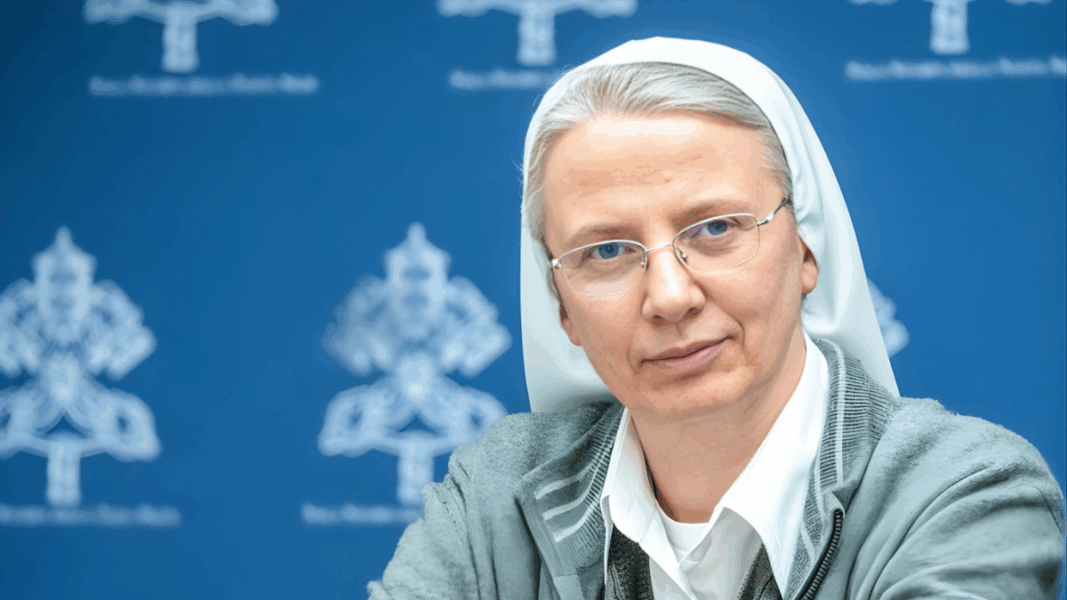
The case of the Heralds of the Gospel remains in the spotlight, with the resignation of Cardinal Damasceno on November 18 and the rejection of the request by Sister Simona Brambilla, prefect of the Dicastery for Institutes of Consecrated Life and Societies of Apostolic Life (DIVCSVA), on November 21, the future of this private association of the faithful remains in uncertainty.
Since 2019 they have been living under a pontifical commissariat imposed by the DIVCSVA. The measure was justified at the time by alleging the need to «verify» areas such as governance style, formation, finances, and community life. However, over the years, civil and ecclesiastical investigations dismissed the initial complaints, and yet the intervention not only remained in place, but became more opaque.
In this scenario, the figure of the Consolata missionary nun emerges: Sister Simona Brambilla. From Infovaticana we present a reconstruction of her profile according to what is exposed in the book: The commissariat of the Heralds of the Gospel. Chronicle of the events 2017-2025. Sanctioned without dialogue, without evidence, without defense, Coordinated by Prof. Dr. José Manuel Jiménez Aleixandre –doctor in Canon Law from the Pontifical University of St. Thomas Aquinas (Angelicum) in Rome– and Sister Dr. Juliane Vasconcelos Almeida Campos, doctor in Philosophy.
From secretary to prefect of the Dicastery
Sister Simona Brambilla appears linked to the case from the beginning of 2024 as secretary of the DIVCSVA, a position from which she signed official communications that marked the course—and the blockage—of the process. After the death of Pope Francis, in April 2025, she was appointed prefect of the dicastery, succeeding Cardinal João Braz de Aviz.
That is, she became the highest authority responsible for the commissariat of the Heralds of the Gospel at a critical moment.
Her rise did not bring changes to the organism’s line; on the contrary, it consolidated a stance that, according to the documents collected in the book, continued in the same restrictive direction as the previous stage.
The direct interlocutor of the pontifical commissioner
In February 2024, when Cardinal Damasceno traveled to Rome to present the complete progress of his work, Prefect Braz de Aviz refused to receive him. The only person in the dicastery who agreed to meet with him was Sister Simona Brambilla, then secretary. On that occasion, the commissioner left all the documentation in Brambilla’s hands, trusting that the material would reach its destination.
Later, already as prefect, Brambilla granted a long audience to the commissioner on May 16, 2025, accompanied by the dicastery’s canonist, Fr. Leonello Leidi. There she personally received a monumental dossier: 1,088 pages, with the complete balance of the commissariat since 2019.
Cardinal Parolin and Pope Leo XIV received only a summary. The only person who received the complete report was Sister Simona Brambilla.
Decisions that marked the course of the commissariat
The book documents that Sister Simona played a central role in key decisions that perpetuated the stagnation of the process.
Blockage of the Chapters and the Assembly
In the letter of March 8, 2024, signed by Braz de Aviz and Brambilla, it is confirmed that the convening of the General Chapters or the Assembly would not be authorized, the Dicastery would impose its own external specialists in theology and canon law, and an unusually harsh phrase directed at the commissioner is added:
«We ask you not to insist on this matter»
The tone of this communication made clear the dicastery’s will: nothing would advance.
The repeated argument of “insufficient deepening”
Despite the vast documentation presented, the decisions signed by Brambilla maintain that the indicated areas «have not been sufficiently deepened».
The commissariat, according to the dicastery, had not done what was necessary.
This, despite the fact that: Brazilian civil justice archived all complaints alleging lack of evidence. The Dicastery for the Doctrine of the Faith found no substance in the doctrinal accusations. The commissioner delivered exhaustive reports, with thousands of pages of annexes.
The dicastery’s position—and Brambilla’s—remained immovable.
Her influence in the final stage of the case
After her appointment as prefect, the decisions did not vary. In May 2025, Brambilla received the final report of the commissariat, but—according to the book’s documentation—it produced no sign of openness, response, or progress.
The commissariat continued without authorization to conclude its work.
The Chapters remained prohibited.
Legislative changes remained pending.
The intervention continued without a clear horizon.
In practice, Sister Simona Brambilla became the figure who consolidated the longest administrative and legal blockage that the Heralds of the Gospel have faced.
A decisive role in an immobile process
According to the documents provided, Sister Simona Brambilla has had a determining role in the case of the Heralds of the Gospel: First, as secretary who signs the most restrictive decisions. Then, as prefect who receives the complete documentation of the commissariat. Finally, as the authority who maintains the same line of blockage inherited from Braz de Aviz.
What remains, in light of the book’s analysis, is the portrait of a figure who—with external discretion but enormous internal power—has directed the evolution of the case toward a prolonged state of paralysis, without offering explanations, without responding to the commissioner’s exhaustive reports, and without showing intention to close a process that already exceeds five years.
https://infovaticana.com/2025/11/23/exclusiva-brambilla-rechaza-la-renuncia-del-cardenal-damasceno-como-comisario-de-los-heraldos/