


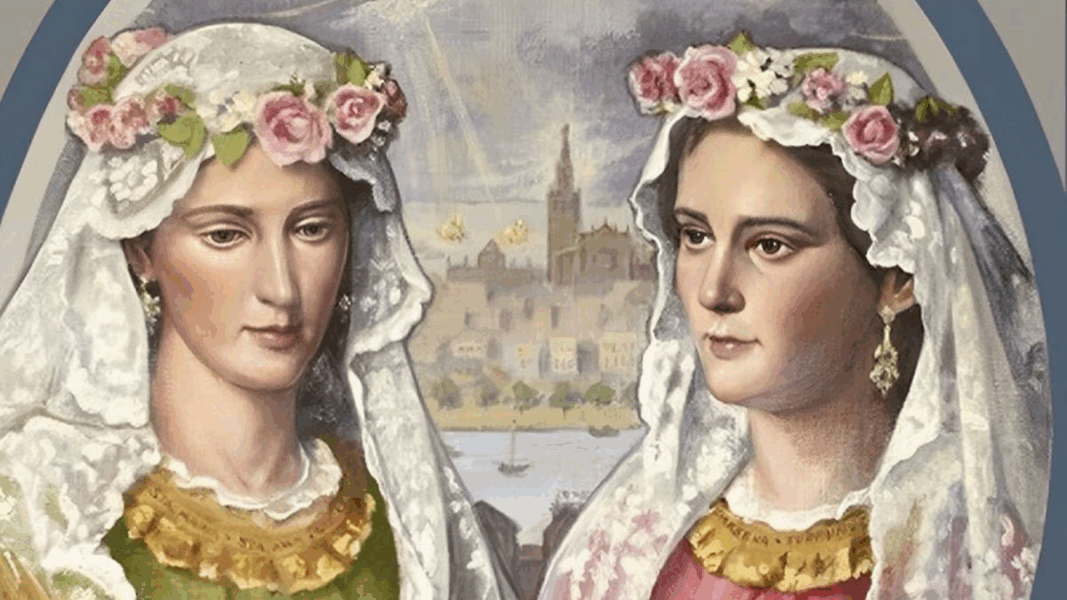
9th-Century Córdoba: Apparent Coexistence, Real Persecution
In the era of the independent emirate, coexistence between Christians, Jews, and Muslims was conditioned by Islamic legislation. The Mozarabs could maintain their worship, but under strict limitations: payment of special taxes, prohibition of building new temples, public restrictions, and absolute prohibition of any word considered offensive against Muhammad or Islam.
From the decade of the 840s onward, this situation hardened. Dozens of Christians were arrested for publicly denouncing Islam or for professing their faith without hiding it. This spiritual movement, led by figures like Saint Eulogius of Córdoba, defended the idea that no Christian should hide their faith out of fear of punishment. Within this context are situated the martyrdoms of Flora and Maria.
Saint Flora: Daughter of a Muslim Father and Christian Mother
Flora was born into a mixed family, which made her confession of faith especially dangerous. According to Islamic law, she was considered Muslim by paternal lineage, even though she had been educated in Christianity by her mother. Denouncing her faith before the authorities was, therefore, considered apostasy, a crime punishable by death.
After being denounced by her own brother, Flora was arrested and brought before the qadi. She was offered pardon in exchange for publicly renouncing Christ. Not only did she reject the proposal, but she calmly reaffirmed her Christian faith. She was imprisoned for months, subjected to constant pressures and threats that failed to break her.
Saint Maria: The Persecuted Nun Who Chose Martyrdom
Maria, also a Mozarabic Christian, lived consecrated to God in a women’s monastery. Her older sister, already martyred, had been executed for refusing to abandon Christianity. Maria followed her example.
She was arrested likewise for «blasphemy against Islam,» a common accusation against Christians who fearlessly defended the faith. Unlike Flora, Maria legally belonged to the Mozarabic community, but this did not protect her: the authorities considered her words a threat to the established political and religious order.
United in the Testimony of Christ
Both young women coincided in prison, where they mutually strengthened their faith. Saint Eulogius— an exceptional witness to those events— recounted in his Martyrdom Documents the fortitude and serenity with which Flora and Maria awaited the sentence.
On November 24 of the year 851, they were beheaded in Córdoba. Their bodies were thrown into the Guadalquivir River to prevent Christians from venerating them, but the Mozarabic communities kept their memory alive. Over time, they were incorporated into the group that history knows as «the Martyrs of Córdoba.»
Why Does Their Testimony Remain Relevant Today?
The story of Flora and Maria is not a marginal episode of the past. It reminds us that the Christian faith has been persecuted in Spanish soil itself under political systems that considered themselves hegemonic. Their martyrdom demonstrates that religious freedom is not a value assured by default, but a conquest that can always be threatened.
They also challenge today’s Church: both preferred truth over survival, fidelity to Christ over comfort. Their example dismantles the myth of an «idyllic coexistence» in Al-Andalus, so often repeated in contemporary cultural discourses that omit the limitations and repressions suffered by Christians.
Mozarabic Martyrs: Hispanic Root of a Resisting Faith
The martyrdom of Flora and Maria is part of a firm Hispanic martyrial tradition, cultivated during the Roman persecutions, prolonged under Islamic occupation, and still alive in modern centuries against other totalitarianism. Their blood is part of Spain’s history, its Christian identity, and the faith that has shaped its civilization.
In a time that relativizes everything, the testimony of these two young women restores clarity: Christ deserves to be confessed even when the world demands silence. They did not remain silent. And the Church remembers them because their lives, though brief, were luminous.
The Value of Martyrdom
Saint Flora and Saint Maria of Córdoba are examples of Christian courage in a context of political and religious pressure. They did not seek death, but accepted martyrdom as a consequence of their fidelity. Their faith was stronger than fear, and their memory continues to be a call to remain firm amid any persecution, open or covert.