


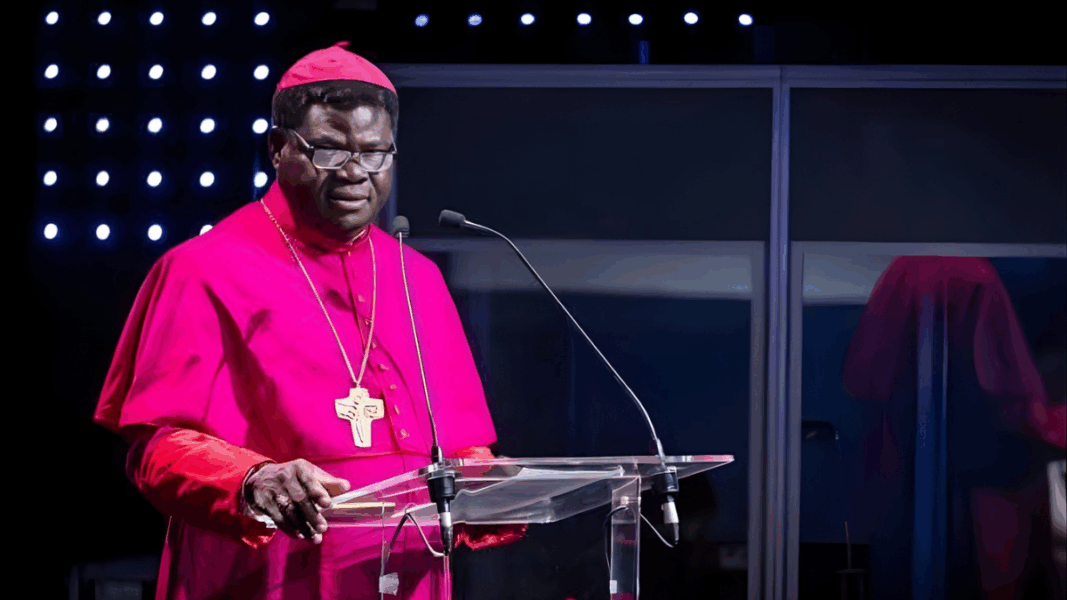
Bishop Wilfred Anagbe, of the diocese of Makurdi, warned U.S. legislators that Christian communities in northern and central belt Nigeria could disappear if the international community does not act quickly in the face of the escalation of religious violence plaguing the region.
According to The Catholic Herald, the prelate appeared on November 20, remotely, before the House Foreign Affairs Subcommittee on Africa, where he offered direct testimony on the magnitude of the attacks perpetrated against parishes, schools, and Christian villages.
“Without urgent intervention, Christianity could be eradicated”
Anagbe left no room for ambiguity.
“Without rapid intervention, Christianity is at risk of elimination in parts of the north and the Middle Belt in a very short time,” he stated with visible exhaustion.
His words coincided with a new attack: that same day, armed men burst into a Catholic boarding school in western Nigeria and kidnapped children from their dormitories.
The bishop explained that, despite Nigeria’s recent designation as a Country of Particular Concern by the United States—a status that recognizes serious violations of religious freedom—this symbolic measure “does not replace the need for coordinated political, military, and humanitarian intervention.”
Systematic attacks: churches burned, villages razed, and families fleeing
During his intervention, Anagbe recounted a chain of attacks that have devastated communities in his state, Benue, one of the hardest hit by Islamist extremism and violence from armed groups. He recalled that several members of his family were killed on May 22, when his native village of Aondona was attacked.
He described a bleak panorama: temples set on fire, families displaced, and thousands of Christians living in makeshift camps, exposed to new attacks.
“The blood of Nigerian Christians cries out to you. We cannot wait any longer. Inaction emboldens extremists,” he insisted.
He called for specific sanctions—including measures under the Magnitsky Act—and a significant increase in humanitarian aid for displaced families.
U.S. legislators acknowledge the failure of the Nigerian government
The committee chairman, Congressman Chris Smith, declared that “Nigeria is ground zero for religious persecution.” He denounced that authorities in Abuja have avoided admitting the religious component of the attacks and demanded imposing conditions on U.S. aid, as well as visa bans and asset freezes on those responsible for the atrocities.
Both Republicans and Democrats agreed that the Nigerian government has failed to protect Christian communities.
A pattern of religious persecution: Boko Haram and armed Fulani groups
Officials and experts present recalled that attacks on churches, Christian villages, and priests’ residences follow a systematic pattern. It is not— they warned— “common criminality,” but an ideologically motivated campaign that groups like Boko Haram and radicalized elements of Fulani militias have been extending for years across the north and central belt of the country.
This deterioration has strained Nigeria’s international relations, which faces pressure from other governments to recognize the religious nature of the violence, as required by the U.S. International Religious Freedom Act.
Bishop Anagbe, international voice of Christian suffering in Nigeria
The prelate had already issued similar warnings in the British Parliament earlier this year, at an event organized by Aid to the Church in Need. There he stated that Benue has become a battlefield where Islamist extremists and violent herders attack defenseless villagers “without consequence.”
He asked the United Kingdom to condition its relations with Nigeria on the restoration of displaced communities and the guarantee of justice for victims.
Born in 1966 and ordained a priest in 1993, Wilfred Anagbe was appointed bishop of Makurdi in 2015. His diocese is one of the most affected by violence in the Middle Belt region, and he has become one of the strongest voices in defense of persecuted Christians in Nigeria.