


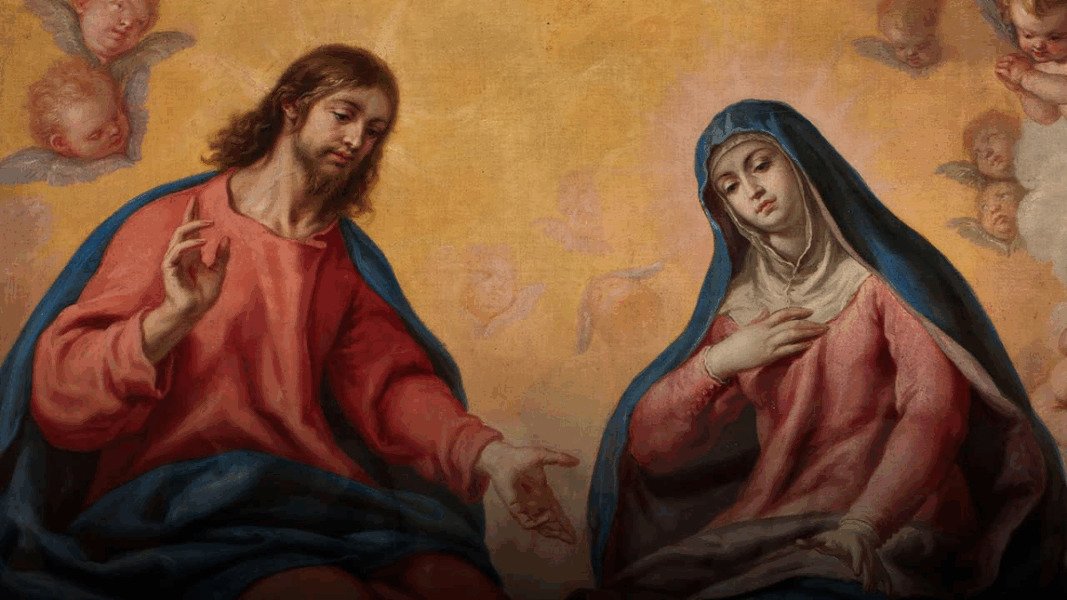
I
Whether or not we have deep knowledge of dogmatic theology or biblical exegesis, I believe it is a duty of every fervent and well-formed Christian (and with a settled «sensus fidei«), to try to defend what our ancestors (including many Popes) firmly believed: that «our God and Savior Jesus Christ» (2 Pet. 1:1), «born of woman» (Gal. 4:4), wished to associate that woman, the Blessed Virgin Mary, with his work of redemption. And that, his saving work being perfect and definitive in itself through the sacrifice of the cross, it was his will that she be linked in a special and unique way to that sublime immolation that merited the salvation of all men.
We have always upheld this peacefully, and using the term co-redemptrix without complexes. And now is the moment for each one to seriously ask why they believe it, beyond the fact that it is certain Catholic doctrine. To defend this truth, the faithful Catholic could educate themselves with good arguments from renowned theologians, or papal pronouncements from the past, and contrast them with the reasons why the Roman Note discourages its use (I want to assume that for a more prudential than ecumenical reason). Many have done so. But I prefer to follow my natural Christian instinct, rather than copy the abundant theological, liturgical, and Catholic tradition arguments from others to support this profound truth of faith. I know them, of course, and although I may cite some, I consider it more appropriate for my Christian heart to speak (sometimes the reasons it has are more powerful than those of the head, as Pascal points out) because I truly feel, in this matter, that «the zeal for your house consumes me.»
The Code of Canon Law itself states that «the faithful have the right, and sometimes even the duty, in virtue of their own knowledge, competence, and prestige, to manifest their opinion on those things which pertain to the good of the Church» (Canon 212).
Consequently, whether or not I possess knowledge or competence (prestige certainly not), I am a Catholic and I think the matter is too grave to remain silent. I will speak, therefore, of what my experience as a Christian, my theological studies, my passionate readings of the Bible, and my prayers have taught me, «always safeguarding the integrity of faith and morals, reverence for the Pastors, and taking into account the common good and the dignity of persons» (Canon 212 in fine). I believe this is one of those occasions when every Catholic, sheltered in what they have received from those who preceded them (2 Thess. 2:15-2 Tim. 2:2), not only must say «no» to certain unfortunate communications from the competent authority, but above all argue and «give a reason for their hope» (1 Pet. 3:15).
I humbly ask for the assistance of the Holy Spirit, for «though we are weak, he comes to our aid» (Rom. 8:26), and I place myself under the protection of my blessed mother in Heaven, who has never denied and will never deny what a Christian asks in praise of her Son. Because let us not be confused: recognizing Marian co-redemption does not diminish Christ’s perfect and definitive saving work, but quite the contrary. That Christ associated his blessed mother with his redemption honors the Son of God more than the Blessed Virgin Mary, for it thus reveals in a sublime way «the depth of the riches and wisdom and knowledge of God» (Rom. 11:33).
Consequently, I will set forth two convictions that I have matured in my Christian life:
a).- The mediation of the Christian in general.-
The first is that the term «co-redemption,» in my judgment, is certainly not the appropriate one to explain the cooperation of any Christian in grace for the salvation of others (by virtue of the impressive communion of saints), although it does reflect that idea in a certain way. Indeed, if in the Christian in grace the Holy Spirit dwells and fervently beseeches Christ not to allow the perdition of a brother, it is reasonable to think that, in many cases (if the Lord has willed to heed our supplication from his eternal Providence), we can help save his soul; that is, achieve that it accept Christ’s mercy in the last instant, if it is an inch from hell. That is why it is so necessary to pray for the dying (and also for the dead, for God there is no time), whether or not we have reasonable doubt about whether they have been saved. It may be that we do not achieve their salvation, but in all those cases in which that man attains it—if Jesus heeds our prayer, because he had foreseen doing so from before the times—we could affirm that we have been, in a certain way, «co-redeemers.» In any case, this word does not seem correct here, and we should better use the biblical terms of prayer of mediation, and efficacy of the prayer of the just. We Christians are born in sin and have been redeemed. And we know «by such a cloud of witnesses» (Heb. 12:1), that the title co-redeemer is exclusive only to Mary, who unlike us never had sin because she was redeemed preventively.» «While the Most Blessed Virgin has already attained perfection, the faithful still strive to grow in holiness» (Lumen Gentium 65).
b).- Mary’s co-redemption by the will of her Son.-
The second conviction is the one we just noted: Mary is the only «co-redemptrix» (only Christ is the Redeemer). In the case of the Blessed Virgin Mary, yes we can and must use it. Here the term acquires a much more real and intensive dimension because, being she the most powerful mediator (like Christians in a state of Grace) to whom we can also turn by her maternal condition, her intercession is—in fact, that is, by the experience of Christians of all centuries—infallible (in the sense of always effective and sure). I repeat so that no one is scandalized, it is a truth of fact; which means that, although it is not a Truth of faith (for the moment), it is Truth with a capital T. And I do not think any Christian—including Víctor Fernández—dares to deny it as such, for in that case they should, for example, anathematize as heretical the Memorare of St. Bernard and the sense of faith of the Christian people. But if it is infallible (in a factual sense) as we Christians believe, we must conclude that Mary not only mediates, not only intercedes but that, in doing so, she obtains the redemption of the interceded (because her Son always accepts it, since he wished to associate her with his sacrifice). The mediation of any Christian in grace is powerful but can fail. Hers, never. That is why she is co-redemptrix.
Next, I will try to develop both mediations in more detail—and with the authority of the Word of God.
II
The first thing is to know precisely what we are talking about with the word «co-redemption,» and there is an essential principle that we must always keep in mind, and never deviate from it:
For the Christian faith, there is only one redeemer, not two redeemers, and that redeemer is Christ, true God and true man, who with his sacrifice on the cross paid superabundantly the debt of human sin. He needs nothing or no one else. Scripture is unequivocal:
«There is salvation in no one else, for there is no other name under heaven given among men by which we must be saved» (Acts 4:12). And
«For there is one God, and there is one mediator between God and men, the man Christ Jesus» (1 Tim. 2:5).
Jesus saved us «once for all when he offered himself» (Heb. 7:27), so there are no longer or will there be new victims or new redemptive sacrifices. The unique sacrifice consummated with definitively expiatory efficacy, our duty as Christians is none other than to live in thanksgiving and obey the will of the Victim, who wished that we do this in remembrance of him (1 Cor. 11:24) (in the biblical sense, not a remembrance but a making present), to unite ourselves «as living sacrifices, holy and pleasing to him» (Rom. 12:1). To live eucharistically, in sum. That is why his unique and definitive sacrifice is actualized through the purified hands of the priest, in the memorial through which his salutary benefits are applied to us. And we will continue to do so—as he commanded us during the Last Supper (Lk. 22:19)—until the end of time.
Precisely in that public prayer—the Holy Sacrifice of the Mass—each Christian of the Church militant unites in prayer with the Triumphant Church in Heaven, but «in primis gloriosae semper virginis Marie genitrice Dei (Roman Canon)—in the first place, with her—to implore not only their own salvation. Also with the hope of being able to obtain it for all those for whom we pray, in the certainty of faith of the «immense value before God of the fervent prayer of the just» (Jas. 5:16).
That is a luminous truth, recalled by the Sacred Scriptures as well as by the popes: that God grants powerful efficacy to the fervent prayer of the man who is in his Grace—especially united to the Priest in the Sacrifice of the Altar—because he confers on him the power to contribute to saving (to redeeming) a soul in danger of damnation. For example, Pius XII, in his encyclical Mystici Corporis Christi of 1943 (no. 44):
«Misterium sane tremendum (…), quod hominum multorum salus a precibus et voluntariis expiationibus membrorum Corporis mystici Iesu Christi»
«A truly awe-inspiring mystery that the prayers and voluntary sacrifices of the members of the Mystical Body of Jesus Christ have saving efficacy for many«
Despite everything, I reiterate that I consider it inadequate to qualify that mediatory or intercessory action of the Christian in a state of grace as co-redemption, even knowing that in him the Holy Spirit dwells and therefore he is truly divinized, already here on earth. Strictly speaking, as I pointed out earlier, that term we must apply to the most important mediators by infallibility, the original mediator (or as the classical theologians say by merit de condigno, Christ) and the subordinate mediator par excellence, mediator by merit de congruo (the Blessed Virgin Mary).
But let us leave aside the previous scholastic distinctions and focus on the conviction that the Lord hears our prayers. And although it is true that sometimes—too many—» you do not know what you are asking» (Mt. 20:22) (which never happens with the Virgin Mary, who asks and obtains, for example in Cana of Galilee), the insistence and perseverance of the just has its reward, for God «Will not God vindicate his elect, who cry to him day and night?» (Lk. 18:7).
And let us also remember what, in the Gospel of John, the Lord assures us:
«Truly, truly, I say to you, whoever believes in me will also do the works that I do; and greater works than these will he do, because I am going to the Father. Whatever you ask in my name, this I will do, that the Father may be glorified in the Son» (Jn. 14:12).
Therefore, let us never underestimate our intercession and be conscious of the immense dignity—and spiritual power—that we possess as true children of God. And as for the difficulty of the cited biblical texts, especially 1 Tim. 2:5, as the theologian Cándido Pozo explains after careful exegesis, it is clear that the redeemer, Christ, is «one,» which means that he is «one alone (that is, the same person) and is mediator with respect to all.» This implies that «the word ‘one’ does not oppose the possible existence of subordinate mediators, but rather limits the mediatory efficacy of Christ Jesus, for He encompasses the totality of men in his action. Thus, the text only affirms that there is a unique mediator, that is, the same and unavoidable for all, but it does not address whether that mediation is compatible or not with the existence of subordinate mediators» (Cándido Pozo, Mary, New Eve, p. 364).
III
We come to the moment of explaining why I believe with certainty that Mary is legitimately «co-redemptrix.» And why I consider that, being an error against the Catholic faith to place her mediation on the same level as that of the unique redeemer, Christ Our Lord (an error in which, by the way, I have never seen any sound Catholic fall), it is an absurdity to try to banish for spurious (ecumenical) reasons this legitimate Marian title, endorsed by Catholic tradition. Therefore, neither «false exaggeration,» nor «excessive narrowness of spirit» (Lumen Gentium, 67). By excess or by defect we cannot err, and therefore it is advisable to assure ourselves with the Truth of the Sacred Scriptures, as the Catholic Tradition has always understood them, the only way by which we are exempt from erring.
And an attentive and constant reader of the Sacred Scriptures perceives something crucial: both Jesus Christ and Mary (God-man the first and created creature the second), are the only biblical characters who appear and simultaneously: at the beginning of the history of salvation, at the culminating moment of that redemption, and finally (through symbolic figures) in its consummation. That is, they are always linked to the salvation of fallen man.
Both characters are the nerve that runs through the entire Bible, from Genesis to Revelation, to transmit the light of salvation. They, and no one else. There is no need to highlight a specific act of association, when the Bible has associated them in every determining salvific milestone. Mother and Son emerge at the beginning, in the middle, and at the end of sacred history, and appear committed, beyond their maternal-filial bond, by an absolute enmity with a sinister figure who has ruined the lives of men and will desire to destroy the work of redemption, the devil. That is, as we will see next, the entire history of salvation is related to the two (even when Mary did not yet exist), which is a strong indication that Christ clearly wished to associate his blessed mother in his redemptive work. We examine those three moments:
(1).- At the beginning of the Sacred Book.-
Bereshit, In the beginning… We admire the Logos that creates light, but also, very soon, the woman mortal enemy of the serpent—of sin—will be mentioned. Indeed, we can find Our Lord Jesus Christ in the first Word heard in the Bible, a performative command in the midst of chaos: Let there be light. And this was not so much identified with a physical reality as with Wisdom (Wis. 7:26) and with Life (Jn. 1:4), the same aspirations that led our first parents to perdition, for in those two specific goods the devil tempted them: «you will know and not die» (Gen. 3:4-5). Gravest lie. Without Christ there is no life (Jn. 13:6), no wisdom (1 Cor. 1:24) and no salvation (Acts 4:12).
That is why Christ is the central figure of the entire Bible, from beginning to end. He creates, gives life, and redeems us.
But man falls. And then—first hope of humanity—a woman is announced to whom God has granted the gift of having perpetual enmity with the serpent, and from her seed will arise the one who will crush the reptile’s head (that is, kill it), although it will harm him and wound his heel (Gen. 3:15).
It is the Protoevangelium, which not only mentions Christ’s triumph in crushing the serpent’s head after an immense sacrifice—kenosis and a death on the cross (Phil. 2:7-8), symbolized in the heel wound—but also, mysteriously, the woman from whom the seed that will destroy it will arise. I use that adverb because if the inspired writer wanted to allude to the redemptive action of the fruit of that woman, of Christ, it would have sufficed to say: «the seed of a woman will crush your head, while you wound his heel,» taking for granted that enmity. But it actually points to much more, it expresses a radical enmity serpent-woman, in such a way that she is cited in Scripture even before the redemptive seed. The enmity of Gen. 3:15 is therefore not a antipathy limited to a specific moment, but rather an absolute and permanent aversion, from the beginning to the end of the human adventure. Simply because that incompatibility is something that God confers on her, the Holy of Holies; it is not something that springs/springs from the natural goodness of that woman: I will put enmity, so here we speak of Grace, of supernatural Gift, which Christian reflection from very ancient times interpreted as the exemption from all stain of sin from the first instant of conception. Mary participates, as a creature, in the ontological holiness of God, and participates from when she was only the most beautiful idea of the Creator from all eternity. But she participates for a very specific purpose, which is none other than our redemption. The absence of original sin in Mary, with what it implies as a problematic exception to the universal rule (Rom. 5:12 ff.), makes no sense if not in order to our salvation. She was redeemed preventively, because Christ wanted to associate her with the redemption of the human race.
It is important, finally, to highlight that in the literal translation of the Masoretic Hebrew text, of the Septuagint and of St. Jerome’s Vulgate, the «seed» of the woman is the actor who crushes the reptile’s head, while in the first copies of the Vulgate—probably due to a copyist’s error—it is that same woman who performs the action. That providential equivocation, which has so influenced historically Catholic piety, iconography, and painting, confirms the strongest bond between both. Once again God writes straight with crooked lines.
In any case, if we want to delve deeper into that cooperation we must go to the decisive moment of the mother, the Son, and the history of humanity: the holy sacrifice of Calvary.
(2).- In the zenith phase of the history of salvation: the passion and death of the Son of God.-
The Psalms sing: «Precious in the sight of the LORD is the death of his saints» (Ps. 116:15). The wounded heel of the crucified Jesus fulfills the dramatic prophecy of Genesis. Beside Him (as the Gospel of John points out) his blessed mother, the Blessed Virgin Mary, the woman enemy of the serpent. Christ is crucified and she stands before her Son on Mount Calvary. In a certain way also crucified: Pierced.
Because to that woman, in an obscure way, the priestly drama of Calvary had been announced, by a prophet of old times—the elderly Simeon. He referred to her an enigmatic—and terrible—prophecy just at the moment when he had announced that her Son would be a «sign that is spoken against» (Lk. 2:34). To interpret this dramatic prophecy, «a sword will pierce through your own soul also,» as a mere metaphor for the pain of a mother who sees her Son cruelly murdered is to have a scant idea of the sense of biblical prophecy. Correction, it is to have no idea at all.
As the best theologians have explained, Jewish prophecy does not so much seek to anticipate future events, as to announce or explain a salvific event, transmit the Word of God to the people, interpret history in the light of Israel’s faith and ultimately, be a sign of hope in difficult historical moments. And that Mary was pierced spiritually, at the same time as her Son is—besides spiritual, materially—is something that is said exclusively of them; of no one else who was at Calvary at the hour of our redemption; neither of Mary Magdalene or the beloved disciple. They suffer for Jesus whom they love passionately; Mary suffers with Jesus whom she has engendered in her womb. Mary and the crucified Jesus share the same: a sacrifice for the redemption of man. Mary’s, derived and subordinate to Jesus’s. She dies spiritually with her Son, to become the mother of all sinners, the mother of each one of us. From mother of God to mother of sinners, Mary’s kenosis, in solidarity with that of her Son. Mary, refuge of sinners.
In the Old Testament, the prophet Isaiah foresaw the sufferings of the Servant of the LORD, all linked to a specific end of healing, of salvation. The Servant:
«Surely he has borne our griefs and carried our sorrows; yet we esteemed him stricken, smitten by God, and afflicted. But he was pierced for our transgressions; he was crushed for our iniquities; upon him was the chastisement that brought us peace, and with his wounds we are healed» (Is. 53:4-5).
That Simeon had foretold the Blessed Virgin Mary that same dramatic event of her piercing on Calvary (and significantly after the rite of her Son’s circumcision, his first blood shed), is the confirmation that God wished to link the sufferings of both for the same salvific purpose: Christ’s Passion on the cross, Mary’s Co-passion at the foot of the cross, both pierced. Our Lord’s Passion was and is the perfect sacrifice, but by his superabundant charity—by the «breadth and length and height and depth» (Eph. 3:18) of his love—it was very fitting that he give us Mary, the daughter of Zion, so that with her Co-passion, she be co-redemptrix, thus cooperating, with her powerful intercession (so powerful that it is infallible), to redeem sinful man. And as I pointed out at the beginning and will repeat again and again, Marian co-redemption neither takes away nor adds anything to Christ’s redemption, rather it illuminates it, manifesting its efficacy. To Him the only glory for willing it and doing it! And as Duns Scotus would say: «he willed to do it, he could do it, and he did it.»
Finally, the circumstance that Christ himself delivered his mother to the beloved disciple (Jn. 19:26-27) cannot be interpreted flatly as a domestic concern of the Lord before Mary’s future loneliness. She is given to us as mother of all and each of the Christians, because the Lord knows that we need her as sinners that we are. The moving phrase «and from that hour the disciple took her to his own home,» can only be understood in one way: whoever welcomes Mary into their home, into their life and into their heart, and listens to her sweetest voice that asks us: «Do whatever he tells you» (Jn. 2:5), need not fear for their salvation.
But there is something more relevant shortly after that episode. Mary will be established as mother of the Church. The proof is unequivocal: the next occasion we find her in the Sacred Scriptures is in the upper room with the disciples—the first Christian Community—»all these with one accord were devoting themselves to prayer» (Acts 1:14), awaiting the powerful outpouring of the Holy Spirit at Pentecost. She, from eternity, was proclaimed Mother of the Incarnate Word; from Calvary, Mother of sinners, and from Christ’s resurrection, Mother of the Church. And as such she will carry out her last intercessory and mediatory mission—co-redemptrix—together with her Son in this admirable history of our rescue until the Lord returns and recapitulates all for the glory of the Father, the Son, and the Holy Spirit.
(3).- At the close of the Scriptures and of all human history, where the heavenly destiny of the redeemed is culminated.
After the earthly death of both, they continue to operate our salvation from Heaven. Christ triumphed on the cross, «by canceling the record of debt that stood against us with its legal demands. This he set aside, nailing it to the cross» (Col. 2:14). And after his burial, he was «exalted at the right hand of God» (Acts 2:33), and «Heaven must receive him until the time for the restoring of all things about which God spoke by the mouth of his holy prophets long ago» (Acts 3:21).
As for the Blessed Virgin Mary «when the course of her earthly life was completed, she was assumed in body and soul into heavenly glory» (Apostolic Constitution «Munificentissimus Deus,» Pius XII, 1950).
From Heaven and throughout the history of the Church, Christ has offered and continues to offer to the Father—through the Holy Mass celebrated in every place on earth—his same and unique sacrifice for the redemption of sins and for the reconciliation of fallen man with God. And beside Him, his mother—as Queen Esther did with King Ahasuerus (Est. 8:4-6)—intercedes for sinners and obtains for us all the good she desires, as the most powerful mediator that she is. Until her Son returns.
Because he will return. And he will do so as monarch of a Kingdom that will have no end and «he will put all enemies under his feet,» all his enemies, including death, which will be the last defeated (1 Cor. 15:26-27, Rev. 21:4). A time and a Kingdom that we long for, but that we still cannot comprehend clearly (for «we see in a mirror dimly» (1 Cor. 13:12), although we have the certainty of faith that it will be established. And even certain signs of our time, in my humble opinion, point to the fact that those last or final times are not too far away.
And as it could not be less, in that last existential stretch that will lead to the glorious time where there will be «new heavens and a new earth in which righteousness dwells» (2 Pet. 3:13), mother and Son will continue united as they have been from the beginning, in the mission of defeating the serpent/devil—sin. But they are no longer just figures of history, but persons integrally glorified so that their unitary intervention in the concluding stage of the annals of humanity must be expressed prophetically through the symbol. And so John does it masterfully in the book that closes the Sacred Scriptures with a golden brooch.
Indeed, the glorious Christ of Revelation appears through three allegories, which signify his triple prophetic, royal, and priestly character: a Son of Man, who announces the destiny of the seven Churches (seven ages of Christendom (Rev. 1:13 ff.); the royal Rider on the White Horse, who will defeat the antichrist and the false prophet, and chain the devil (Rev. 19:11-21) and, finally, a Slain Lamb but brimming with wisdom and power, whose sacrifice redeemed men (Rev. 5:6-14). An impressive paradox, for he seems defeated and yet is the only one worthy to receive the exclusive titles of God: «Power, Strength, Glory, Wisdom, and Blessing,» and receive Adoration (Rev. 5:12-14).
And the same paradox—strength/weakness—we find in the powerful symbolic image of the beautiful woman clothed with the sun, who represents, at the same time, the Blessed Virgin Mary and the Israel of God or the Christian Church (Rev. 12:1).
Her triumph is accredited by wearing her crown of twelve stars (royalty over the Old and New Israel, that is, over all the saints), and her foot on the moon, treading the paradigm par excellence of the changeable and ephemeral (the world, «the first earth and the sea that will disappear» -Rev. 21:1-). Her weakness, however, is her painful state of childbirth and the threatening presence of a sinister red dragon that forces her to flee to the desert (Rev. 12:2-3), but which, in any case, will not prevail against her (Rev. 12:6-7). They are the dramatic times of the last battle against evil, of a Church returned to the catacombs and of the ephemeral reign of three and a half years of the Antichrist, before the coming of the Lord.
The Church will suffer greatly. But paradoxically the Christian is strong only in weakness (2 Cor. 12:10). Hand in hand with Mary it must ascend to the same Calvary, to be configured with her in faith, in obedience, and in fortitude of spirit before the immolated Son. The stations of Holy Thursday and Good Friday of Christ will have to be traversed by his «mystical body,» by his Church, in eschatological times, but always in fervent expectation of Easter Sunday. And when the Church—the faithful remnant that remains of it—is fully identified with the faith, obedience, and spiritual fortitude of Mary, it will glimpse on the horizon the royal rider who will save it from its enemies. Only then «he might present the church to himself in splendor, without spot or wrinkle or any such thing, that she might be holy and without blemish» (Eph. 5:27).
With all the enemies of Christ and man defeated forever—the last will be death (1 Cor. 15:26)—Revelation will employ the biblical metaphor par excellence to describe the time of imperishable happiness: the joy of a wedding and the banquet of the guests (that is, the salvation of the elect). Let us remember the prophet Hosea:
«And I will betroth you to me forever. Yes, I will betroth you to me in righteousness and in justice, in steadfast love and in mercy» (Hos. 2:19).
What was prefigured in the wedding at Cana—the love alliance of Christ with his Church—is now established forever, and the best wine will remain, the superabundant grace of Christ in the heavenly feast (Jn. 2:10). And then we will contemplate the Church as heavenly Jerusalem, as a bride adorned who descends to receive her spouse, the Lamb of God who takes away the sin of the world, and to whose eternal wedding festivities, to his heavenly celebration, all believers are invited. «Many waters cannot quench love, neither can floods drown it» (Song 8:7).
In short, from all that has been seen, four are the fundamental milestones of Mary’s co-redemptive collaboration in our salvation: (1).- the Woman of Genesis as prophecy; (2).- Mary’s divine Motherhood as historical fact; (3).- the full identification of the Church of the last times with Mary at Calvary, as premise of the glorious coming of Christ, and (4).- the espousals of the Church and the Lamb as metaphor of the future and eternal indissoluble unity of Mary and Jesus with his people. All of them unequivocally point to the same soteriological conclusion: Jesus Christ and Mary—she by the loving decision of her Son—accomplished our salvation together.
To conclude, how ironic it is that many fathers of the Second Vatican Council for ecumenical trifles rejected the independent schema on the Blessed Virgin Mary, to place her treatise as a mere appendix to the Constitution on the Church, Lumen Gentium, ch.VIII. Despite everything, the mercy of God—not exempt sometimes from fine irony—grants the prophetic gift to the «high priests,» no matter how unbelieving they are (see Caiaphas, Jn. 11:51). And, unwittingly, these announced a decisive eschatological sign: they probably opened the last stage of the history of salvation—as we perceive in Revelation—in which, as we have seen, our mother and co-redemptrix fully identifies with the Christian Church, which suffers but will triumph. It is the Church of Christ that will present itself adorned to its eternal wedding, as beautiful as a jeweled bride, and as resplendent as the heavenly Jerusalem that descends from Heaven for its sumptuous wedding with the Lamb of God (Rev. 21:2). May all of us be summoned and see ourselves happy there. May it be so.
May the Lord count us among his elect!
And may his blessed and sweet mother, co-redemptrix with Him, and who is also our mother, ensure our election! We Christians implore you; I implore you, mother:
«For never has it been heard that anyone who has recourse to you, imploring your aid and seeking your help, has been abandoned by you. With this hope I come to you, O Virgin of virgins, and though groaning under the weight of my sins, I dare to appear before your sovereign presence. Do not reject my supplications, but rather hear and attend to them benignly, Amen.«
A.M.D.G