


By Daniel Guernsey
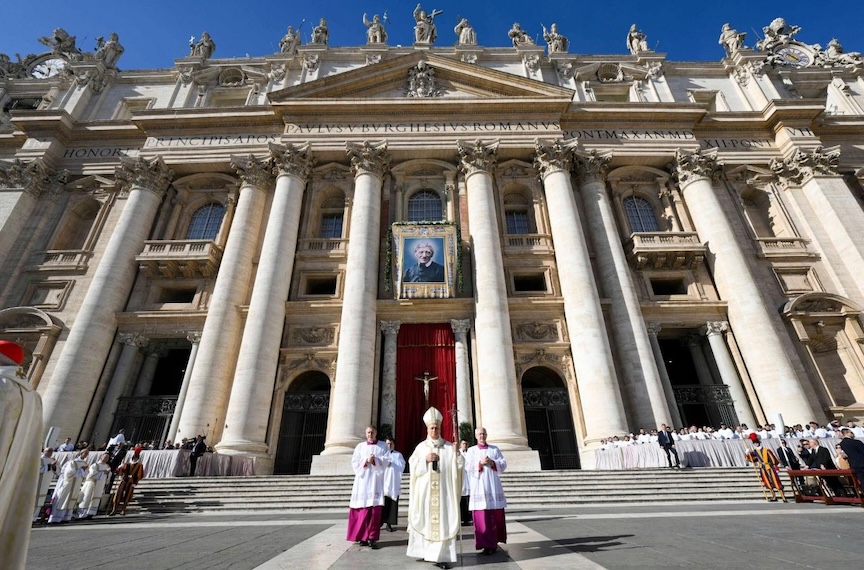
As part of the Jubilee celebrations, Pope Leo XIV presented in recent days a vision for Catholic education, and also declared St. John Henry Newman the 38th Doctor of the Church and co-patron (along with St. Thomas Aquinas) of Catholic education. These declarations are of great help at this time, because Newman’s educational vision is deeply Catholic, integrated, centered on truth and Christ, and a sure guide for Catholic educators around the world.
The Pope also addressed the participants in the Jubilee and the students, preached a homily and published an Apostolic Letter during the educational events. He touched on several traditional themes of Catholic education, but added his own noteworthy emphases, particularly a profound appreciation for St. Augustine.
First, he emphasized the importance of Augustinian “interiority,” quoting the saint: “Those whom the Spirit does not teach inwardly leave without having learned anything. . . . Do not look outward, return to yourself, for truth dwells within you.” Students need to develop an interior life, hindered by lives lived on screens or superficially in the world. He tells them: “Say in your heart: ‘I dream of more, Lord; I long for something greater; inspire me!’” Leo has clearly identified the need to help modern young people focus, interiorize, and turn silently to the Holy Spirit in their education.
A related papal theme, already recognizable, is the prudent use of technology. Leo encourages students: “Humanize the digital, building it as a space of fraternity and creativity—not a cage in which you lock yourselves, not an addiction or an escape. Instead of being tourists on the web, be prophets in the digital world!”
He also advises educators: “Technology must serve, not replace, the person; it must enrich the learning process, not impoverish relationships and communities.” Artificial Intelligence will have an enormous impact on education and human development. And the deep and human wisdom of the Church will be needed to use it correctly.
Furthermore, he underscores the importance of a solid Christian anthropology, given the rampant confusion of modernity: “The foundation remains the same. . . the person, image of God (Gn 1:26), capable of truth and relationship.”
It is clear that we must educate the whole person (mind, body, and spirit): “Desire and heart must not be separated from knowledge: it would mean dividing the person.” Educators must remember the primacy of the student’s spiritual development and learning the virtues that ‘cannot be improvised’.
Finally, he focuses on unity, referring to his Augustinian papal motto: “In Him who is One (Christ), we are One.” This constitutes a radical and wonderful Christology, also reflected in St. John Henry Newman’s educational vision.
One of Newman’s central insights in The Idea of a University is:
“All branches of knowledge are connected together, because the subject-matter of knowledge is intimately united in itself, as being the acts and the work of the Creator. Hence it is that the Sciences… have so much of a mutual relation and sympathy, and admit—or rather require—comparison and adjustment.”
This should encourage a profound appreciation for liberal arts education. Leo supports this vision with statements like: “The Catholic school is an environment in which faith, culture, and life are interwoven. It is not simply an institution, but a living setting in which the Christian vision permeates every discipline and every interaction.” And also: “Following the thought of St. John Henry Newman, [Catholic pedagogy] goes against a strictly mercantilist approach that often measures education by its functionality and practical utility.”
Leo’s support for classical Catholic education offers a remedy for those seeking something different from modern secular education, which has been put on trial and found deficient.
However, there are some troubling elements amid these excellent observations. Leo repeats Pope Francis’s support for the ‘Global Educational Pact’, a completely secular project loaded with trendy environmental and social justice themes, and a distraction from the Christian light that Catholic schools bring to these and almost all other matters.
Progressive leanings also appear in the letter, such as the tendency to favor novel causes and certain worn-out language from the previous pontificate (“building bridges,” etc.).
At times it seems to pull its punches, with statements like: “The Church is ‘mother and teacher’ not by supremacy, but by service.” Pius XI’s educational encyclical Divini Illius Magistri expresses it with very different boldness: “Education belongs primarily to the Church by a double title in the supernatural order, conferred exclusively by God Himself; absolutely superior, therefore, to any title of the natural order.” Offering revealed teaching is precisely our Catholic service.
Unfortunately, the title of the Letter itself, “Drawing New Maps of Hope”, establishes an extended metaphor about maps and constellations. But sometimes the metaphors get confused or clash, or risk dissipating into thin air. We do not get a clear map; we do receive inspiration.
In the end, however, these four new documents show Leo as an eloquent defender of Catholic education. His chosen themes help propel the essential task of Catholic education. And in doing so, he continues to remind students and educators: “Look even higher, to Jesus Christ, ‘the sun of justice’ (cf. Lk 1:78), who will always guide you along the paths of life.”
About the author
Dan Guernsey, Ed.D., is a Senior Fellow of the Cardinal Newman Society and Director of the Master’s Program in Catholic Educational Leadership at Ave Maria University.