


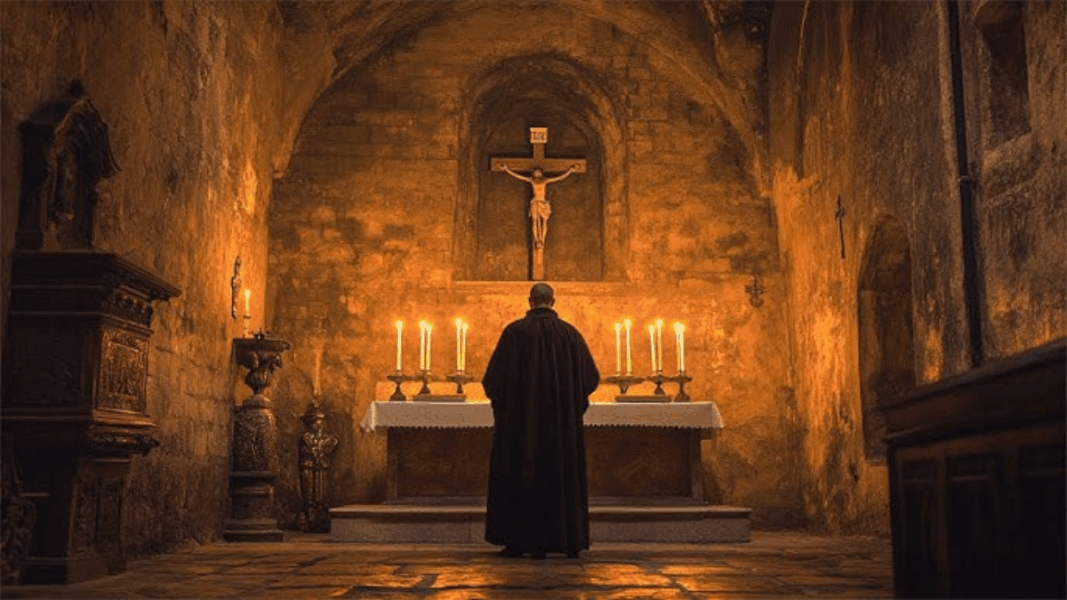
A reflection published by Silere Non Possum presents a stark diagnosis of the situation in many monasteries in the West. Behind the crisis lies not only aging or a lack of vocations, but a deeper change: the displacement of the center of religious life from the Mystery to human categories, shaped by contemporary culture.
A silent shift toward the self
For decades, numerous communities have undertaken renewal processes motivated by good intentions: updating the liturgy, dialoguing with the modern world, addressing internal fragilities, or seeking new forms of expression. However, without solid discernment, these initiatives can foster a Christianity that revolves increasingly around the individual.
Adjustments in language, celebrations, or internal dynamics, even when born of pastoral motives, can lead to a spirituality centered on one’s own experience. When prayer becomes self-representation and the Word of God an echo of one’s own emotions, monastic life loses precisely what defines it: verticality, the gaze toward the eternal.
Five decades of reforms and an unexpected consequence
Religious life has gone through a long period of transformations. Some have been necessary; others have led to the loss of elements that sustained monastic identity. To this trend has been added a narrative that has taken hold strongly: the awareness of “precariousness.”
What began as a phase of adaptation has become, for certain monasteries, a permanent state. The sense of fragility ends up blocking any impulse for renewal. One learns to survive in uncertainty, but not to unfold the charism anew.
In this climate, tranquility can disguise a subtle form of interior capitulation. When the priority ceases to be holiness and becomes self-preservation, monasticism becomes sterile.
Communities that stop expecting new life
One of the most worrying phenomena is the withdrawal of some monasteries into themselves. They are no longer lived as places of birth for new generations, but as spaces to protect the calm of the last members. The daily rhythm is preserved, but the ardor is lost.
The risk is evident: confusing stability with resignation. Monastic life does not consist in preserving walls, but in safeguarding a fire. The monastery exists to affirm to the world that God is real, not to ensure a quiet end.
Inculturation that weakens identity
Inculturation is often discussed in a missionary key, applied to distant contexts. However, there is a more imperceptible and harmful form of inculturation: the adoption of the dominant mentality, marked by personal well-being, relativism, and the absence of transcendent references.
When that logic penetrates religious life, it ends up shaping expectations, criteria, and even prayer. If the environment does not speak of God, the monk may become accustomed to expecting nothing from Him. Authentic fidelity does not consist in adapting the charism to the world, but in letting the charism transform the world.
A crisis born of the loss of height
The true conflict between consecrated life and modernity is not moral, but metaphysical. It is not just about norms or behaviors, but about the disappearance of the sense of holiness, of the greatness of a God who transcends and transforms.
Without this spiritual height, even the most balanced rules become empty. Forms of relativism arise that do not deny principles, but mold them to convenience. And where there is no height, there are no vocations: nothing invites one to embark on a path that seems not to lead to transformation.
The timeless path: recovering the gaze toward God
Throughout history, monks have understood that religious life is not sustained by strategies or administrative reforms, but by the decision to take God seriously. The Rule was never a refuge for comfortable souls, but a path that promised true conversion.
Every time this tension toward the heights weakens, monasticism falls into routine. Every time it is reborn, communities capable of attracting and fructifying emerge.
And, as Silere Non Possum reminds us, there is no scandal in monasteries disappearing. What matters is not preserving places, but transmitting the fire of the charism where it can ignite new lives.
A necessary mission in times of uncertainty
The current world is going through a stage of confusion, insecurity, and searching. Precisely here, monastic life has a decisive task: to be a visible sursum corda, a sign that reminds the world that hope is not theory, but experience.
The future of monasteries will not depend on survival strategies, but on a return to the origin: men and women who forget themselves to lift their gaze toward God, and from that height offer the world a testimony that cannot be replaced by any structure or program.