


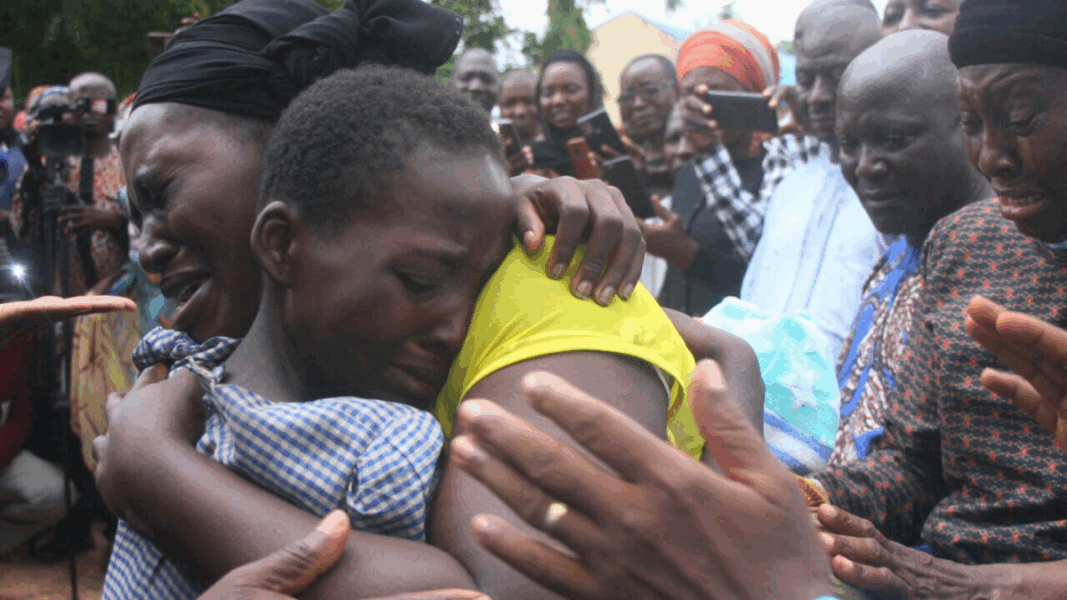
More than 300 children and teachers have been kidnapped in one of the most serious attacks recorded in Nigeria in recent years. Armed men burst into St. Mary’s School in the early hours of Friday, a Catholic school located in Papiri, in Niger State, and took away 303 students and 12 teachers, according to the Christian Association of Nigeria.
The figure even surpasses that of the girls kidnapped in Chibok by Boko Haram in 2014, making this tragedy one of the most shocking mass kidnappings the country has suffered.
The attack occurred around 02:00 in the early morning, when the assailants entered the school’s dormitories. The police have reported that security forces are “combing the forests” in the area to try to locate the minors.
Relatives of the students describe a scene of absolute anguish. A woman said through sobs that her nieces, aged six and thirteen, are among those kidnapped: “I just want them to come home.”
The authorities of Niger State have ordered the closure of all schools in the state following the attack and accuse St. Mary’s School of not having complied with a previous instruction that required closing the boarding schools due to the high risk of attacks.
A week of extreme violence
This mass kidnapping is the third serious attack that Nigeria has suffered in just one week. On Monday, more than twenty female students—Muslims—were kidnapped from a boarding school in Kebbi State. And in Kwara State, an attack on a church left two dead and 38 people abducted.
The growing insecurity has led President Bola Tinubu to cancel all his international trips, including the one planned for the G20 summit in South Africa.
In the United States, some political leaders—including former President Donald Trump—have once again denounced that Christians are being persecuted in Nigeria. The Nigerian government rejects these accusations and assures that it is indiscriminate criminal violence, but from the United States, actions are announced in the face of the international community’s passivity and the regrettable lukewarm Vatican response.
Pope Leo XIV expresses his “deep concern”
Pope Leo XIV expressed his deep concern and closeness to the affected families during Sunday’s Mass. The Pontiff is closely following the evolution of the kidnapping and has asked that “all necessary efforts” be made to achieve the release of the children and teachers.
Likewise, the Pope has recalled the duty to protect minors and to safeguard religious freedom in regions where Christian communities suffer repeated attacks.
A violence with multiple dimensions
Although the Nigerian government maintains that these attacks have no religious motivation, organizations that monitor violence in the region emphasize that jihadist groups—active for more than a decade—select Christian targets, such as churches and confessional schools.
In the center of the country, the conflict between pastors, mostly Muslims, and farmers, mostly Christians, also persists, where disputes over land and resources often intermingle with religious identities. However, the social background does not minimize the religious component of the persecution. All religious persecutions in history where martyr’s blood was shed were based on socio-political excuses.
Eleven years after the Chibok kidnapping, more than a hundred girls remain missing. The country is now reliving the same nightmare as hundreds of families await news from St. Mary’s School.
The Echo of Parolin’s Words
A few weeks ago, at an event organized by Aid to the Church in Need, Cardinal Pietro Parolin downplayed the situation by saying that many episodes of violence in Africa are “tribal issues, not religious.” His statements—prior to this kidnapping, but now resounding with an echo that shames—were received with discomfort in the continent’s Christian communities.
For many Nigerian Catholics, everyday experience disproves that reading: attacks on schools, parishes, and Christian villages are, for them, an evident reality. That is why Pope Leo XIV’s words are welcomed with special relief, for his closeness and for his recognition of the suffering experienced on the ground.