


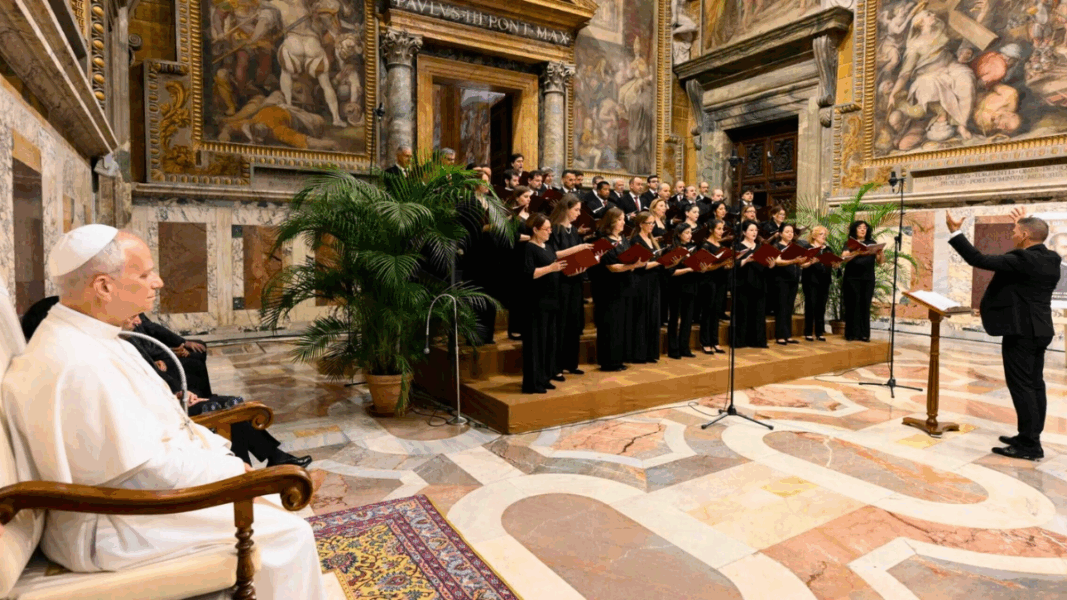
During the Mass for the Jubilee of Choirs and Choral Groups, held today in St. Peter’s Square on the occasion of the solemnity of Christ the King, Pope Leo XIV delivered an extensive homily dedicated to the spiritual, pastoral, and community mission of sacred music. The Pontiff emphasized that liturgical singing is not an accessory element, but an expression of God’s love and a tool for the unity of the Church. He invited the choristers to live their service with humility, interior discipline, and deep spiritual life, avoiding exhibitionism and promoting the participation of the entire People of God.
We leave below the complete homily of Leo XIV:
Dear brothers and sisters:
In the responsorial psalm we have sung: “Let us go with joy to meet the Lord” (cf. Sal 122). The liturgy of today invites us, therefore, to walk together—in praise and joy—to meet our Lord Jesus Christ, King of the Universe, the meek and humble sovereign, He who is the beginning and the end of all things. His power is love, His throne is the cross and, through the cross, His kingdom radiates in the world. “God reigns from the wood” (cf. Himno Vexilla Regis) as Prince of peace and King of justice who, in His Passion, reveals to the world the immense mercy of God’s heart. This love is also the inspiration and the reason for their songs.
Dear choristers and musicians, today you celebrate your jubilee and thank the Lord for having granted you the gift and grace of serving Him by offering your voices and talents for His glory and for the spiritual edification of your brothers (cf. Conc. Ecum. Vat. II, Const. Sacrosanctum Concilium, 120). Your task is to involve them in the praise of God and to make them participate better in the liturgical action through song. Today you express precisely your iubílum, your joy, which arises from a heart flooded with the joy of grace.
The great civilizations have given us music so that we can manifest what we carry deep in our hearts and that words cannot always express. All the feelings and emotions that arise within us and from a living relationship with reality can find voice in music. Song, in particular, represents a natural and complete expression of the human being; in it the mind, feelings, body, and soul unite to communicate the great things of life. As St. Augustine reminds us: «Cantare amantis est» (Sermon 336, 1), that is, «singing is proper to one who loves». He who sings expresses love, but also pain, tenderness, and the desire that dwells in his heart and, at the same time, «loves the one to whom he sings» (Commentary on the Psalms, 72, 1).
For the People of God, song expresses invocation and praise; it is the “new song” that the risen Christ raises to the Father, making all the baptized participants in it, as a single choir animated by the new life of the Spirit. In Christ we are singers and, at the same time, we are the song; and our song, fruit of grace, reaches heaven in the immense symphony of the saints, confident that He welcomes our humble service and makes of it an acceptable offering.
St. Augustine also exhorts us to walk singing, like weary travelers who find in song a foretaste of the joy they will experience upon reaching their goal. «Sing, but walk […], advance in goodness» (Sermon 256, 3). Therefore, being part of a choir means advancing together by taking brothers by the hand, helping them to walk with us and singing God’s praise with them, consoling them in sufferings, exhorting them when tiredness seems to overcome them, infusing them with enthusiasm when fatigue seems to prevail. Singing reminds us that we are the Church on the way, an authentic synodal reality, capable of sharing the vocation to praise and joy with all, in a pilgrimage of love and hope.
St. Ignatius of Antioch also uses moving words relating the choir’s song to the unity of the Church: «In your symphonic and harmonious love it is Jesus Christ who sings. Let each one of you also become a choir, so that, in the harmony of your concord, you may take on the tone of God in unity, sing with one voice through Jesus Christ to the Father, so that He may hear you and recognize you by your good works» (To the Ephesians, IV). Indeed, the different voices of the choir harmonize with one another giving life to a single praise, a luminous symbol of the Church, which unites all in love, in a single and gentle melody.
You belong to choirs that carry out their activity mainly in liturgical service. Your ministry demands preparation, fidelity, mutual understanding and, above all, a deep spiritual life, so that, if you pray by singing, you help everyone to pray. It is a ministry that requires discipline and a spirit of service, especially when it is necessary to prepare a solemn liturgy or some important event for your communities. The choir is a small family of different people united by love for music and by the service they offer. But remember that your great family is the community; you are not ahead, but part of it, with the commitment to make it more united, inspiring it and making it participate. As in all families, tensions or small misunderstandings can arise, normal things when working together and striving to achieve a result. We can say that the choir is a sign of the unity of the Church which, oriented toward its goal, walks in history praising God. Although the path is sometimes full of difficulties and trials, and moments of joy alternate with others of greater fatigue, song makes the step lighter and encourages us to go forward.
Commit yourselves, therefore, to transforming your choirs more and more into a prodigy of harmony and beauty; be the most luminous soul of the Church that praises its Lord. Study carefully the Magisterium, which indicates in the liturgical documents the best norms to develop your service to the fullest. Above all, be capable of always making the People of God participate, without yielding to the temptation of exhibitionism, which excludes the active participation of the entire liturgical assembly in song. Be, in this, an eloquent sign of the Church’s prayer, which expresses its love for God through the beauty of music. Watch over your spiritual life so that it is always up to the service you perform, so that this may authentically express the grace of the liturgy.
I commend you all to the protection of Saint Cecilia, the virgin and martyr who, here in Rome, has raised with her life the most beautiful song of love, giving herself totally to Christ and offering to the Church her luminous witness of faith and love. Let us continue singing and make our own, once again, the invitation of the responsorial psalm of today’s liturgy: “Let us go with joy to meet the Lord”.