


A few years ago, I was in Balaguer (diocese of Urgell, province of Lérida) for work reasons on the day of the Presentation of the Child Jesus in the Temple and the Purification of Mary, February 2.
In the city, with about twenty thousand inhabitants, there is a convent of Poor Clare nuns, of which the basilica of the Holy Christ of Balaguer (jubilee temple) is the conventual church. It is one of the oldest Poor Clare convents on the Iberian Peninsula, where the original community was replaced just over a decade ago, due to the transfer of the community because of its aging, by another community that is quite sui generis: an elderly Spanish abbess and 8 or 9 young nuns from Guatemala. A case of what the late Pope Francis defined, with his usual vulgarity, as “artificial insemination of vocations.” Which, though vulgar, is no less true.
The Mass at the nuns’ convent suited me very well schedule-wise, being early in the morning, and I attended. The “staging” was already quite strange. But one is already accustomed, unfortunately, to seeing all kinds of oddities in the Catholic liturgy. There were few faithful; I don’t think more than fifteen. The religious community, instead of being during the Mass in what appears to be a side choir with a magnificent grating, were seated in the presbytery, on both sides of the altar, in folding chairs, in the manner of two choirs, with their chant books placed at the feet of the chairs (it reminded me of my university years, with all the books on the floor around those uncomfortable chairs with a writing platform).
The Mass proceeded in a “normal” /bland way ( “rat-like” liturgy, as a great friend defines it; the one that has led thousands of Catholics to the loss of faith). Nothing striking. No mystery. The abbess played an organ and some nuns sang into a microphone, all impeccable in their beautiful habits. But then something strange happened: when the moment of consecration arrived, one of the sisters went toward the tabernacle with a piece of cloth in her hand, opened the tabernacle and extracted a chalice, which she placed on the altar. The priest consecrated two chalices and, at the time of Communion, placed one of the chalices on the far right end of the altar and, while he went to give Communion to the few faithful who were in the pews, the nuns, in a line, took the consecrated host with their hand, dipped it into the chalice, and received Communion in a self-service ceremony under both species. As far as I know, that way of receiving Communion is not permitted by the Church. Nor did the number of faithful justify consecrating two chalices and having the religious receive Communion in that manner, which seemed scandalous to me.
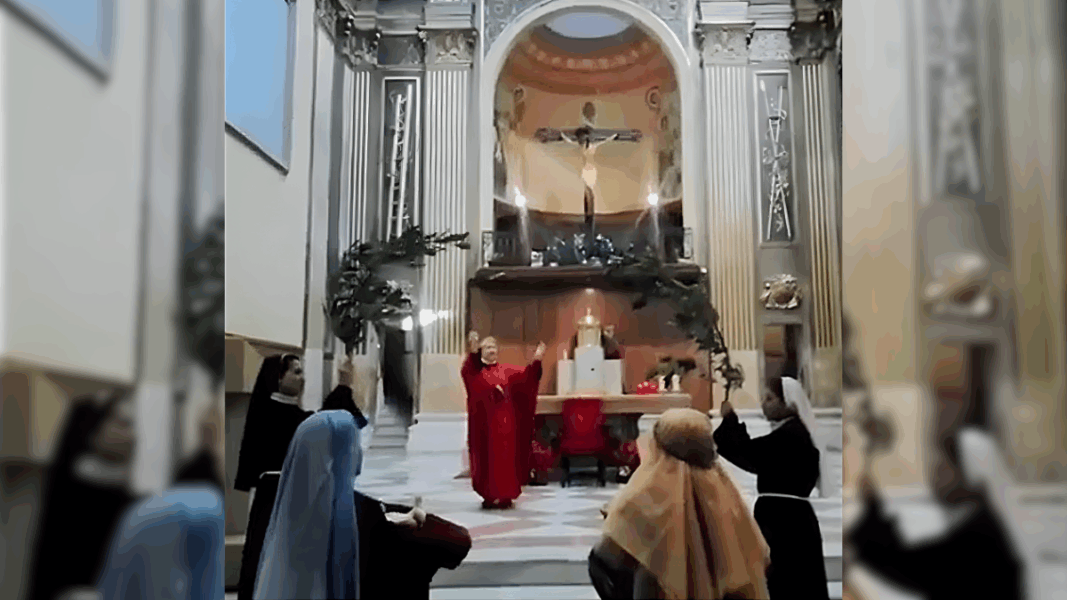
What little remained of the Mass continued until, without finishing the Mass (that is, without saying “you may go in peace”), the vested priest sat in a seat placed on the left side of the altar, while the nuns entered the choir and came out again DISGUISED, as you can see in the image, with tulle and tunics over their habits, to represent what I later saw on their Instagram account was the “auto” of the presentation of the Child Jesus in the temple.
Apparently, the most notable particularity of this community of Poor Sisters of Saint Clare are their well-known dances in the temple, either immediately before or after (or during) Mass, and that in a few years they have gone from calling them “choreographies” to “autos” and, currently, “sacramental acts”. And, despite their orthodox clothing with habits, the abbess is a nun with a long history of conflict with different ecclesiastical bodies and persons, in addition to being very heterodox and progressive in her approaches. That is why the issue of their “sacramental autos” is controversial.
Having reached this point of horror and embarrassed smiles among the faithful, I would like to comment on some aspects of this “auto”: it begins with two nuns, as you can see in the image, holding palms. Then two sisters appear disguised as Mary and Joseph, one holding the Child and the other with the offering of two turtledoves. In the presbytery, the abbess, dressed in a red tunic, awaits them performing rhythmic movements, accompanied by recorded background music, and sometimes pretending to play a kind of horn. The nuns playing the roles of the Virgin and Saint Joseph ascend to the presbytery and the abbess takes the Child in her hands and raises him (in the manner of the elderly Simeon, I imagine). Then, the Child passes from hand to hand among all the religious in a circle in the presbytery, until he is placed in the manger. Next, another sister ascends to the presbytery showing the Lectionary with arms raised – in the manner a deacon might approach with the Gospel book to proclaim the Word of God in Mass – and places the book as shown at a level higher than that of the Child God, in front of the altar. Then, several sisters, on both sides of the altar, kneel holding tall lit candles aloft, while the Mother Abbess ELEVATES A CHALICE AND PATEN placed behind the altar, like the presbyter in the Novus Ordo Mass. It is scandalous; especially considering the modernist temperament of this problematic nun and how she likes to preach from the ambo whenever she can, as far as I have been able to learn.
First of all, let’s look at the concept: sacramental auto. In an online Catholic encyclopedia I have read that the terms autos and mysteries are used to designate the religious drama (in its sense of theatrical representation) that developed among Christian nations at the end of the Middle Ages. The embryonic representations, which at first were performed inside churches, have been called “liturgical dramas.” In the same Catholic encyclopedia it can be read that the autos are “sacramental autos,” which are explained as “a form of dramatic literature peculiar to Spain (…) that can be defined as a dramatic representation of the mystery of the Eucharist.”
In other sources it can be read that a sacramental auto would be a religious play, a kind of liturgical drama, of allegorical structure, performed on the day of Corpus Christi during the 16th and 17th centuries, until the genre was prohibited by the Church in 1765. Apparently, the sacramental auto used a great scenic apparatus and the representations generally comprised biblical episodes. In Spain, great authors like Pedro Calderón de la Barca, Tirso de Molina, and Lope de Vega composed liturgical autos.
The oldest known sacramental auto is the anonymous “Auto de los Reyes Magos,” from the 12th century. From the beginning, however, sacramental autos are related to the Eucharist and Corpus Christi. Thus they spread from the 15th century onward. Later, the act becomes generalized, religious pieces and themes appear, and they are compiled, reaching composers of the stature of Calderón de la Barca in the Spanish Golden Age.
The 17th century represents its moment of crisis: some autos are presented in a comic, undemanding, and even irreverent and blasphemous manner. Their literary and doctrinal values are also questioned. And finally, in 1765, a royal decree of June 11 prohibits the representation of sacramental autos.
If we focus on the “sacramental autos” performed by the Poor Clares of Balaguer, apparently they are composed by themselves, exhibiting a wide repertoire of “autos” and “choreographies” at different times of the liturgical year, as they themselves show on their Instagram account and YouTube channel (from which the image for this text was taken). The “auto” represents the legend of the Sant Crist de Balaguer, that of the presentation of Jesus in the Temple, the Birth of the Lord, the solemnity of Saint Clare, and others. If we look at the representations of the Clares, there are no dialogues, but rather it is dances accompanied by music in which the different nuns, with tulle of various colors covering their habits, represent, always in silence, the respective roles. Therefore, perhaps the name they initially used, “choreographies,” was more appropriate than “sacramental autos,” given the nature of the performance.
Secondly, we encounter the issue of the moment of representation of the sacramental auto. Apparently, initially the autos were performed in churches or their porticos, and later, in the 17th and 18th centuries, they moved to public squares. Being a sort of religious play, it does not seem that it was performed immediately before or after, and much less during, a Mass. However, these are the moments when the Clares of Balaguer perform their dances. During Mass, indeed, they perform some of these autos after Communion and before finishing the Mass.
If we review the issues that they are not theatrical works performed at the entrance of the temple or in squares but simple choreographies based on biblical passages, could it be that we are actually dealing with a kind of “liturgical dance,” rather than a sacramental auto? It may be a trap by the abbess, a prolific writer and “historian” of the Franciscan order, to pass off as something with historical pedigree what is nothing more than a childish little dance. Dances in the temple which, moreover, as we can read in abundant sources, “dance or dancing within the liturgy is not permitted, except in some cases in mission lands in Africa or Asia, and not just any kind of dance or dancing.” In the document on “Dance in the Liturgy” by the Sacred Congregation for the Sacraments and Divine Worship (Notitiae, 1975, pp. 202-205), the aforementioned Congregation specifically establishes that liturgical dance is not appropriate in Western countries. On this matter, Cardinal Francis Arinze clearly states that “dancing is not known in the Latin rite of the Mass.” Therefore, “if religious dance is to be welcomed in the West, care must be taken that it takes place outside the liturgy.” The same Joseph Ratzinger had written in his work “The Spirit of the Liturgy” that “dancing is not a form of expression in Christian liturgy (..). It is totally absurd to try to make a liturgy ‘attractive’ by introducing dancing pantomimes”.
You can see more dances by these nuns on their YouTube channel:
https://www.youtube.com/watch?v=sTXtOteT-Kw
What laziness, certainly, this type of characters and actions in the Church. Because, while good priests are persecuted by bishops, monstrosities like these pseudo-sacramental autos are permitted, being heterodox, in addition to aesthetically questionable. The same Wanderer dismissed them with a stroke of the pen, calling them ridiculous in the wake of the approval of the “Mayan liturgical rite.”
What different standards our episcopoi have, although a common denominator is observed: their hatred of tradition, which is reaching levels of censorship and cancellation never seen before.