


By Anthony Esolen
I take it for granted that God commands only what is good for us and forbids only what is evil, which sometimes implies not allowing others to do evil. We are social beings, and permission slides into participation, participation into approval, and approval ends up demanding celebration, and even compulsion.
That is how Solomon’s idolatry began, when he sought wives outside of Israel. By the time Ahab was on the throne of Israel with the malevolent Jezebel, loyalty to God could cost you your life. Obadiah, Ahab’s steward, had to hide a hundred and fifty prophets of the Lord in a cave to protect them from Jezebel’s murderous hatred.
If that were not enough, Ahaz, king of Judah, turning to the gods of Assyria, “cut in pieces the vessels of the house of God, shut the doors of the temple of the Lord, and built altars in every corner of Jerusalem.” (2 Chronicles 28:24). No doubt Ahaz considered himself a religious man.
When things reach such an extreme, to return to health, we may need to uproot evil at its root. The holy king Josiah did not limit himself to promoting the worship of the true God while allowing well-established idolatry to continue around him. As soon as he was old enough to command, “he began to purify Judah and Jerusalem from the high places, the groves, the carved images and the molten images,” destroying the altars of Baal, reducing the images to powder and scattering it over the graves of those who had sacrificed to them. (2 Chronicles 34:3-4)
Then the true renewal could begin. He repaired the Temple, and Hilkiah, the high priest, searching in an old and forgotten place, “found the book of the Law of the Lord given by Moses.” (34:14). Perhaps the priest knew where it was all along. Josiah read the book before all the people of Jerusalem, committed himself to keeping the commandments of the Lord, and demanded that the people do the same.
Josiah’s reform had some permanence; it continued during his reign and retained some strength afterward, though there were setbacks. Only the destruction of Jerusalem and the captivity in Babylon managed to turn the hearts of the people back to the Lord.
And yet I am sure that, before that, people had already grown accustomed to idolatry. Pluralists and tolerant all! What does it matter if babies were sacrificed to Moloch? Babies do not have “real” life yet.
And if some enjoyed ritual prostitution and sodomy in the worship of the Baals? Hiel perhaps went too far in rebuilding Jericho during Ahab’s reign, laying its foundations with the body of his firstborn Abiram and its gates with the body of his younger son Segub (1 Kings 16:34), but who could be indignant, aside from someone like the half-mad ruffian Elijah?
We are now in the midst of a great and widespread disease. Children are destroyed in the womb, between 2,500 and 3,000 every day in the United States. Many who condemn those murders are content with something related to abortion, equally horrific and with greater power to destroy human civilization: the deliberate manufacture of children and the freezing of “unwanted” embryos.
Marriage is in free fall, and so are birth rates. Many neighborhoods are empty most of the day, which means they are no longer neighborhoods, but just locations.
Pornography is everywhere. Libraries invite drag queens to read stories to young children that inseminate their minds with perversion. The unnatural is celebrated, and in many workplaces it is imposed on you so constantly that it is difficult to get through a day without paying it some kind of tribute.
Children are mutilated, and people applaud the mutilation, pretending that a boy can become a girl or a girl a boy. The confusion is so widespread and infectious that language itself is twisted to please it. Imagine explaining to anyone, the day before yesterday, that you could use the “wrong pronoun” to refer to someone standing in front of you.
In this horrific situation, the Church holds the last lifeline. Its teachings condemn this multifaceted madness. It promotes and corroborates what is healthy and in accordance with our human nature.
It defends the priceless value of human life in the womb. It condemns the separation of the marital act from conception, whether by contraception or by manufacture. It allows separation, but forbids divorce. Its doctrines—not always its ministers, unfortunately—protect the innocence of children.
It is certain of the goodness of man and woman, and does not tolerate the sterilization that necessarily follows when healthy sexual organs are mutilated to affirm a fantasy.
But perhaps the most visible sign of its sanity is what now embarrasses many of its leaders and faithful: the male priesthood.
I accept the argument that a woman cannot truly offer the sacrifice of the Mass in persona Christi, since Jesus was a man and not a woman. But we cannot stop there. If it is good for us that there be an all-male priesthood, we should know why.
That question implies not only the man at the altar, but the very meaning of manhood and of priestly brotherhood. And since grace builds on nature, we should not consider such brotherhood as an extravagant exception. It should be a model of sanity. Not only priests should unite in brotherhood.
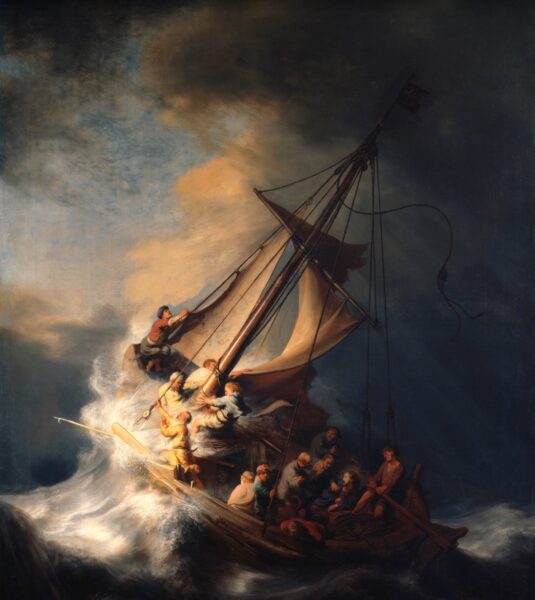
We are not in a position to point the finger at the Church for not “keeping up.” The times are bad. Or worse: they are insane. The Church holds the lifeline. Let us thank God for it and cling to it without reservation.
About the author
Anthony Esolen is a lecturer, translator, and writer. Among his books are Out of the Ashes: Rebuilding American Culture, Nostalgia: Going Home in a Homeless World, and most recently The Hundredfold: Songs for the Lord. He is a distinguished professor at Thales College. Visit his new website, Word and Song.