


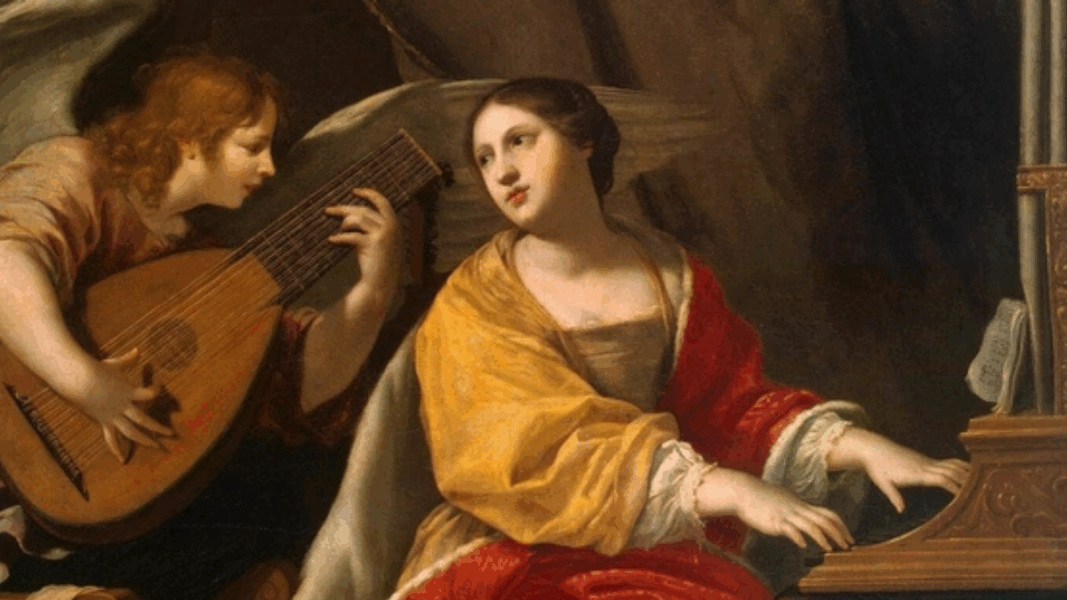
The Church celebrates today Saint Cecilia, one of the most venerated martyrs of the early centuries and a symbol of Christian fidelity in the face of persecution. Her figure, enveloped in the strength of her martyrdom testimony, has become over the centuries a spiritual and cultural inspiration, especially as patroness of sacred music.
Although historical data about her life are scarce, the ancient Acts agree in presenting her as a young Roman woman who consecrated her virginity to God and lived her faith with courage in times of hostility against Christians. She belonged to a noble family, but did not hesitate to renounce privileges and security in order to remain faithful to Christ.
A faith that is not negotiable
Tradition tells that, despite being forced to marry a young pagan named Valerian, Cecilia announced to him on their wedding night that she had consecrated her virginity to God and that an angel protected her. Surprised by her firmness, Valerian asked to see that sign; after being instructed by Pope Urban I, he received baptism and his brother Tiburtius followed the same path.
Both would be martyred shortly after, and Cecilia continued to support the Christian community with boldness, distributing alms, caring for the poor, and burying the martyrs, a practice forbidden by Roman authority.
When she was finally arrested, she refused to renounce her faith. The sentence sought her death in a cruel way, but according to the accounts, Cecilia miraculously survived the torment of the scalding steam in the bath of her house. Finally, she was beheaded, giving her life while professing faith in Christ.
Her body, found incorrupt in 1599 by Cardinal Baronius, was a testimony that strengthened devotion to her throughout the Church.
Patroness of music… because of her interior life
Saint Cecilia has been invoked for centuries as patroness of musicians, singers, and organists. Not because she was an artist in the modern sense, but because the Acts describe how, on the day of her forced marriage, “She sang to God in her heart.” That interior song, an expression of prayer and fidelity, became a symbol of the harmony between faith, beauty, and liturgy.
Great composers—Handel, Purcell, Gounod, or Britten—dedicated works to her memory, and numerous schools, choirs, and music academies bear her name. In Rome, the Basilica of Saint Cecilia in Trastevere preserves her memory and hosts liturgical and musical events every year.