


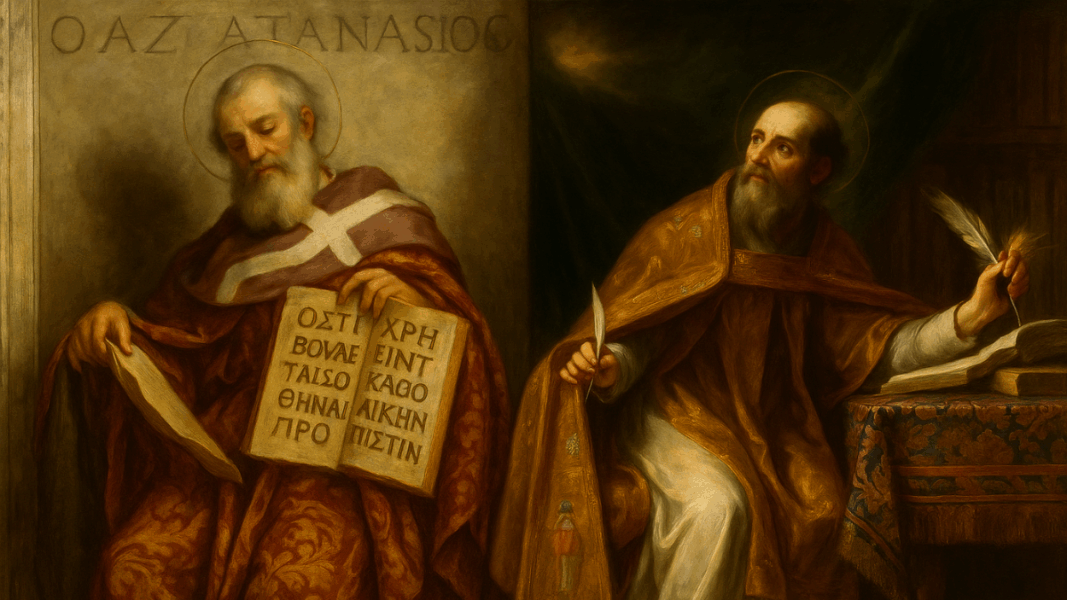
The fourth century, so often idealized as an era of spiritual serenity, was in reality a theological battlefield. After Constantine’s peace, the faith stopped hiding in catacombs to expose itself to a new threat: the secularization of the clergy, the politicization of doctrinal decisions, and above all, the explosion of heresies that sought to redefine Christianity from within. In that whirlwind, two pillars arose that upheld orthodoxy: Saint Athanasius and Saint Augustine. Two different men, two opposing temperaments… and the same mission: to defend Christ and his Church when many preferred to yield.
Saint Athanasius: the bishop who did not bend
In the Arian dispute—the heresy that denied the divinity of Christ and threatened to disfigure the core of the faith—Athanasius was not simply a brilliant theologian; he was a fighter. A young priest during the Council of Nicaea, he collaborated in the inclusion of the term homoousios, the decisive affirmation that the Son is “of the same substance as the Father.” When the storm broke, already as bishop of Alexandria, Athanasius preferred exile to betrayal: five exiles, nearly twenty years away from his see, smear campaigns, fabricated accusations, and constant threats.
But nothing deterred him from the fight. His defense was not academic; it was pastoral, existential. Athanasius clearly saw that denying that Christ is God amounted to emptying the Incarnation and redemption of meaning. That is why he wrote, preached, debated, traveled, and resisted. His entire life was an act of unwavering fidelity. As Newman would say centuries later, he was one of the privileged instruments through which God preserved the truth for future generations.
Saint Augustine: intelligence turned into a wall of containment
If Athanasius defended the divinity of Christ, Augustine defended the fallen dignity of man and the absolute necessity of grace. His youthful life—marked by desire, intellectual pride, and Manichaeism—seemed to lead him away from the Church. But the patience of Saint Monica and the preaching of Saint Ambrose led him to baptism. From then on, his figure becomes one of the brightest beacons of the faith.
In his time, Christianity faced two opposing temptations: Donatism, which dreamed of a pure and immaculate Church that would expel sinners; and Pelagianism, which made grace unnecessary by affirming that man could save himself.
Augustine responded to both with an unprecedented theological depth. He taught that the Church is holy, yes, but made up of sinners; that grace does not destroy freedom, but elevates it; and that salvation is not a human merit, but a gift. His anti-Pelagian writings marked history, and his vision of original sin, grace, and freedom became one of the pillars of Christian thought. He was, in a certain way, the architect of the intellectual synthesis that crossed the Middle Ages and reached us.
Two lives, the same mission
Athanasius and Augustine lived in different times and faced different dangers, but they shared the same conviction: that the faith deserves to be defended even when the price is high. Their biographies are not pious images, but testimonies of a Church that survived not through comfort or compromises, but through saints capable of upholding the truth against fashion, power, and opinion.
Today, when old errors resurface under new labels, their legacy becomes urgent again: doctrinal clarity, intellectual courage, and fidelity without fear. Without giants like them, the faith would not have reached us.
In Defenders of the Faith, Charles Patrick Connor portrays these two spiritual giants with a precision that illuminates both their time and ours. A book that invites us to rediscover how the Church remained firm thanks to men who did not negotiate the essentials and defended the truth when many preferred silence.