


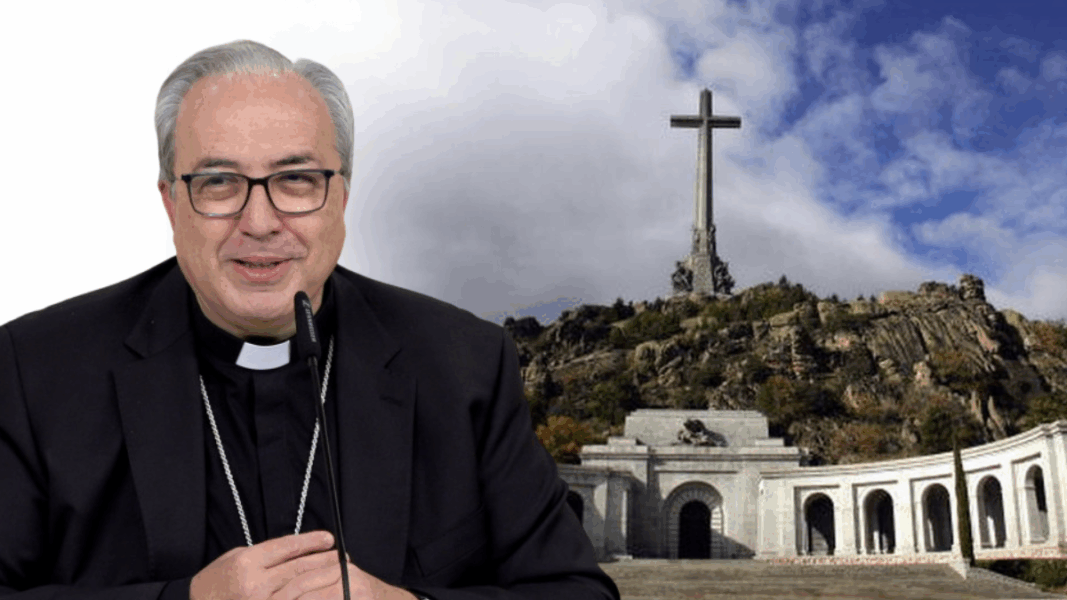
In the press conference of the 128th Plenary Assembly of the Spanish Episcopal Conference (CEE), held on the morning of this Friday, the general secretary, Mons. César García Magán, responded to questions about the situation of the Valley of the Fallen and the “re-signification” process promoted by the Government. The prelate made it clear that the Episcopal Conference has no leading role in this matter and that the issue is the competence of other ecclesial instances along with the civil authorities.
«It has been a dialogue process in three parts, between the Government of Spain, the Benedictine community with its superiors, that is, the abbey of Silos and the abbey of Solesmes in France, and on the other hand the Archdiocese of Madrid.»
Previous agreements on the basilica and Benedictine presence
The general secretary confirmed that among the mentioned parties “points of agreement had already been reached” related to the basilica, Catholic worship, and the continuity of the Benedictine community in the precinct. These aspects—he indicated—depend on the understanding between the directly involved actors.
In addition, he pointed out that the CEE finds it “valuable” that the reached agreements “be maintained in time and space,” but insisted that it does not correspond to the Episcopal Conference to carry out the analysis of these processes or to pronounce on their implications.
Regarding the information related to the removal of religious images—such as The Pietà or the evangelists—the general secretary stated that he had not seen the architectural project. “What I understand and what I have read, that model was of maximums,” he explained.
and added that, according to the available information, “The Pietà is not removed, nor the images of the evangelists on the cross,” but reiterated that the CEE has not participated nor participates in those decisions. Nor does it have access to the final design of the restructuring:
«I have not seen the architectural project.»
Competence of the involved actors and, if applicable, of the Holy See
The general secretary recalled that any assessment of the evolution of the Valley of the Fallen falls to those who formally participate in the dialogue with the Government. Adding that, if necessary, “the Holy See as well” would have the last word on those issues that require intervention by pontifical authority.
Finally, regarding the reliability in a negotiation process with the Government and the reliability of the processes, he referred to the process of care and reparation for victims, where the CEE maintains an open negotiation, “I do trust the negotiations we are having,” he affirmed. So far, he indicated, the agreed points “have been maintained and fulfilled” adding, “about the other I don’t know; ask the Archdiocese of Madrid if they trust it.”
Despite that lack of direct competence, he pointed out that the cardinal archbishop of Madrid has indeed been working with all the parties involved to “safeguard the fundamental principles and essential requirements” related to the basilica, the religious community, and the dignity of the deceased.
With his statements, the CEE marked institutional distance and avoided entering into the political and media debate generated by the profanation of the Valley, referring the responsibility to the parties with direct competence.