


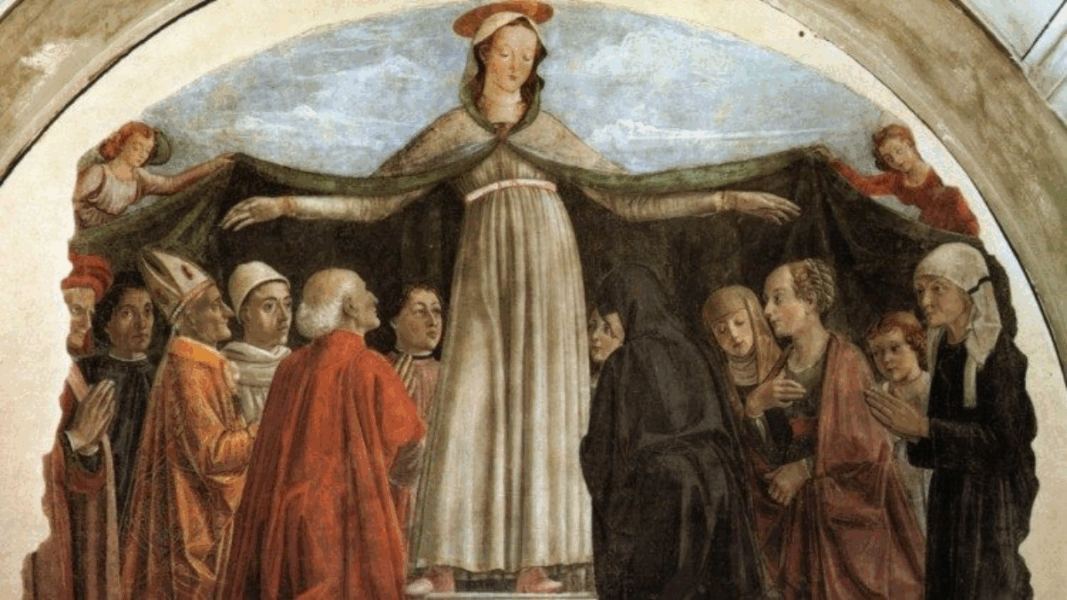
A Title with Roots in Scripture and in Patristics
Although the expression “Mother of the Church” does not appear literally in Scripture, its doctrinal content is deduced from the Gospel itself. Mary is the Mother of Christ, and Christ is the Head of the Mystical Body. From this relationship it follows that she who is Mother of the Head is also so of the Body. This intuition was affirmed by the Fathers of the Church.
Saint Ambrose, in the 4th century, saw in Mary the figure of the Church that engenders new children through baptism. Saint Augustine, for his part, taught that Mary is mother of the faithful because she cooperates in the spiritual birth of each Christian. Saint Irenaeus had said earlier that the economy of Christ and that of Mary were united as the new creation that restores what Eve had lost. All of this built, without the term yet being pronounced, the fully Catholic idea of Mary as Mother of the Christian people.
The Liturgy, Silent Transmitter of Marian Titles
Before any magisterial definition, the liturgy already recognized this aspect of Marian motherhood. In prayers, hymns, and Marian prefaces of East and West, the image of Mary as refuge, protection, and spiritual mother of Christians appears. The Eastern Churches invoked her as “protector of the people” and “seat of wisdom,” titles that manifest her maternal mission with respect to the community of the faithful.
In the West, medieval piety—from Saint Bernard to the monastic world—intensified this awareness. The title “Mater Ecclesiae” appears in manuscripts, icons, antiphons, and theological commentaries. Although it was not yet a magisterial definition, the faith of the people and the liturgy acted as a natural channel for doctrinal transmission.
Modern Mariology Paves the Way
Between the 19th and 20th centuries, mariological reflection acquired a decisive impetus. The dogma of the Immaculate Conception (1854) and that of the Assumption (1950) highlighted Mary’s singular mission in the history of salvation. In doing so, they indirectly reinforced the awareness of her spiritual motherhood with respect to the Church.
Pius XII, in Mystici Corporis (1943), advanced clearly toward the formulation of the title. There he affirmed that Mary, “associated with Christ in the work of redemption,” exercises a spiritual motherhood over all the members of the Mystical Body. The term “Mother of the Church” was not yet solemnly pronounced, but theologically it was already fully grounded.
The Second Vatican Council and the Proclamation of Paul VI
The Second Vatican Council gathered this secular tradition in chapter VIII of Lumen Gentium, dedicated to the Virgin Mary within the mystery of Christ and of the Church. There it expounds her cooperation in the work of salvation, her singular holiness, and her intimate relationship with the Church that is born from the opened side of Christ.
«By conceiving Christ, bringing him forth, feeding him, presenting him to the Father in the temple, suffering with her Son as he died on the cross, she cooperated in a totally unparalleled way in the work of the Savior through obedience, faith, hope, and burning charity to restore the supernatural life of souls. For this reason, she is our mother in the order of grace.»
With this doctrinal background, on November 21, 1964, in closing the third conciliar session, Paul VI solemnly proclaimed Mary “Mother of the Church, that is, Mother of the entire Christian people, both of the faithful and of the pastors.” His declaration did not introduce a novelty, but rather made explicit the constant faith of the patristic and liturgical tradition.
In doing so, Paul VI also offered a key to reading the entire conciliar work: the Church is properly understood only when contemplated in relation to Mary, her most perfect member and her eschatological figure.
Doctrinal Meaning of the Title “Mother of the Church”
The proclamation is not a mere affective recognition. It provides important doctrinal clarity: the Church is not merely a structural or institutional reality. It is a living body, sustained by grace, born from the Paschal mystery and developed under the maternal guidance of the Virgin.
Mary exercises this motherhood in a real and effective way: she intercedes, accompanies, sustains, and spiritually forms believers. She does not replace Christ’s unique mediation, but participates in it according to the divine plan, as a humble and docile cooperator.
From Theological Recognition to Liturgical Celebration
The 1964 proclamation received wide acceptance in the Church. John Paul II adopted it as a key to his personal mariology; Benedict XVI integrated it into his vision of ecclesiology; and Pope Francis incorporated it into the liturgical calendar in 2018 as an obligatory memorial on the Monday after Pentecost.
This liturgical insertion confirms that the title belongs to the doctrinal heritage and that its expression in communal prayer is part of the living tradition of the Church.
The History of Marian Titles
The history of the title “Mother of the Church” shows how the Marian title does not arise from improvisations or isolated decisions, but from an organic and continuous development. From Scripture to patristics, from the liturgy to papal documents, the Church has always recognized in Mary the spiritual mother of the faithful.
With its proclamation during the Second Vatican Council, the magisterium placed a definitive seal on a truth deeply rooted in Catholic faith: Mary accompanies the Church because she is Mother of Christ and Mother of his members. Her motherhood illuminates ecclesial identity, sustains Christian life, and guides the faithful toward faithful following of the Gospel.