


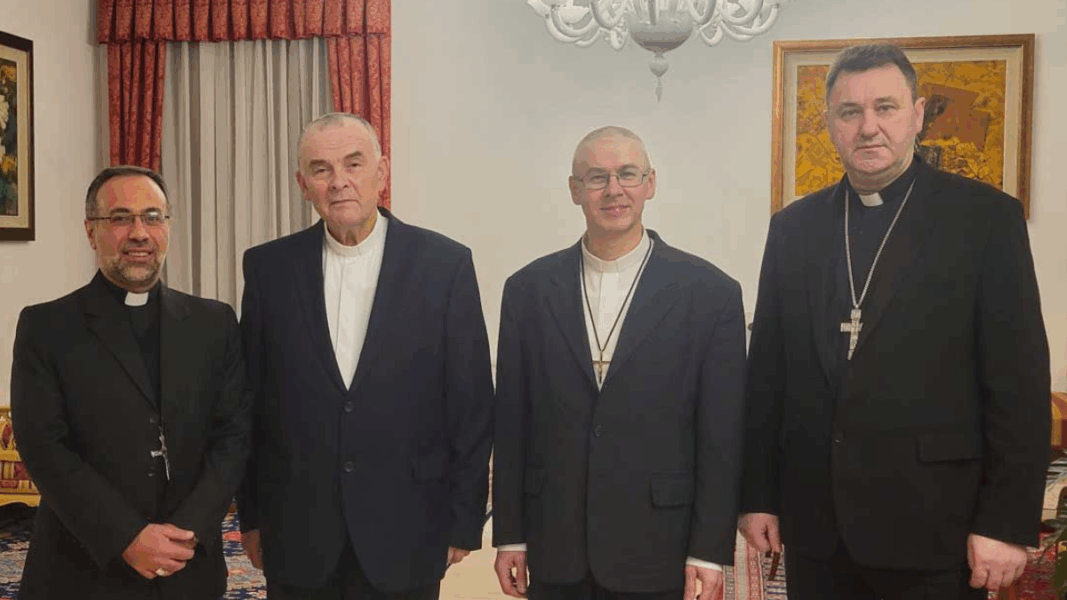
The government of Belarus announced the release of two Catholic priests convicted of “serious crimes against the State” following a process marked by allegations of political persecution, contested accusations, and growing tensions between Minsk and the local Church. The pardon comes after an intensification of diplomatic contacts between Belarusian authorities and the Holy See, as reported by the state media BelTA.
The release of Father Henrykh Akalatovich and Father Andzej Yukhnevich was presented by the regime as a gesture of “goodwill, mercy, and respect” toward the Jubilee Year proclaimed in Rome. However, this case reflects the delicate situation faced by the Catholic community under the government of Aleksandr Lukashenko, who is noted for systematically limiting civil and religious freedoms.
The Belarusian Church thanks those who facilitated the release
According to the Catholic News Agency (CNA), the Belarusian Episcopal Conference expressed its “gratitude to all those who contributed to the release of the imprisoned priests,” with special mention of Vatican officials and local Church leaders.
The bishops thus highlighted that this progress allows maintaining “a positive dynamic in bilateral relations, based on traditional values, fraternity, tolerance, and respect for believers”.
The case of Father Akalatovich: a spying accusation rejected as a “provocation”
Father Henrykh Akalatovich, in fragile health after suffering a heart attack and undergoing surgery for cancer, was detained in November 2023 and sentenced on December 30, 2024, to 11 years in prison for “high treason”. This charge, used by the regime to punish opponents, included the accusation of spying “for Poland from the Vatican”.
The priest described those accusations as a “crude provocation,” publicly denouncing—through the human rights organization Viasna—that “there was not a single true piece of evidence” against him, and that the entire case was based on “lies, threats, and blackmail”.
According to Viasna, the release was possible “thanks to the visit of Cardinal Claudio Gugerotti,” prefect of the Dicastery for the Eastern Churches and a good connoisseur of the region due to his previous diplomatic work.
The case of Father Yukhnevich: a conviction surrounded by doubts
The second pardoned priest, Andzej Yukhnevich, had received a sentence of 13 years in prison for alleged abuses against minors. Reuters reported that the priest denied all accusations from the beginning.
Viasna maintains that the testimonies presented against him “could have been given under pressure,” although it acknowledges that it does not have additional data to delve deeper into that claim. Even so, the organization emphasizes that Yukhnevich “tried to prove his innocence throughout the process”.
The Belarusian regime offered no further details on the reasons that led to the pardon beyond general references to “goodwill” and dialogue with the Vatican.
A country where religious freedom continues to deteriorate
The release of the priests takes place in a context of widespread rollback of freedoms and rights in Belarus. The U.S. Commission on International Religious Freedom denounced in 2023 that the country’s situation “continues to worsen,” pointing to state pressure on churches, communities, pastoral activities, and charitable organizations.
The report mentioned the closure in 2022 of the Church of Saints Simon and Helena—the popular “Red Church” of Minsk—, considered a symbol of the protests against Lukashenko in 2020. For many faithful, the closure of the temple marked a before and after in the relationship between the regime and Catholic believers.
A pardon with a political reading
Although the release of the priests provides relief for their communities and families, it can hardly be separated from the political context. Lukashenko’s regime seeks to project moderation before international organizations, especially amid sanctions and growing diplomatic isolation.
For the Church, however, the measure represents a respite within an environment marked by surveillance, opaque processes, and the recurrently political use of justice.