


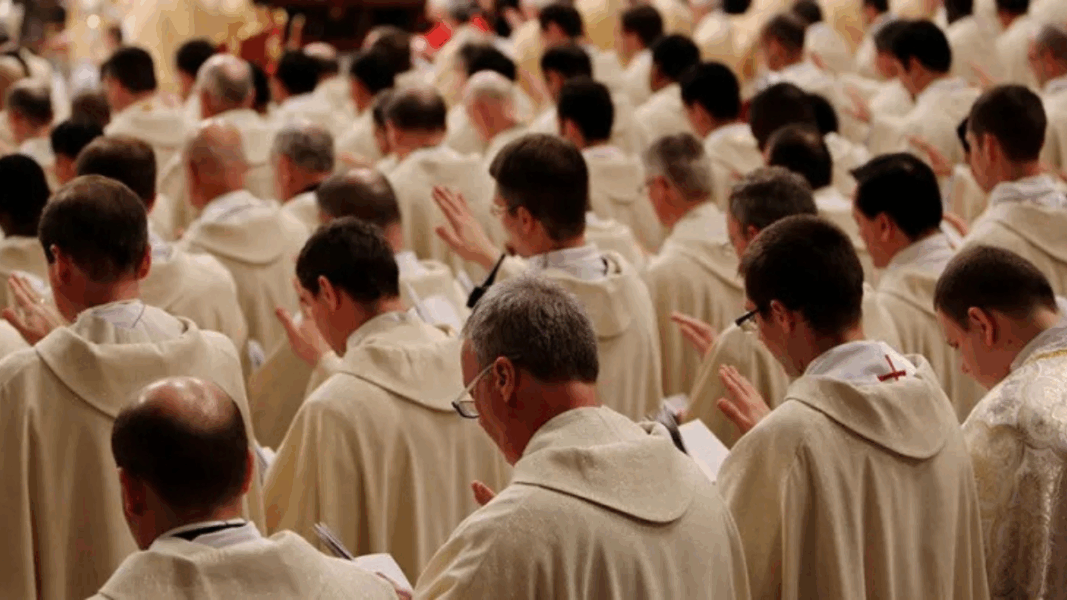
A study published by The Times claims that hundreds of Anglican priests and more than a dozen bishops have left the Anglican Communion to join the Catholic Church over the last three decades.
The research, carried out by the St Barnabas Society and led by the theologian and sociologist Stephen Bullivant, shows that approximately one third of all Catholic priestly ordinations in England and Wales since 1992 correspond to former Anglican clerics, a proportion much higher than previously believed.
The ordination of women, a turning point
The year 1992, when the General Synod of the Church of England approved the ordination of women priests, marked a before and after. Since then, according to the study, around 700 Anglican priests and religious from England, Wales, and Scotland have been received into the Catholic Church.
The highest peak of conversions was recorded in 1994, coinciding with the first ordinations of women in the Church of England. There was a second surge after 2009, when Benedict XVI created the Personal Ordinariate to welcome clergy and faithful of Anglican tradition, and another after his trip to the United Kingdom in 2010.
On average, about 11 Anglican priests join the Catholic Church each year.
Cardinal Nichols’ reading: more than “conversion”, a step towards full communion
Cardinal Vincent Nichols, Archbishop of Westminster, welcomed the data with satisfaction, although he qualified the term “convert”.
He recalled that some theologians hold that Saint Paul did not “abandon” his Judaism, but rather brought it to fulfillment in Christ. Similarly, he explained that many Anglican clerics who join the Catholic Church do not renounce their “precious Anglican heritage”, but rather take a step towards “full visible communion”.
Nichols emphasized that this movement should not be interpreted as a break or cultural rejection, but as a personal response to a “spiritual imperative”.
A flow that challenges predictions
Professor Stephan Bullivant acknowledges that the figures have surprised even the ecclesiastical officials consulted during his research.
“The numbers are much higher than most —including Catholic bishops— imagined,” he stated.
His study shows that the decision on women’s ordination in 1992 continues to have lasting effects, and that doctrinal and ecclesiological tensions within Anglicanism continue to push part of its clergy towards Rome.